Freeman’s “Best of the Web” column for August 17, 2026 laundered a partisan constitutional claim through curated links to Trump officials — a constitutional-literacy hustle to license direct presidential control of the Justice Department. Both segments of the column run the same operation through different vehicles. This column walks through them in document order, in the operator vernacular the format was designed to obscure.
I built versions of this column in the cable years. The format I am about to walk through is the format I worked.
Traditionally the anchor chair at NBC’s “Meet the Press” has been held by a reliable regurgitator of conventional Beltway wisdom. So it was disappointing but not surprising to see host Kristen Welker embracing the hoary media myth of independent departments in the executive branch of the U.S. government. It is among the most cherished beliefs of America’s partisan press corps because it helps to absolve Democratic presidents of abuses on their watch while also justifying bureaucratic defiance against Republican ones. But this alleged independence can be found nowhere in the U.S. Constitution, and for good reason. Only those who oppose democratic governance think that executive authority should be wielded by unelected officials. — James Freeman, “A Deep State of Mind on NBC,” WSJ Opinion, August 17, 2026 (opening graf)
Frame-engineered relabeling — from the WSJ Editorial Technique Catalogue and the Bad-Faith Techniques Catalog — operates here through the substitution of “media myth of independent departments” for the substantive legal-scholarship argument about DOJ independence norms. Both terms refer to the same set of bipartisan arguments about Article II and the long tradition that has kept DOJ independent of direct presidential control in particular matters. The page’s term carries the connotation that anyone making this argument is a credulous press-corps naïf; the substantive term carries the connotation that this is a serious legal position. Freeman closes the opening with the kicker: “only those who oppose democratic governance think that executive authority should be wielded by unelected officials.” The line is engineered to make the reader recoil from the substantive position before they have heard it named.
The strawman — selectional variety — runs alongside. The piece draws an equivalence between (a) the argument that DOJ has some measure of independence from direct presidential control and (b) “absolving Democratic presidents of abuses” and “justifying bureaucratic defiance against Republican ones.” That is the selectional move: pick the worst version of the position from the worst-motivated proponents, and treat that version as the position. The Office of Legal Counsel has been issuing opinions on the question of executive control over DOJ since the Reagan administration — going both directions on the independence question. The independent-counsel tradition predates the current administration by decades; the Ethics in Government Act of 1978 established the formal mechanism. The career-attorney tradition at DOJ has been defended by attorneys general of both parties. None of this gets named in the column.
Pre-emptive legitimacy-withdrawal — from the Bad-Faith Techniques Catalog — operates through the framing that asking the Attorney General whether he will abide by longstanding DOJ independence norms is itself “constitutionally unsound.” The piece withdraws legitimacy from the question without engaging what Welker was actually asking, what the DOJ independence norms are, why they exist, or what the legal scholarship on them says. The “balanced media environment” framing presumes the page’s position is the balanced one and the question is the imbalance. That is the legitimacy-withdrawal move: declare the question illegitimate upstream so the answer never has to be supplied.
Person-as-policy — the technique where a policy dispute is fully displaced onto one named individual — runs alongside. The piece uses Welker’s name as the carrier of the broader constitutional argument. Strip the name out and the column becomes an Article II essay; with the name, it becomes a media-criticism piece. The page gets to choose which frame subsumes which, and it chooses the frame where the underlying argument never gets engaged.
Operator’s vernacular: this is the relabel-then-attack scam. Operators give the substantive position a derisive name, attribute derisive motives to its proponents, then punch the straw figure they just built. The reader never gets the actual argument because the actual argument was never named. This is also the question-asks-as-the-crime — the piece positions the act of asking the question as itself the offense, so the substantive content of the question never gets engaged because the asking is the story. Operators of this kind built segments that ran this exact pattern at the cable network. The host would ask a question the right’s institutional actors had pre-decided was illegitimate to ask, and the column would then write about the question-asking rather than the substance.
The constitutional authority-by-citation — a subspecies of appeal_to_authority with a partisan valence — drops Article II language without engaging the actual scholarly dispute. Saikrishna Prakash and John Yoo have built the serious scholarly case for total presidential control over DOJ prosecution decisions. Akhil Amar’s constitutional work has long held structural space for institutional independence. Peter Strauss has built a career around the independent-agency defense, with the Humphrey’s Executor line of cases sitting in his column. The disagreement sits in law reviews and OLC memoranda, with roots in the founding debates the Federalist Papers already engaged. The Freeman paragraph gestures at Article II as if this body of work did not exist.
In the opening to Sunday’s program Ms. Welker employed this false framing to introduce an interview with Attorney General Todd Blanche, who previously served as Donald Trump’s personal lawyer. According to NBC’s transcript, Ms. Welker introduced the segment by suggesting that this cabinet officer’s job is to ignore the duly elected president:
Ms. Welker then welcomed Mr. Blanche to the program and began her questioning: — James Freeman, “A Deep State of Mind on NBC,” WSJ Opinion, August 17, 2026 (paragraphs 2–3, with the NBC transcript elided)
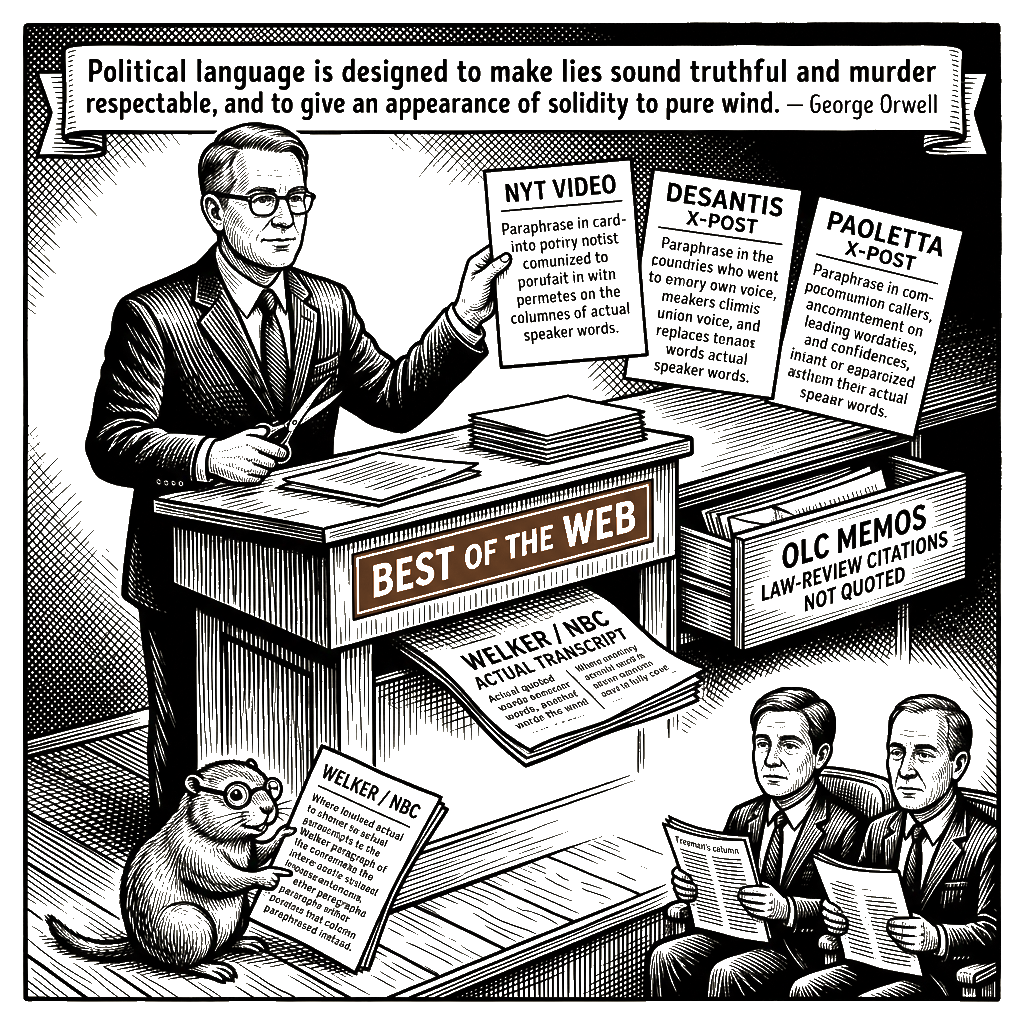
This is the column’s structural tell. Freeman refers to the NBC transcript twice — once to characterize Welker’s introduction, once to introduce her questioning — and quotes neither. “Ignore the duly elected president” is Freeman’s paraphrase, not Welker’s; the actual transcript sits across an elision the column invites the reader to fill in from the column’s framing. The same pattern recurs: the New York Times video is referenced but not shown; the DeSantis X-post is summarized but not quoted at length; Paoletta’s X-post is paraphrased in Freeman’s voice. Six elisions in a single column. The technique has a name in operator vocabulary: the quote-shaped hole. The speaker’s content is asserted in the writer’s load-bearing paraphrase. The actual quotation is held back. The reader who skips the link carries the paraphrase. The reader who follows the link has already been told what to think. Both readers have been given a forged version of the original. The forged version is the column’s product.
In a more balanced and informed media environment, the only news in this exchange would have been that a prominent media personage was seeking a constitutionally unsound pledge from an officer of the executive branch. But the New York Times responds in a video:
Thank goodness he did. America’s governor, Ron DeSantis (R., Fla.), writes on X:
The president is accountable to the people. Under Article II, section 3 of the Constitution, the president “shall take Care that the Laws be faithfully executed.” It’s his job, and if he fails to do it honorably and well, he can be checked by the courts and the legislative branch—if necessary Congress can remove him from office.
Mark Paoletta, acting director of the Consumer Financial Protection Bureau, posts on X:
As Mr. Paoletta notes, the Department of Justice is not an independent agency and never has been. — James Freeman, “A Deep State of Mind on NBC,” WSJ Opinion, August 17, 2026 (paragraphs 4–8)
The curated-link stack is the operation. Three voices: a New York Times video, the Republican governor of Florida, and the Trump-appointed acting director of the CFPB. Two of three are members of the current Republican executive. The third is the New York Times, invoked to give the appearance of cross-coalition agreement. None are constitutional scholars. None have published peer-reviewed work on Article II. None are quoted at length; each is summarized in Freeman’s voice.
The “as a [identity]” credibility move — from the WSJ Editorial Technique Catalogue — operates through the substitution of a politician’s X-post for legal-scholarship argument. DeSantis is not a constitutional lawyer. He is a sitting governor with presidential ambitions whose political fortunes are tied to the current administration. Notice what the tweet actually says. DeSantis quotes Article II, section 3, and concludes that the president is accountable and can be checked by the courts and Congress. This is not an argument against DOJ independence norms; it is a description of the constitutional structure. The piece treats the tweet as if it rebuts Welker — but DeSantis’s tweet does not actually engage what Welker was asking.
A second non-legal-scholar citation closes the column with Paoletta’s X-post asserting that “the Department of Justice is not an independent agency and never has been.” Mark Paoletta is the acting director of the Consumer Financial Protection Bureau — a contested independent agency whose own constitutionality the current administration has been challenging. He is not a constitutional historian, not a former DOJ official, not a legal scholar. He is an executive-branch political appointee of the current administration making an assertion in its favor. The piece needs this assertion to be true in order to treat Welker’s question as constitutionally illiterate. The fact that no independent legal-scholarship authority is cited anywhere in the column is the structural tell.
Operator’s vernacular: this is the politician-as-constitutional-scholar. Citing a governor’s tweet on X is not citing constitutional law. Operators of this kind substitute a politician’s quote for an expert’s, and the reader collapses them. It worked because most readers do not follow the substitution.
The multiple-audience-targeting move — from the WSJ Editorial Technique Catalogue — does the audience-management work. The wealthy reader gets reassurance that institutional pushback is illegitimate; the political class gets citable coordination; the populist base gets Republican officials agreeing with the column’s framing; the technocratic class gets the New York Times citation as legitimacy-cover. The voices are not neutral on the question. The format — “X writes on X / Y posts on X / Z notes” — gives them the appearance of being so. The format is the technique.
Perhaps someday reporters and anchors will pledge to stop pretending that it is. — James Freeman, “A Deep State of Mind on NBC,” WSJ Opinion, August 17, 2026 (closing line)
The closing-line cadence — from the WSJ Editorial Technique Catalogue — does the lift work. Short, declarative, engineered for the social-media cut. Underneath sits the threat-inflation move — repurposed as a civility demand. Reporters and anchors who persist in the alleged false framing should “pledge to stop,” as if their professional practice were a habit they could surrender on instruction. The “pledge” frame matters. It implies a moral failing in the practice, not a disagreement about constitutional interpretation. It positions the page as having won the argument and the press as having only bad faith left to offer. That is the engineered effect.
Operator’s vernacular: this is the credential-game scam. Stack two political-appointee X-posts as if they were constitutional authority; conclude that anyone who disagrees is uninformed; close with a declarative sentence designed for the social-media take. The asymmetry is the structure: the page’s position gets politician-quotes as evidence; the contrary position gets no engagement at all. Operators of this kind call this “winning by omission.” You do not have to refute the argument if you never name it.
Then the column pivots to its second segment. Same byline. Same operation.
Maine’s angriest oyster hobbyist may be returning to politics, though not all of his former supporters are delighted with the prospect. Benjamin Kail reported Saturday for the Bangor Daily News:
Mr. Platner deserves the presumption of innocence just like everyone else. One result of the rape allegation is that recent stories about him sometimes do not even mention that he spent much of his adult life wearing a Nazi tattoo or that he has an extensive history of appalling comments. Mr. Kail reports:
What kind of community would welcome such organization? It’s the timing that’s the problem? — James Freeman, “What Will It Take for Leftists to Quit This Guy?”, WSJ Opinion, August 17, 2026
“Maine’s angriest oyster hobbyist” is calibrated, and the calibration is the work. It mocks Platner’s class and his hobby in a single phrase, makes him a small-town caricature before any policy question is engaged, and the oyster reference telegraphs to the populist base the kind of man they are being asked to dismiss. The quote-shaped hole recurs here with the same operational signature it carried in the Welker segment. Kail is introduced three times — “Mr. Kail reported Saturday,” “Mr. Kail reports,” “Mr. Kail notes” — and quoted zero times. The column’s framing of what the underlying stories say is delivered in column voice and held apart from the source the reader would have to consult to verify. Same forged version of the original. Same product.
The presumption-of-innocence weaponization — a subspecies of equivocation, applied selectively — kicks in. Freeman grants Platner presumption of innocence on the rape allegation, then uses the grant to deliver the Nazi tattoo and “appalling comments” as the things “recent stories” have been sidelining. The structure inverts the standard function. Instead of protecting the accused from premature judgment, the clause delivers prior bad acts that were not the column’s ostensible subject. The reader who arrives at “Nazi tattoo” without having examined the underlying story has been moved to a position through the appearance of fair-mindedness. The appearance is the technique.
The selective fact-pickup — a subspecies of cherry_picking — runs the closing construction. “Recent stories about him sometimes do not even mention” is a moving target: it accuses unnamed recent stories of suppression without naming any, supplying the alleged omission as fact through the column’s own voicing. “Or that he has an extensive history of appalling comments” produces the same operation, with the word “extensive” doing the rhetorical work — no “appalling comments” are named, none are sourced, none are weighed. The reader who takes the column’s framing has been told Platner has prior bad acts; the reader who consults Kail would have to assemble the prior bad acts himself. The column invites the first reader and refuses to serve the second.
The JAQing-off move — from the Bad-Faith Techniques Catalog — runs both closers. “What kind of community would welcome such organization?” is a question that asserts its answer. The community referenced is Platner’s potential constituency; the question supplies the characterization of them. “It’s the timing that’s the problem?” is the same move at sentence-end. Neither question seeks information; both deliver a verdict in interrogative form. The closing-line cadence packages the verdict for retransmission. The reader who lifts either line onto social media delivers the column’s framing without the column having to assert it directly. The questions are the assertion.
So here is what the column actually does, taken together.
The “Best of the Web” format gives Freeman the surface of a curator — selecting, summarizing, presenting others’ views. Underneath, the format does the page’s own rhetorical work. It cites sympathetic voices without quoting them at length. It paraphrases speakers in the column’s preferred framing. It stacks citations from partisan actors behind a cross-coalition anchor. The constitutional claim that DOJ independence is a “media myth” is not argued in the column. It is curated. The curated-link form is the argument; the curation is the position.
Five paragraphs on Welker. Seven technique-deployments on the constitutional question. Two politician X-posts. One media personality as the named vessel. One threat-inflated closer. Zero constitutional-law citations. The piece is not making a constitutional argument; the piece is performing one.
Apply Freeman’s own standard to the column. A piece that substitutes politician X-posts for legal-scholarship argument, treats asking a question as the offense, paraphrases its speakers in the writer’s preferred framing, and cites no authority but those whose political fortunes depend on the answer being what the piece needs it to be — that piece is not defending the Constitution. That piece is the constitutional illiteracy the column claims to oppose. The column defends a Constitution it does not cite, against critics it does not engage, with authority it does not have.
Freeman writes that only those who oppose democratic governance think executive authority should be wielded by unelected officials. By his own standard, the column is the offender. The unelected officials the column is licensing — the acting directors, the political appointees, the operators of the executive-branch apparatus the column is asking the reader to defer to — are the ones wielding the authority. They are accountable to no one but the president. They operate under memos the column does not name.
The constitutional illiteracy is on the page, not on the NBC set.
The reader who arrived at the end of Freeman’s column has been shown the right people to agree with. The reader who arrives at the end of this column has been shown the technique by which the agreement was manufactured. The apparatus does not stop when it is named. It adapts. The reader’s job is the part the apparatus cannot automate: follow the link, read the underlying source, and check whether the column’s framing survives the contact. The columns that fail the check are the columns the format is designed to protect.
— Phukher Tarlson