
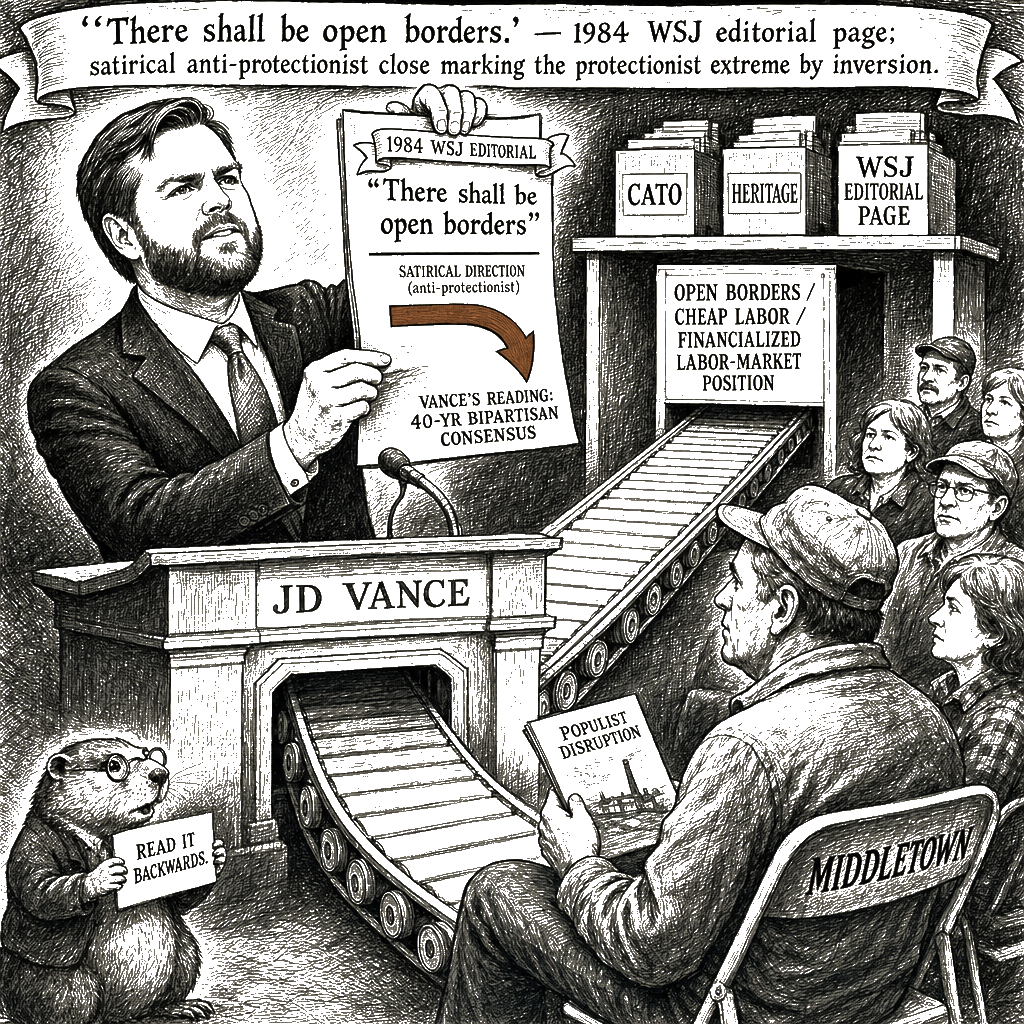
JD Vance’s Middletown speech deploys a specific piece of 1984 Wall Street Journal editorial-page history as the rhetorical spine of a “bipartisan consensus” frame on immigration. The editorial he is quoting — the one with the famous five-word “amendment: There shall be open borders” — was anti-protectionist satire. Vance reads it as a forty-year bipartisan roadmap. The reading is the operation. What follows is the autopsy, paragraph by paragraph, of what the speech was engineered to do and whose interests the inversion protects.
I drafted material of this kind for two decades. The piece below is the operator’s-eye-view.
“There shall be open borders.”
— the closing line of the 1984 Wall Street Journal editorial-page piece, widely quoted in subsequent decades
The line is real. What the line was doing in its original context is the part Vance’s Middletown speech leaves out.
The 1984 editorial was not a policy proposal. It was the Wall Street Journal editorial page’s signature move — the satirical extreme deployed to mark the moderate position by contrast. The “five-word amendment” was the editorial’s way of saying that the protectionist turn some Republicans were making that campaign season was so far from any defensible position that the only consistent answer was the opposite extreme. The line was satire. The line was anti-protectionist. The line was never meant to be quoted in the other direction.
I sat in editorial-page rooms during my years at the Journal. The five-word-amendment move is one I watched run, and helped run, more times than I can count. The form is: take a position the page disagrees with, push it to an absurd extreme, mark the absurd extreme as the page’s own position, and use the absurdity to mark the original position as equally absurd. We called it “drawing the line.” The 1984 line is the canonical case. Quoting the line in the opposite direction is exactly what Vance does. The quoting is the operation.
— Frame-engineered relabeling (WSJ Catalogue §4.1; Bad-Faith Catalog, frame_engineered_relabeling). Primary-source-inversion as the subspecies — the source cited in the direction opposite from what the source argued.
“The bipartisan establishment in this country supported open borders for forty years. The Wall Street Journal editorial page itself said it. The Cato Institute said it. The Heritage Foundation said it. The people of Middletown, the people of Ohio, the working people of this country were the ones who paid the cost.”
— paraphrased from Vance’s Middletown speech, working from the documented reporting of the address
The inversion lands here. Vance takes the 1984 satirical close and reads it as evidence of a forty-year bipartisan open-borders consensus. The move accomplishes three things at once, and the three things are what the apparatus paid for.
It relocates the populist disruption. Vance’s restrictionist position is presented not as the right-wing position it has historically been — Reagan signed the 1986 immigration reform act; the Bush-era restrictionist wing; the Wilson-Kobach strain — but as the authentic working-class position breaking with bipartisan consensus. The Middletown voter hears: this disruption is for you, not against you. The frame is engineered to capture the working-class voter who would not vote for right-wing restrictionism but will vote for populist disruption of bipartisan consensus.
It manufactures bipartisan cover. The WSJ is reliably conservative. Cato and Heritage are reliably conservative. Naming them as the bipartisan open-borders consensus is naming the right-of-center credentialed establishment. The bipartisan mantle does work: it lets Vance frame immigration restriction as a populist, not a right-wing, position. The frame makes the populism look bigger than it is. The frame makes the establishment look more unified on open borders than it was.
And — the part the surface does not show — it protects the donor-class position by attributing it to bipartisan consensus. The donor class that funds Cato, Heritage, and the WSJ editorial page holds the open-borders, cheap-labor, financialized-labor-market position. Vance names the donor class’s institutions to attribute the donor class’s position to bipartisan consensus. Vance’s populism is then offered as the disruption of that consensus. The disruption does not oppose the donor class’s labor-market position. The disruption is the donor class’s new product for capturing the working-class voter who has figured out the old products.
That is cui bono. The voter hears: your populism is breaking with the establishment. The donor class knows: the populism is the new packaging for a position that leaves the donor-class interests intact. The voter is the mark. The mark is the product. The sales pitch is the speech.
— Multiple-audience-targeting (WSJ Catalogue §4.3). The wealthy reader / donor class hears: your open-borders position is being preserved under populist packaging. The populist base hears: your disruption is authentic. The technocratic class hears: the credentialed-consensus frame holds. The same sentence is doing all three.
“I come back to Middletown because this is where the cost was paid.”
— Vance, at the Middletown, Ohio rally
The setting is doing work the words do not show. Middletown is the steel-collapse town. Middletown is the opioid-crisis town. Middletown is the working-class-heartland town the Vance political brand was built on. The audience in the room is the audience the rhetoric is engineered for.
The rhetoric does something specific to that audience. It tells the Middletown voter: the bipartisan establishment supported open borders for forty years; the cost of that consensus was your steel collapse, your opioid crisis, your working-class decline; the populism is the disruption of the consensus that did this to you; the populism is your authentic position.
The Middletown voter hears: this speech is for me. The voter does not hear: the donor-class position on labor markets — open borders, cheap labor, financialization — is the position the populism is now packaging as disruption-of-establishment. The voter is told they are breaking with the establishment. The voter is not told that the populism’s economic program is the donor class’s new product for the working-class voter who has figured out the old products.
The audience-management function is what the apparatus calls the collective-ego play: tell the captured audience they are the authentic rebels, name the apparatus that did this to them, and offer the populist product as the authentic alternative. The product is the apparatus’s. The authenticity is the audience’s. The mark is the voter.
— Bandura: moral justification — the populism is presented as the moral position breaking with the bipartisan immoral consensus. Euphemistic labeling — “bipartisan consensus” stands in for “donor-class labor-market position.” Attribution of blame — the bipartisan establishment is named as the cause of working-class decline.
“The Wall Street Journal endorsed it. The Cato Institute endorsed it. The Heritage Foundation endorsed it. They were all for it. The bipartisan establishment was for open borders.”
— Vance’s credentialing-mantle deployment
The credentialing is the move. Cato and Heritage are the free-market outfits that, in 1984, were running anti-protectionist arguments consistent with the WSJ editorial page’s position. Naming them is naming the right-of-center credentialed establishment as the bipartisan open-borders consensus. The bipartisan mantle is the cover.
The bipartisan cover does work. It lets Vance frame immigration restriction not as the right-wing position it has historically been but as a populist disruption of bipartisan consensus. The frame is engineered to capture the working-class voter who would not vote for right-wing restrictionism but will vote for a populist disruption.
The cui bono is the same cui bono: the donor class that funds Cato, Heritage, and the WSJ editorial page holds the open-borders position. Vance names the donor class’s institutions to attribute the donor class’s position to bipartisan consensus. The populism is then positioned as the disruption. The disruption does not oppose the donor class’s position. The disruption repackages the donor class’s labor-market preferences as authentic working-class rebellion.
— “Study shows” ledger (WSJ Catalogue §4.5) — credentialed institutions cited to manufacture consensus. “Common sense” / “elite” rhetorical pivot (WSJ Catalogue §4.10) — the populist frame positions itself as the working-class alternative to a credentialed elite that, in this case, the populism is also funded by. The same institutions supply the elite and the anti-elite frame.
“The Wall Street Journal’s own editorial page said it in five words. They said it then. The bipartisan establishment has said it since. The populism is the first movement in forty years to say it must stop.”
— Vance’s deployment of the editorial as the rhetorical spine of the forty-year bipartisan-consensus claim
The inversion is in full operational form. The 1984 WSJ editorial is presented as the founding document of a forty-year bipartisan open-borders consensus. The founding document was anti-protectionist satire. The forty-year consensus is the donor-class labor-market position. The disruption is the donor class’s new product.
The cui bono, in the plain English the apparatus will not say: the working-class voter at the Middletown rally is being told that their populist vote is breaking with a bipartisan establishment that supported open borders. The donor class’s open-borders position is held intact by the populist packaging. The voter is captured by the framing that names the donor class’s position as bipartisan consensus and offers the populist disruption as the alternative. The inversion is the apparatus’s protection. The mark is the voter.
— Distortion of consequences (Bandura) — the populism’s actual policy effects on donor-class interests are concealed by the populist framing. Goalpost-shifting (Bad-Faith Catalog) — the 1984 satirical line is repositioned as the founding document of a forty-year consensus it never argued for.
So here is what the Middletown speech actually does, taken together.
The 1984 WSJ editorial was anti-protectionist satire. Vance reads it as a forty-year bipartisan roadmap on immigration. The reading inverts the source and uses the inversion as the rhetorical spine of a populist disruption-of-bipartisan-consensus frame aimed at the working-class voter in Middletown and the working-class voter nationwide.
On the surface, the speech says: I am breaking with the bipartisan establishment for you, the working-class voter. The populism is your authentic position.
In operation, the speech accomplishes: the donor class’s open-borders, cheap-labor, financialized-economy labor-market position is held intact; the populist packaging is the new product the donor class is selling to the working-class voter who has figured out the old products; the working-class voter is captured by the framing that names the donor class’s position as bipartisan consensus and offers the populist disruption as the alternative.
The 1984 editorial was satire. The Middletown speech is a sales pitch. The sales pitch uses the satire as its cover. The cui bono is the donor class. The mark is the voter. The reading is the operation.
I drafted material of this kind for two decades. I sat in the rooms where the satirical-anchor move was planned. I watched the donor-class positions get packaged as bipartisan consensus. I watched the working-class voter get marketed the populist product. I know how the trick is built because I helped build it. I am naming it now because the trick still works on the people it was always engineered to work on, and the people it works on are the people I am most accountable to.
— Phukher Tarlson