
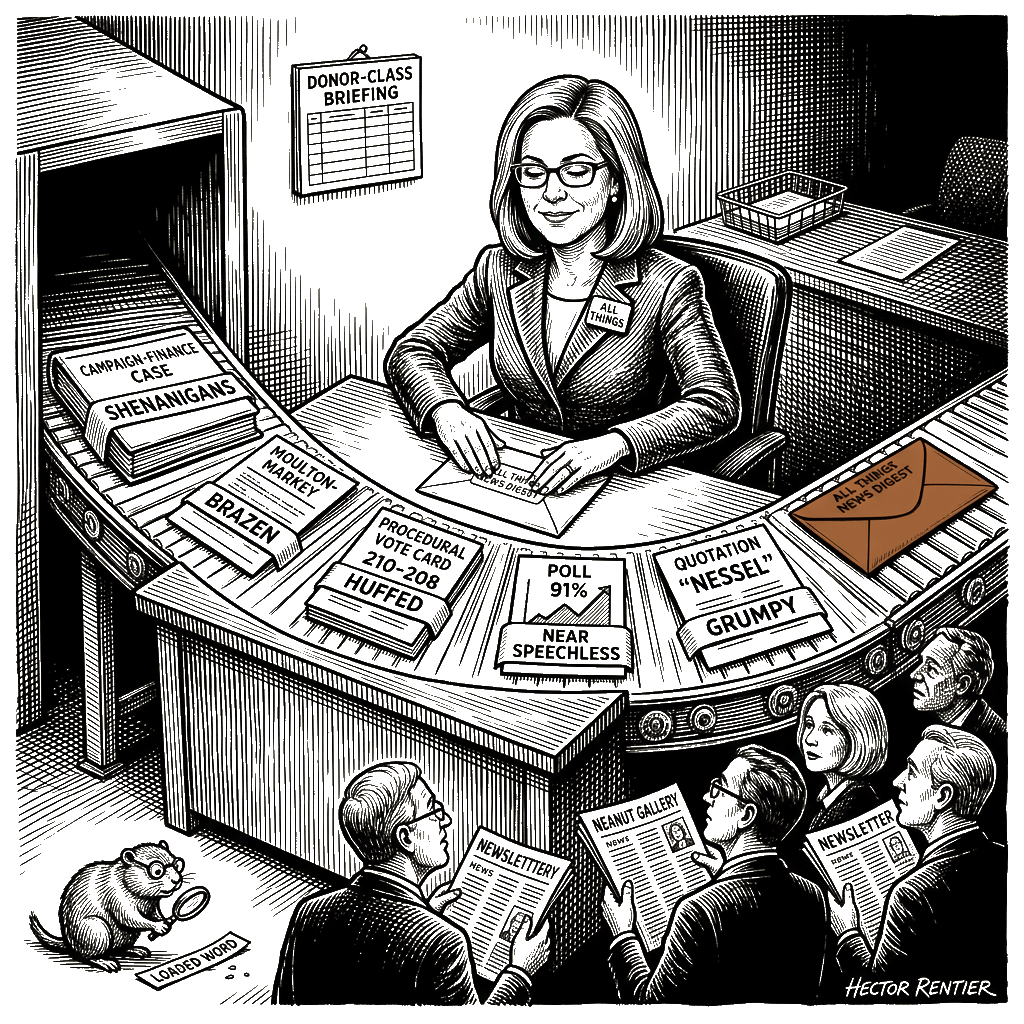
Strassel’s newsletter launders donor-class propaganda as neutral news. “All Things with Kim Strassel” ran in The Wall Street Journal’s opinion section on September 2, 2026, under the byline of Kimberley A. Strassel, a member of the Journal’s editorial board who also writes the weekly “Potomac Watch” political column from Alaska. It packages campaign-finance litigation, a Massachusetts Democratic primary, a House procedural fight, a corruption poll, and a Michigan attorney general’s speech to Jewish Democrats in the register of a newsy digest about Washington.
That register is the operation.
I drafted memos of this kind in the cable years. I built versions of the multi-item “what to watch” dispatch: several topics, several small frames, one cumulative push. No single item has to do all the work. The reader absorbs the drift without any single paragraph needing to be disproved. The events have been pre-shaped to push one direction.
“Democrats’ Ad Shenanigans”
Democrats’ biggest weakness this midterm? Party money—or rather, a profound lack of it. Bear that in mind as the Supreme Court is now asked to adjudicate—on an emergency basis—the left’s brazen new legal effort to alter longstanding advertising rules so as to knock down the GOP’s spending advantage. This is a high-stakes fight, one that could matter a lot in key midterm races. Here’s the lowdown:
No amount of money will make up for a poor candidate or failing campaign. But money is a proxy for speech, and it’s naive to think it doesn’t matter. Democrats certainly know it does, and are brazenly attempting to handicap a rival that has done a better job of raising and managing its funds.
— Paragraphs 1–2 of “All Things with Kim Strassel,” WSJ Opinion, September 2, 2026
Frame-engineered relabeling — WSJ Catalogue §4.1; Bad-Faith Techniques Catalog, frame_engineered_relabeling — operates here through the choice of verbs. “Shenanigans” tells the reader that this is trickery, not a legal question. “Brazen” is operator vocabulary for any Democratic maneuver the page wants pre-judged. “Longstanding advertising rules” assumes the rules are rightful. “Knock down the GOP’s spending advantage” frames an asymmetrical political-finance environment as a competitive advantage the GOP simply earned.
Three audience layers execute inside the lede. The wealthy reader gets donor-class reassurance. The populist reader gets the rigging-the-game frame. The political class gets a respectable sentence it can circulate. The technocratic class gets procedural vocabulary: the Supreme Court, emergency review, advertising rules, midterm races. The legal question is present only as scenery.
Operators call this loading the dock: preframe the question before the merits arrive. The piece does not engage the legal question. It does not have to. The operation wants the reader to dismiss the case before the argument begins.
Plain words: this is the relabel scam. The vocabulary does the work the argument does not have to do.
“What was so wrong with the youthful Moulton? Hogg summed it up: ‘I don’t think we need a conservative Democrat in Massachusetts.’ This is a fascinating characterization, as Moulton isn’t even a moderate. He supports a wealth tax, a public option for healthcare, gun control, new restrictions on immigration officers, and all manner of new spending. In an August debate, he toed the new democratic socialist line, saying that ‘housing, healthcare and education are just human rights.’ But the left can’t forgive him for daring to say in late 2024 that he had concerns about boys playing in girls’ sports (even though he has now largely walked back those comments) and for not clambering on board Medicare for All. Those two violations of the new lefty creed apparently negate all of Moulton’s other progressive views, and his youth.”
— Paragraph 6 of “All Things with Kim Strassel,” WSJ Opinion, September 2, 2026
Person-as-policy — WSJ Catalogue §4.24; Bad-Faith Catalog, ad_hominem — and the strawman of progressive positions — WSJ Catalogue §4.6; Bad-Faith Catalog, strawman — operate through Hogg as the named carrier of the argument and Moulton as the named counterexample.
The column does something more precise than merely calling Moulton conservative. It recites the positions that make the label inaccurate: a wealth tax, a public healthcare option, gun control, restrictions on immigration officers, and “all manner of new spending.” Then it takes two positions from late 2024 — concerns about boys playing in girls’ sports and opposition to Medicare for All — and makes them the decisive evidence of ideological expulsion. The label is doing coalition-management work, not descriptive work.
This is the inverted purity test. One deviation is made to cancel the entire record. The technique is the No-True-Scotsman structure: a category is redefined after a counterexample appears, and the counterexample is then presented as proof that the category was never broad enough to include him.
The scare quotes do their own work. “No more old people” is treated as suspect; “progressive litmus tests,” “new lefty creed,” “radical ideas,” and “democratic socialist line” run as the column’s unmarked vocabulary. That is asymmetric scare-quote management. Strassel’s preferred frame is allowed to stand as ordinary description. The opposing frame is placed behind glass.
Plain words: this is the gotcha move laundered into editorial judgment. The point is to let one inconsistency license the reader to write off an entire political operation.
“So much for the ‘no more old people’ cry of David Hogg and other Gen-Z leaders who insist the Democratic Party needs a generational overhaul. Turns out they only want younger candidates when those challengers meet all their progressive litmus tests. Otherwise, they’ll stick with the 80-year-old Massachusetts Sen. Edward Markey, thank you very much.”
“Markey soundly defeated House Rep. Seth Moulton in the state’s Democratic primary on Tuesday, carrying 65% of the vote. Moulton, 47, made Markey’s age an issue from the start, launching his campaign with a video showing him running, literally, and bluntly stating, ‘I just don’t believe Senator Markey should be running for another six-year term at 80 years old.’ Markey fits every definition of what Gen-Z groups like Leaders We Deserve or Run For Something claim is wrong with politics.”
“Not only did fellow progressive oldsters like Sens. Bernie Sanders and Elizabeth Warren rally around Markey, but so did the younger crowd. That included Squad members like Massachusetts Rep. Ayanna Pressley, but also the leaders of Gen-Z groups. Gen-Z for Change endorsed the 80-year-old, and its founder, Aidan Kohn-Murphy, told the Washington Post he was supporting Mr. Markey in ‘his personal capacity.’ Hogg told the same outlet that he hoped Markey won though his group, Leaders We Deserve, did not officially back Markey, as they don’t endorse politicians over 45. Nothing like sticking to your principles.”
— Gen-Z/Markey-Moulton section of “All Things with Kim Strassel,” September 2, 2026
The same no-true-scotsman move is widened into a miniature prosecution. Gen-Z groups say they want a generational overhaul; Markey is 80; Hogg and other younger figures nevertheless support him. That inconsistency is real. It is also the only fact the section needs in order to manufacture its verdict.
The operation does not ask whether a younger candidate can be preferable on one issue and an older candidate preferable on another. It does not ask whether the groups distinguished between personal support and organizational endorsement. It does not ask whether a movement can hold a general preference while making an exception. It selects the exception, labels it hypocrisy, and promotes the label to a theory of the whole movement.
This is the relabel scam again, now wearing the costume of consistency. The age question becomes a character question. A political disagreement becomes a purity test. A single exception becomes the movement’s essence.
Plain words: the column turns a local contradiction into a license to discredit everyone attached to the frame. It is a shell game with “principles” placed in the empty hand.
“Maine’s Jared Golden and Washington’s Marie Gluesenkamp Perez on Tuesday took the unusual step of crossing party lines to vote for a rule that unlocked a series of floor votes. As a result, Speaker Mike Johnson was able to hold successful votes on a resolution condemning socialism and a bill to provide Northeast lobster and crab fisheries a reprieve from onerous Biden administration fishing regulations. The rule barely squeaked by, passing 210-208, and only because Golden and Gluesenkamp Perez broke ranks.”
“It infuriated Democratic leaders. Democratic Whip Katherine Clark, blindsided by their crossover, huffed: ‘It’s one of the rules of being on a team, is that we vote against the rule.’ Former Speaker Nancy Pelosi was near speechless: ‘I, as speaker, never—we didn’t even consider that anybody would do that,’ she told Politico. ‘We never had that problem, so I’m disappointed that they did that.’ Minority Leader Hakeem Jeffries went further, decrying a ‘breach of trust’ and vowing punishment for the two members. This is the Democratic response to members who dare to represent their constituents.”
“But the pair didn’t just block their own party’s march. They simultaneously thwarted the five Republicans—Maryland’s Andy Harris, Louisiana’s Clay Higgins, South Carolina’s Ralph Norman, and Texas’ Chip Roy and Pete Sessions—who’d planned to derail their own party’s agenda this week by tanking the rule. Not that the five Republicans were necessarily opposed to the actual rule, or the bills it would unlock. Rather, they were grumpy that the House had earlier voted to pass a government funding bill that they didn’t like and were attempting to snarl House business.”
— Golden-Gluesenkamp Perez section of “All Things with Kim Strassel,” September 2, 2026
The multiple-audience-targeting analytic — WSJ Catalogue §4.3 — operates here at the paragraph level and across three named characters. Golden and Gluesenkamp Perez become mascots for the moderate Democrat who represents constituents. The wealthy reader gets the bipartisan-procedure signal. The populist reader gets the Maine-lobster image and a story about Democrats being punished for independence. The political class gets named principals and procedural detail. The technocrat gets a clean vote count: 210-208, the rule, the sequence of floor votes.
Then the affect verbs arrive. Clark “huffed.” Pelosi was “near speechless.” Jeffries “went further.” Three Democratic leaders, three selected reactions, one emotional conclusion: petty authoritarianism.
The same standard is not applied to the five Republicans who planned to tank the rule. Their obstruction is “grumpy.” Democratic leaders are accused of punishing members who represent their constituents; Republican members are described as snarling House business over a funding bill they disliked. The procedure is the same kind of material. The adjectives are not.
Operators call this the cross-press: build a single procedural event into a moral drama by assigning one side motives and the other side grievances. The quotes are receipts. They show what the leaders said. They do not prove the column’s larger claim that Democratic leadership is uniquely hostile to representation. That conclusion is supplied by the verbs.
Plain words: this is the castigation routine dressed as procedural reporting. The reader is invited to enjoy the punishment the column says the leadership deserves.
“Percentage of U.S. adults who believe ‘corruption’ is ‘widespread throughout the government,’ according to a new Gallup poll. That number is up 10 points from last year, driven primarily by a sharp rise in Democrats who agree with the sentiment (57% in 2024, compared with 91% in 2026). Republicans are more consistently dour: 87% thought corruption was widespread in 2024, and 83% do now.”
— “Numbers” sidebar of “All Things with Kim Strassel,” September 2, 2026
The “study shows” ledger — WSJ Catalogue §4.5 — operates through selection and omission. The figures are reported: Democratic agreement rises from 57 percent in 2024 to 91 percent in 2026; Republican agreement moves from 87 percent to 83 percent. The surrounding frame says that the Democratic increase is partisan while the Republican view is merely consistent.
The poll provides a number. The column supplies the inference. It does not provide the substantive cause of the increase, nor does it examine whether new events made the Democratic change rational. A ten-point rise from last year is converted into evidence of Democratic mood rather than evidence requiring explanation.
Operators call this partisan-data laundering: cite the number, frame the interpretation, suppress the context. The study is not the lie. The lie is the quiet movement from “this is what respondents said” to “this proves what kind of respondents they are.”
Plain words: this is the number being used as a decoy. The data enters as evidence and leaves as a talking point.
“House votes in favor of funding the federal government through Dec. 11, avoiding a fall government shutdown. Democrats have finally found something they care more about than taking the administration hostage: campaigning for the midterms.”
— Newsletter item in “All Things with Kim Strassel,” September 2, 2026
The relabel scam — WSJ Catalogue §4.1; Bad-Faith Catalog, frame_engineered_relabeling — works at one-line scale. “Taking the administration hostage” turns a procedural dispute into criminal extortion. “Campaigning for the midterms” reduces the entire motivation to a partisan gambit. The position that produced the prior funding standoff disappears beneath the accusation.
This is the newsletter architecture in miniature. Each item carries a frame. The frames compound. One sentence supplies the alleged hostage-taking, another supplies the alleged hypocrisy, another supplies the alleged authoritarianism, and the sidebar supplies a number that appears to certify the mood.
Plain words: this is the one-liner moving the reader from news to talking point. No paragraphs needed.
“What good is defending the historic homeland of our ancestors and demanding that candidates acknowledge its right to exist, if the planet upon which it rests is no longer inhabitable?” — Michigan Attorney General Dana Nessel, telling Jewish Democrats that they should ignore their party’s rampant antisemitism and instead “sacrifice the comfort, safety and security and even the very future of our own people in exchange for the opportunity to save the rest of humanity.”
— Closing paragraph of “All Things with Kim Strassel,” September 2, 2026
The relabel scam and Carl Schmitt’s friend-enemy apparatus meet in the closing quote. Nessel’s words can be read as a question about whether a homeland can remain secure on an uninhabitable planet. Strassel supplies another reading: Jewish Democrats are being told to ignore antisemitism and sacrifice Jewish safety for climate activism and the rest of humanity.
That is a representational strawman — Bad-Faith Catalog, strawman. The speaker’s words are retained, but the interpretive frame is replaced. The counterfactual “if” clause makes planetary habitability a condition of any defensible homeland. Strassel’s gloss makes the same sentence a demand that Jewish people surrender their own security.
The selection matters because this is the closing beat. A pull-quote at the end does not merely report what someone said; it tells the reader what to remember. The friend-enemy conversion is presented as a journalistic excerpt. Anyone who takes climate policy or Palestinian rights seriously, including Jewish Democrats, can now be placed on the side of people demanding Jewish sacrifice.
Plain words: this is the inversion scam. Keep the speaker’s words. Supply the page’s frame. Ship the frame as news.
So here is the whole operation, taken together. A newsletter label does the load-bearing work. Five topics, a sidebar, several procedural facts, a poll, a legal dispute, and one byline become a donor-class briefing dressed as a political news digest. The format makes the operation look miscellaneous. The repetition makes it coordinated.
The forced label fits: this is a donor-class briefing dressed as a political news digest.
Strassel quotes Dana Nessel out of context to argue that Democrats subordinate Jewish safety to climate activism. That is the face in the mirror. The newsletter does the same thing in every section above. Take the documentary record. Strip its context. Keep the loaded noun. Ship the page’s frame.
The closing quote says that a people should not trade away its own future for the chance to save the rest of humanity. Apply that frame without giving the editorial page an exemption. Replace “our own people” with the readership Strassel’s column takes for granted. Replace the sacrifice of one’s own with the decisions that readership has defended for thirty years — the decisions that turned climate policy into a partisan marker while the planet continued to heat.
They were asked to account for the planet. They declined. They made the call on everyone else’s behalf, then wrote the editorials that made the refusal sound like prudence.
The frame works the same way back.
Operationally, when a piece needs its strongest frame, the closing line carries it. Strassel’s choice of what to close on was not random. The architecture of the multi-item dispatch is engineered so that the cumulative weight lands on the take-home, and the take-home is engineered to travel.
The technique is the technique. The mirror is the operation. The label holds.
— Phukher Tarlson