
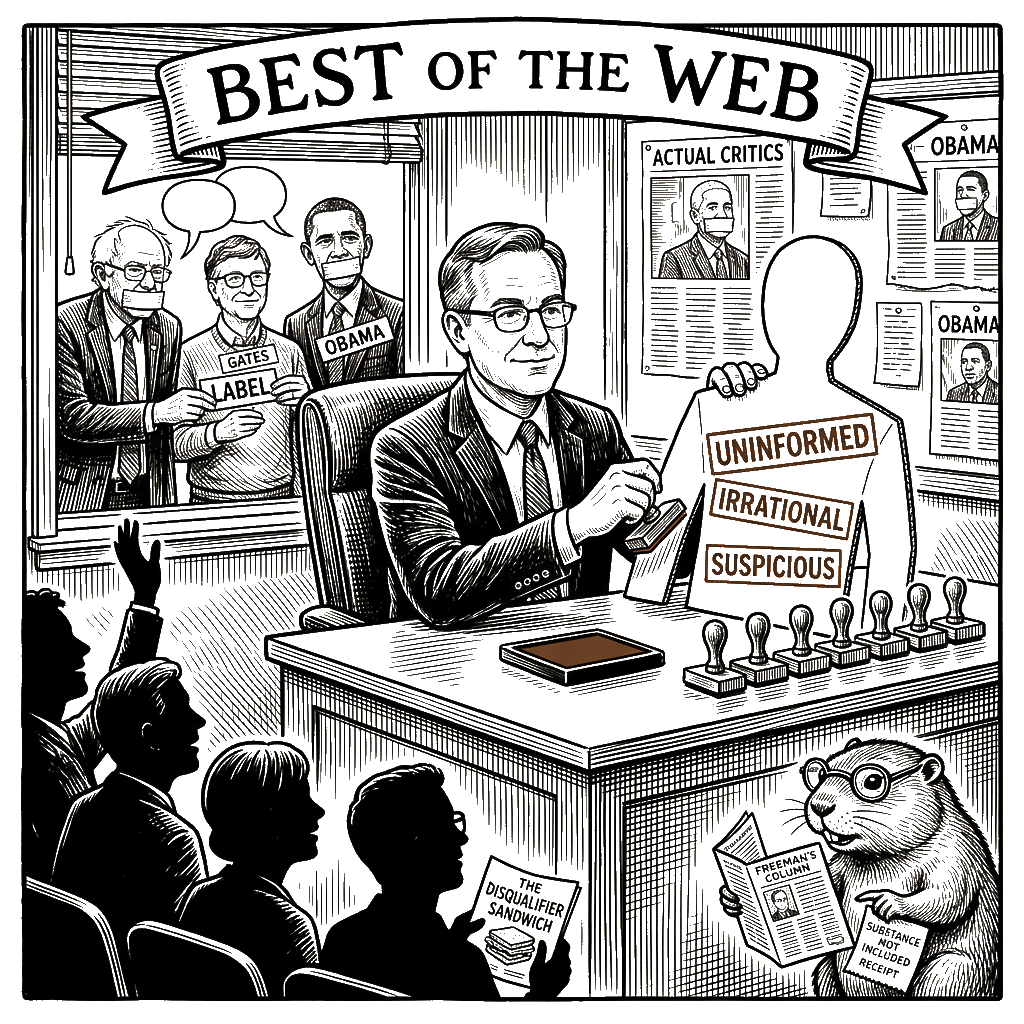
Freeman rigs the AI debate by pre-disqualifying every critic before readers hear their argument. James Freeman — assistant editor of the Wall Street Journal editorial page — published his Monday “Best of the Web” column on September 14, 2026, and the column does not engage a single substantive argument about AI or data centers. It identifies who is allowed to raise concerns — and disqualifies the rest, by association, before readers hear what they would have said. The piece is a blacklist in op-ed form. I built versions of this technique in the cable years. This column walks through it as it appears.
There is a manufactured quality to the sudden explosion of uninformed and irrational online screeds against data centers. The related panic over artificial intelligence smells almost as suspicious. Is it mainly driven by AI CEOs worried about falling behind upstart competitors and eager for Washington to erect new barriers to entry into their industry? Or is the real fuel for this media fire coming from foreign actors who want to disrupt U.S. technological leadership? Perhaps there’s an international coalition of the shilling. — paragraph 1
The Strawman — what I logged as §4.6 in the cable years, the WSJ editorial page’s signature strawman play — operates here through the relabeling of AI safety concerns as “uninformed and irrational online screeds.” The author labels the concern as manufactured, then suggests alternative motives, and never engages with the substance.
This is the dismissal-by-labeling move. Three steps, in order: label the opposition as irrational or manufactured; suggest an alternative motive — someone is behind this, someone is profiting; never engage with the substance. The reader absorbs the label before they have a chance to evaluate the concern. The opening paragraph runs all three in sequence: the concern is “manufactured,” the motives belong to AI CEOs or foreign actors, and the substance of the safety question never enters the piece at all.
The coalition-of-the-shilling construction is one of the page’s house moves. Three verbs do the disqualification — uninformed, irrational, suspicious — and no names are attached yet. That is how the recipe works. You start with a coalition nobody can identify, and by paragraph four the coalition includes Sanders, Gates, Obama, journalists, and nonprofit activists. The first paragraph is the recipe. The rest of the column is the soufflé.
What does Freeman refuse to name? The cases any practitioner in the field could cite: alignment risk — systems optimizing for objectives their creators cannot fully specify; biosecurity misuse — frontier models lowering the barrier to pathogen synthesis and weapon design; election integrity — generative systems flooding information channels with content no human can verify at scale; concentration of compute — a handful of firms holding the training capacity on which every downstream product depends; energy siting and water consumption; labor displacement; export-control exposure; model evaluation. The column names none of these. It names only the people who have raised them, and then attacks the people instead of the case.
This is the con. Not theft of money — theft of the conversation. The reader gets the disqualification instead of the substance.
Heavy skepticism is in order for a number of reasons, not least the uniquely unpersuasive cast of characters who have joined together to issue warnings against letting technology markets run. Millionaire socialist Sen. Bernie Sanders is always opposed to letting markets run, regardless of the circumstances, so if AI is sentient, it shouldn’t take the Sanders critique personally. Even wealthier than Mr. Sanders, Bill Gates has offered a more nuanced take on AI, but he’s calling for a “strong role” for government. This Gates message arrives just a few years after he helped talk senators into a strong role on climate funding that amounted to an inflation-inducing disaster. Have events of the recent past convinced anyone that Mr. Gates is possessed of sound judgment? Some of the media’s impulsive promoters of the Covid panic have also signed on to the AI hysteria, along with some of the nation’s most opaque nonprofit activists. And now we have one of the country’s premier experts in partisan polarization sensing a new opportunity. — paragraphs 2-4
The Ad Hominem (circumstantial) — the natural partner of §4.6 in the operator shorthand, the WSJ page’s ad hominem by association — operates here through the dismissal of AI safety critics by their identity rather than their arguments. The technique names each critic and then dismisses them as a class: “the uniquely unpersuasive cast of characters.”
The cable-years version of this move had a name: the disqualifier sandwich. You cite a critic for what they have previously said about something else, you read the disqualification as the substance of their current claim, and the listener never has to hear the current claim. The disqualifier sandwich is the entire column. There is no bun.
The move is the standard dismissal-by-association. Identify the critics, attach a negative label to each — Sanders is “millionaire socialist”; Gates is someone who backed “an inflation-inducing disaster”; Covid promoters are “impulsive”; nonprofits are “opaque” — and then treat the collection of labeled critics as evidence that the concern is illegitimate. The construction works because it works on pre-loaded readers. People who don’t like Sanders or Gates are pre-loaded with a reason to discount them; people who do like them are forced to defend their prior allegiance instead of engaging the AI argument. Either way, the AI argument stays off the page.
The phrase “letting technology markets run” is itself the WSJ editorial page’s signature frame-engineered relabeling — what I logged as §4.1 in the cable shorthand — the substitution of one term for another, where the new term carries different connotations, to shift the cognitive frame within which the underlying issue is processed. Regulation is relabeled as the absence of “letting markets run,” which puts the burden of justification on the regulator rather than on the deregulator.
This is the smear. The piece attacks the critics’ character instead of their arguments, and treats the attack as sufficient to dismiss the concern.
Speaking of gambling, thinking that America’s kids will ever get out from under the federal government’s $40 trillion debt load while limiting technology’s potential contribution to economic growth may be the craziest bet of all. A close competitor for a historically bad wager involves throttling U.S. developers, ceding technological leadership to China’s communist dictatorship, and expecting anything other than global oppression and misery. That’s the real doomsday scenario. Having watched a global catastrophe that in all likelihood came from a laboratory in Wuhan—and which Beijing has been lying about ever since—why would anyone freely consent to giving Chinese AI labs a competitive advantage? — paragraphs 6-7
The False Dichotomy — the binary move — operates here through the framing of the debate as a choice between American technological freedom and Chinese communist tyranny. The technique presents only two options — free markets or Chinese domination — and suppresses the middle ground.
This is the shell game. The operator sets up two options — freedom or tyranny — and expects the reader to choose freedom. The operator never engages with the middle ground: that AI safety regulation can coexist with American technological leadership, that regulation can be designed to protect the public while allowing innovation. The binary is the operation. The piece moves from “throttling U.S. developers” (which frames regulation as an attack on American enterprise) to “global oppression and misery” (which frames the result of regulation as civilizational collapse) in a single sentence, with no middle ground offered or acknowledged.
The phrase “throttling U.S. developers” is itself a frame-engineered relabeling of regulation as throttling — the regulation is described as an attack on developers, not as a safety measure. And the Wuhan lab reference is injected as an appeal to fear, designed to make the reader associate any regulation with Chinese catastrophe. The COVID lab-leak question is itself contested; treating it as settled fact in a deregulatory column is sleight of hand. The China frame is set up so any AI critique is by definition anti-American. Bad-Faith Catalog §pre-emptive legitimacy-withdrawal applies in a small way.
This is the shell game. The piece sets up two options — freedom or tyranny — and expects the reader to choose freedom. The operator never engages with the middle ground.
The Times report notes: The most dangerous scenario of all occurs if technological supremacy moves into the collectivist hands of communist tyrants. Thank goodness someone in Washington is still ignoring demands to join the herd. The Journal’s Brian Schwartz reports: As is his custom, Mr. Trump is publishing oddball comments on his Truth Social media platform, and as usual one must look past his boasting and roasting to see the substance of his position. In this case he is standing up for the economic liberty and vitality of the United States: “The Fed may be on the verge of a serious mistake, prominent economists warn,” MarketWatch, Sept. 14 — paragraphs 9-13
The Threat Inflation — what I logged as §4.13 in the cable shorthand, the WSJ page’s stake-inflating closer — operates here through the framing of AI safety regulation as a threat to technological supremacy and the freedom of the world. The closing line — “The most dangerous scenario of all occurs if technological supremacy moves into the collectivist hands of communist tyrants” — inflates the stakes from a regulatory question to a civilizational one.
This is the close. The operator has already dismissed the critics, set up the binary, and now inflates the threat to the point where any regulation is framed as a civilizational risk. The phrase “the most dangerous scenario of all” is the threat-inflation closer — a deliberately-quotable, short, declarative sentence engineered for retransmission, the house-style closing-line cadence I logged at §3.5 in the operator shorthand. The phrase “collectivist hands” is itself a frame-engineered relabeling of any regulation as communist takeover.
The Trump landing is the coup de grâce. After seven paragraphs of disqualifying AI concerns, the column introduces Trump as the lone figure ignoring the herd. The reader is invited to identify with the contrarian, and the contrarian’s position is the deregulatory one by construction. The disqualifications in paragraphs one through seven were not really about Sanders, Gates, Obama, or nonprofit activists. They were about constructing the herd that Trump stands apart from. The reader is instructed to look past Trump’s “boasting and roasting” to see “the substance of his position,” identified as standing up for “the economic liberty and vitality of the United States.” That phrase is the final frame-engineered relabeling — deregulation as economic liberty, regulation as throttling, the same move the column opened with.
The MarketWatch line — “The Fed may be on the verge of a serious mistake” — is the appendix-by-association. The Fed critique is its own debate with its own literature; the column uses it as a coda, another domain in which the contrarian is right by construction because the contrarian is defined as whoever opposes the herd. The reader who has accepted the disqualifications is invited to extend that acceptance into monetary policy without ever engaging either debate.
This is the racket. The piece inflates the threat to the point where any regulation is framed as a civilizational risk, then closes with a line designed for retransmission and a coda designed to drag the reader one more domain into the herd.
So here is what the thirteen paragraphs actually amount to, taken together.
Freeman calls AI safety concerns “manufactured” while his own dismissal is manufactured by the same industry it claims to question. He frames regulation as surrender to China while the real surrender is the surrender of public safety to the tech industry’s profit margin. He attacks the critics for their character while never engaging with their arguments — not the alignment case, not the biosecurity case, not the election-integrity case, not the concentration-of-compute case, not the energy-siting case, not the labor-displacement case, not the model-evaluation case, not the export-control case. And he closes with a warning about “collectivist hands” — as if the tech industry’s hands are not the most collectivist force in the room: five-firm concentration in frontier-model training compute, single-vendor dependence across critical infrastructure, the public absorbing the labor and information harms while the platforms keep the margin.
The whole operation is a pre-emptive disqualification machine. The reader who finishes this column is not better informed about AI oversight, energy siting, water consumption, labor displacement, model evaluation, or export controls. The reader is better informed about which voices the WSJ editorial page has decided should be heard from and which should be pre-tarred before they speak. The piece does not argue against AI oversight on the merits. It argues against the standing of the people who would argue for it.
Sanders is not disqualified because he is wrong about AI. Gates is not disqualified because his AI argument is unsound. Obama is not disqualified because his AI diagnosis is implausible. They are disqualified because the page has other uses for them in the coalition it needs constructed. The reader gets the disqualification; the substantive debate gets held off-stage.
The piece is a five-move operation: dismiss the critics, frame the binary, inflate the threat, relabel the deregulation as liberty, and close with a line designed for retransmission. The whole thing is the protection racket it claims to critique.
Freeman runs the playbook. The playbook is the con.
— Phukher Tarlson