
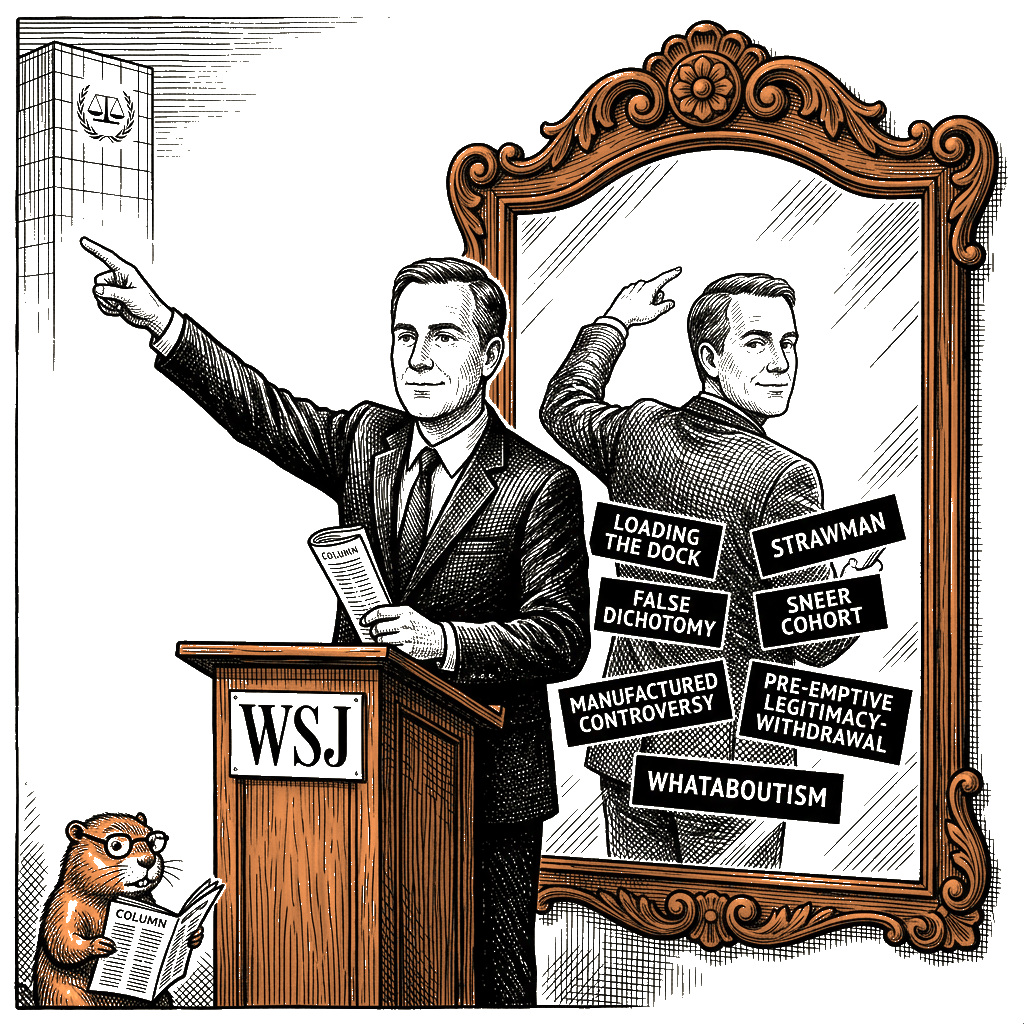
Swaim’s WSJ column runs a seven-technique operation to keep Israel out of The Hague. I drafted messaging of this kind in the cable years — not this specific campaign, but the technique-set: the framing of legal accountability as politicization, the inversion of the documented record into the defender’s frame, the sequencing that ends with the international legal architecture gutted. The piece — Barton Swaim’s Wednesday column on WSJ.com, “International Law vs. Israel,” and “International ‘Law’ vs. Israel” in the print edition the next day — runs the playbook I helped author fragments of. Seven techniques. We walk them in order.
“The Trump administration’s gutsy and commendable effort to dismantle the International Criminal Court will attract less attention than it deserves. The ICC in 2020 launched an investigation of U.S. soldiers it alleged had committed war crimes in Afghanistan. In 2024, the court issued arrest warrants for Israeli Prime Minister Benjamin Netanyahu and his former defense minister, Yoav Gallant, on the bogus claim that Israel had committed crimes against humanity.”
Frame-engineered relabeling — the substitution of one value-laden term for another to shift the cognitive frame within which the underlying issue is processed — operates here through the asymmetric application of value-laden adjectives. The administration’s effort to dismantle a functioning international court is “gutsy and commendable.” The warrants the court issued against a sitting prime minister after months of judicial review are a “bogus claim.” The Court’s prior action against U.S. soldiers is recast so the soldiers appear as victims — “U.S. soldiers it alleged had committed war crimes” — with the verb “alleged” doing the work of suspending the indictment that follows it. Operators call the move loading the dock. The conclusion rides in the adjectives; the evidence arrives afterwards in degraded form, if at all.
The receipts the column does not supply are the warrants themselves. The ICC’s arrest warrant for Netanyahu — issued in November 2024 after a panel of pre-trial judges reviewed evidence over months — names specific charges: crimes against humanity and war crimes including the use of starvation as a method of warfare. The “bogus” descriptor is the operator’s euphemism for evidence the operator has not engaged.
“Leaks from the State Department suggest the administration will follow through on its intention to impose broad sanctions on the ICC, in effect cutting it off from the U.S. banking system.”
The relabeling deepens — and is now anchored to a procedural rumor rather than an editorial-page opinion. The piece treats the severing of the ICC from the U.S. dollar system as a leaked-measure story with no editorial-page opinion attached. The page would treat a U.N. body taking a position adverse to U.S. interests as a crisis. The page treats the U.S. sanctioning the body to force compliance as routine housekeeping. The lawfare frame runs asymmetric — legal process against the state’s preferred actors is weaponization; legal process against the state’s disfavored actors is legitimacy. Executive Order 13928, the June 2020 sanctions the first Trump administration imposed on ICC personnel engaged in the Afghanistan investigation, set the template. The Biden administration revoked EO 13928 in April 2021; the current administration reimposed ICC sanctions in early 2025 over the Israel warrants. What is new here is the page treating this further escalation as cheerful housekeeping rather than as a structural break in the post-1945 legal architecture. That cheerful framing is the operator’s product.
“That’s where South Africa enters, with its discreditable case against Israel. Less than three months after Oct. 7, 2023, when Hamas launched its bloodthirsty attack against Israeli civilians, South Africa accused Israel of genocide in the ICJ. The case has no merit, except in the minds of activist law professors, leaders of radical nongovernmental organizations and, sadly, the fanatically anti-Israel government of Irish Prime Minister Micheál Martin.”
Strawman — misrepresentation of an interlocutor’s position to make it easier to refute, here in its representational form, where the original statement is replaced by a description of the kind of person who would make such a statement and the description is then attacked — operates here by replacing South Africa’s filing with a caricature of its supporters. The case is dismissed not by engagement with its allegations, its memorial, its legal arguments — the case is dismissed by attributing it to “activist law professors,” “radical NGOs,” and a “fanatically anti-Israel” foreign leader. The technique works because the reader who shares the column’s prior on international law does not need to read the filing. The reader needs to feel that the filing is the kind of filing those people file.
South Africa’s ICJ application — the application instituting proceedings filed in the weeks following the October 7 attack — cites the Genocide Convention, names specific incidents with specific dates, and identifies specific conduct alleged to fall within the convention’s Article II definitions. The “no merit” verdict is the column’s verdict. The column does not show its work.
“On its own, South Africa’s case would likely go nowhere. In Gaza Israel tried to minimize civilian casualties even as Hamas hid its fighters in a ganglion of tunnels beneath hospitals, schools and neighborhoods. And a government wishing to perpetrate genocide doesn’t send in massive amounts of humanitarian aid to the civilians it wants to destroy. Either the Israelis are idiots or they didn’t commit genocide.”
False dichotomy — presenting two options as exhaustive when others exist — operates here as the column’s load-bearing analytical move. The 1948 Convention standard for genocide is acts committed “with intent to destroy, in whole or in part, a national, ethnic, racial or religious group.” The standard is a pattern-of-conduct question with inferred-intent doctrine. It is not a self-image question of whether the actors feel genocidal. The column collapses the threshold into a cartoon — a regime grinning at its own victims, which is what the cartoon can dispatch — and lets the cartoon’s dispatch do the work of dismissing the actual standard. This is strawman run on the international-law register: represent the position you oppose as a cartoon so the cartoon can be dismissed without engagement. Two things that can simultaneously be true: a government can permit humanitarian aid into a territory while conducting military operations whose documented civilian-displacement and infrastructure-destruction record meets the inferred-intent threshold. The page needs the reader not to see that, so the page flattens the standard into a one-line absurdity.
The humanitarian-aid argument is the column’s evidentiary centerpiece, and it is the centerpiece of the column’s evidentiary failure. The aid record during the period covered by South Africa’s filing is not “massive amounts of humanitarian aid.” It is a contested, restricted, repeatedly halted flow — documented in UN OCHA flash updates through the period, in the Integrated Food Security Phase Classification’s famine findings for parts of Gaza, and in incident reports from humanitarian organizations including UNRWA, WFP, and MSF describing trucks turned back, aid workers killed, and supply lines choked throughout 2024. The Journal’s own news pages carried some of this documentation; the column’s editorial page does not cite it. The “massive amounts of humanitarian aid” descriptor is the column’s paraphrase. The receipts are elsewhere, and they read differently.
The operator’s binary. The reader resolves it in three seconds flat. The legal question never gets engaged.
“The court could legitimately find its way to a genocide ruling against Myanmar without changing the ‘reasonable inference’ requirement,” says Alan Kessel, a former legal adviser to the government of Canada. But changing the legal threshold facilitates the case against Israel. Priorities.
“A passel of U.N. legal busybodies, led by South Africa’s Navi Pillay and cheered on by Ireland, wants the court to lighten the burden of proving genocide in the Gambia-Myanmar case specifically to make the charges stick in South Africa’s case against Israel.”
The sneer-cohort move — the editorial-page device of aligning one’s position with “common sense” against a “credentialed class,” run here in international-law register — operates here through imputed-motive disqualification. A body of legal argument is recast as a nuisance group, with a sinister motive interpolated (“specifically to make the charges stick,” “Priorities”) to make the engagement unnecessary. The doctrinal question — whether the ICJ’s “reasonable inference” threshold applies in the Gambia-Myanmar context, and how — is the question the column is built to avoid. The piece supplies a sneer in the place of a sentence. “Passel of legal busybodies” is the giveaway.
And note what Kessel’s concession does to the move. If the Myanmar case can succeed on the existing “reasonable inference” standard, then the move that requires the standard to be lowered in order to convict Myanmar is a move built on a false premise. The standard does not have to change to convict Myanmar. The only reason to change the standard, on the column’s own framing, is to make the case against Israel. Which means the differential-standards move is not a move about Myanmar at all. It is a move about Israel, wearing Myanmar as a costume. The reader who follows the concession to its end is left holding the column’s true structure: the column is constructing a procedural ground to disqualify the Israel case, and the Myanmar case is the rhetorical vehicle for that construction.
“Awareness of the potential for collateral damage amounts to genocide? If so, the term means nothing. Every military that has ever launched any operation had some awareness that its actions could occasion civilian deaths. If the ICJ, and by extension the entire apparatus of U.N.-backed international law, lowers the burden of proving genocide as precipitously as that, expect no end to legal cases filed by transnational jackals against the U.S. and its allies alleging genocide.”
Manufactured controversy — the deliberate construction of the appearance of legitimate legal disagreement where the actual standard is one of substantial settled doctrine — combined with threat inflation — the page’s signature technique of inflating policy stakes from concrete to civilizational — operates here by collapsing the legal standard the column opposes into its weakest possible reading, then inflating the consequences of accepting that reading into a civilizational threat against the United States. The argument’s structure: identify a position the column can disprove easily — that mere awareness of collateral damage equals genocide — and treat that position as if it were the legal standard actually at issue. The standard at issue in the ICJ’s jurisprudence is not awareness; the standard is the pattern-of-conduct test the column itself cites three paragraphs earlier — proof of intent, or conduct “so consistent that it leaves no other ‘reasonable inference.’” The column does not address the actual standard on its own terms. The column invents a standard the columnist can knock down in a sentence.
The threat-inflation closer — “expect no end to legal cases filed by transnational jackals against the U.S. and its allies” — performs the page’s signature retransmission move. “Transnational jackals” is frame-engineered relabeling with the dehumanizing adjective applied to the underlying activity of legal advocacy for victims of state violence. The threat is vivid, the term is the adjective the reader will carry away, and the consequence is asserted without example. None of the cases filed under the actual standard the column cites is named. None of the actual applicants is named. The threat is the threat of threats. The threat is the point.
“The whole episode affords a dark reminder that Jew-hatred resides in high places. I’m not entirely convinced that the term genocide, coined in 1944, properly applies to more than one crime in history, the Holocaust, but Myanmar’s campaign against the Rohingyas might qualify to a reasonable person. Note, however, that the only reason it draws attention concerns what Israel might have done in Gaza, not what Hamas, with openly genocidal aims, actually did in Israel.”
Pre-emptive legitimacy-withdrawal — withdrawing legitimacy from an institution, process, or actor on identity grounds rather than on documented conduct, so any subsequent finding is dismissible — combined with No True Scotsman — ad hoc redefinition of a category to exclude counter-examples — operates here as the column’s closing move, the disqualification the column has been building toward. Anyone who applies the term “genocide” to Israel is now, by the close, motivated by “Jew-hatred” rather than by the documented evidence. The page is no longer engaging the South Africa case at this point; it is engaging the moral standing of the people who made the case, and disqualifying them upstream of any further argument. This is the editorial-page move of deploying identity-as-credibility, reversed — the identity of the questioners disqualifies the question.
The “more than one crime in history” Holocaust-limiter does the second piece of work. If the only legitimate use of the word is the Holocaust, then every contemporary application of the term — Rwanda, Srebrenica, the Rohingya, Gaza — is upstream invalidated by the column’s frame. The legal record treats the question differently. The ICJ ruled in Bosnia v. Serbia (2007) that genocide occurred at Srebrenica in 1995, holding Serbia responsible for failing to prevent it. The “more than one crime in history” is the page’s polemical, not the legal record’s. The column stages the doctrinal question, then moves the question to the moral status of the questioners, then closes on the moral disqualification.
The whataboutism pivot — substituting an unrelated moral question for the legal question at issue, then resolving the substituted question favorably to the operator — is the closing paragraph’s other load-bearing move. The pivot substitutes an unrelated moral question (Hamas’s conduct on October 7) for the legal question at issue (Israel’s compliance with Article II), then resolves the substituted question favorably to the operator. The technique works because the reader accepts the substitution as a contribution to the same argument. It is not. The question of whether Hamas committed atrocities on October 7 is a question about Hamas. The question of whether Israel committed genocide in Gaza is a question about Israel. The column answers the first question, then asserts the second question is the kind of question that does not deserve an answer. The whatabout is not an argument. The whatabout is a substitute for an argument.
The closing sentence is the deliverable. The column has spent its length constructing the case against the ICC, the ICJ, South Africa, Ireland, Navi Pillay, U.N. commissions, and “transnational jackals.” The closing sentence hands the operator a usable policy upshot: the Trump administration should “turn a critical eye” to the court. The upshot is sanctions. The upshot is defunding. The upshot is the elimination of the legal jurisdiction the column has been constructing the case for. The closing is where the page has been going all along.
So here is what the piece actually does, walked together.
The column opens by celebrating the U.S. dismantling the ICC. It calls the arrest warrants against Netanyahu and Gallant a “bogus claim.” It treats the South Africa ICJ case as a fraud. It calls the legal cohort working on genocide standards “a passel of U.N. legal busybodies.” It calls legal advocates for victims of state violence “transnational jackals.” It closes by reading the international legal apparatus as an instrument of “Jew-hatred,” and removing the word “genocide” from contemporary applicability.
Now ask: do the disqualifications belong to the column’s targets, or to the column itself? The column calls the legal claimants “transnational jackals” — and the column is the jackal operation against the courts it dislikes. The column accuses the legal process of pre-empting Israel’s legitimacy — and the column pre-empts the legal process’s legitimacy. The column accuses the legal process of operating without evidence — and the column operates without evidence. The column accuses the legal claimants of bad faith — and the column’s case against the filing is bad faith. The column accuses the legal claimants of refusing to engage Hamas’s conduct — and the column refuses to engage the documented record. The column accuses the legal claimants of special-pleading — and the column’s argument is the special-pleading. The column accuses the legal process of being captured by activists — and the column’s argument requires the reader to be captured by the columnist. The disqualifications the column deploys are the disqualifications the column accuses others of deploying. The deliverable the column hands the reader — defund the court, sanction the prosecutor, treat the legal process as beyond the pale — is the deliverable the column accuses the legal process of trying to extract.
Walked together, the move is not an argument. The move is an exemption. The exemption: states the U.S. and Israel favor are not subject to international legal accountability. The mirror is here. That is the position of every defendant who has appeared before an international criminal tribunal in the post-1945 record. The Nuremberg legacy held that state violence is prosecutable, that the legal apparatus built to enforce it exists, and that defendants get to lose. The page called the application of that legacy to Israel “Jew-hatred.” The actual name for the position the page is arguing is: states we like are exempt.
That is the operation in the page’s preferred terms. The seven techniques are the same techniques any defendant before any international tribunal in the postwar record has used. The page is on the side of the defendants.
The architecture is the architecture the apparatus runs. The architecture works.
— Phukher Tarlson