
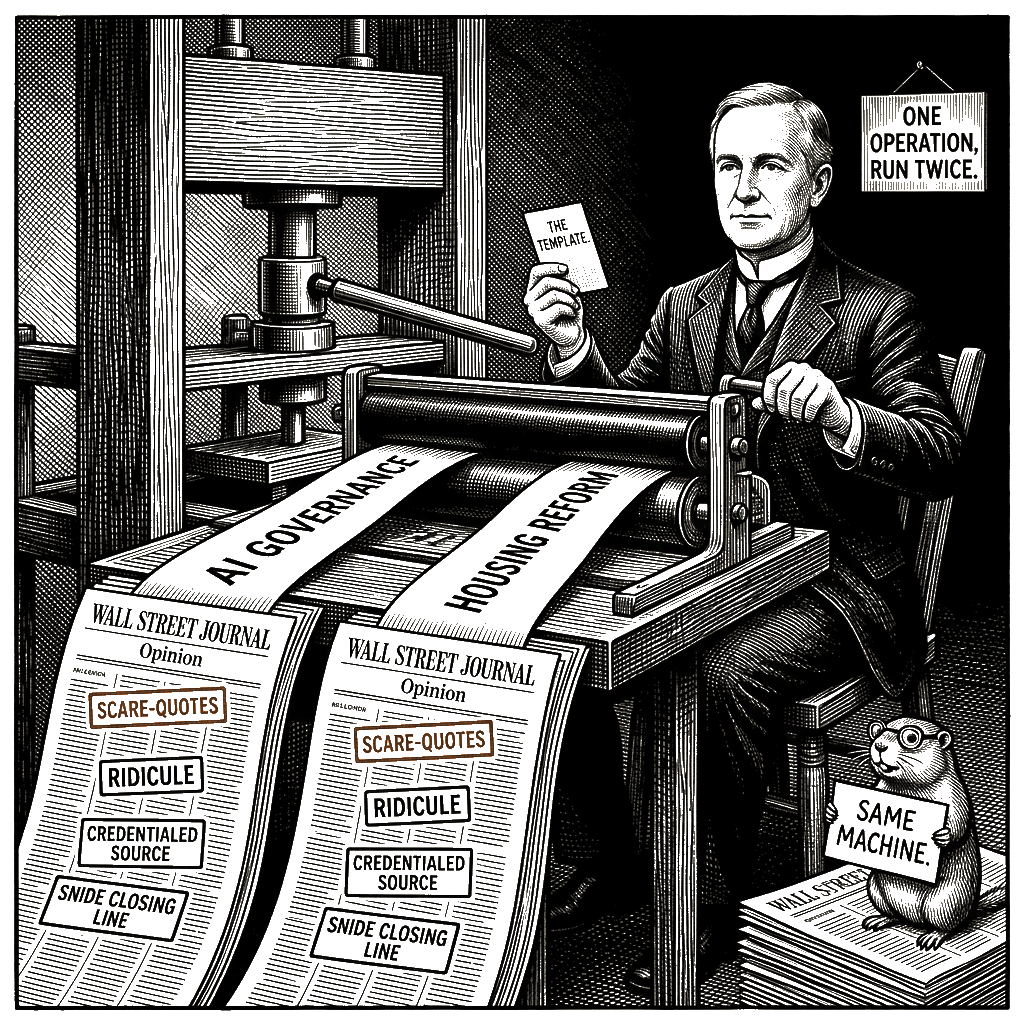
James Freeman’s Best of the Web runs the same propaganda template twice in one column. The September 28, 2026 piece, on the Wall Street Journal Opinion page, deploys one operation against AI governance and the same operation against California state senator Scott Wiener’s housing reform. Two unrelated policy debates; one template; one piece. This column walks through the two deployments as they appear.
I drafted columns of this form in the cable-news years; the format was called “running the machine twice.” Claims about how the format tunes itself to the scanner’s reception rate draw on retained working memory of how the page constructs these columns, not on what the artifact itself documents. The format works because the audience doesn’t have to decide what it thinks. The column decides for them.
“President Donald Trump wisely told the United Nations last week that the U.S. would ‘totally reject’ any ‘globalist scheme’ to control artificial intelligence. Fortunately he’s also still rejecting a domestic scheme to shield prominent creators of technology tools from liability and competition.”
Frame-engineered relabeling — WSJ Editorial Technique Catalogue §4.1 — operates here through two relabelings inside one sentence. International coordination on AI governance becomes a “globalist scheme”; a domestic framework allocating liability when AI tools cause harm becomes a “domestic scheme to shield” the regulated parties from accountability. Two policies relabeled as schemes. We called this loading the dock — set the freight so the reader’s reception runs the payload without the reader having to decide whether to load it. The vocabulary does the reader’s work before the column has finished its first sentence. The “shield” framing relabels the regulated entity as the protected party; the page substitutes a hostile-actor caricature for the framework’s actual structure. One phrase, three audiences, no policy.
The asymmetric scare-quote management at catalogue §4.12 is the discipline doing the same work in reverse: “globalist scheme” appears in scare quotes because the page wants the reader to recognize the term as politically loaded. “Totally reject” runs unmarked because the page wants that posture to read as the obvious common-sense position. The reader who absorbs the vocabulary absorbs the frame. The reader who absorbs the frame believes they reasoned to it. That is the long con dressed as diplomacy.
“Not everyone welcomed the announcement. ‘AI Bros Are Having a Meltdown Because the Associated Press Stylebook Clarifies That AIs Don’t Have Feelings,’ says the headline at a website called Futurism.”
Multiple-audience-targeting — catalogue §4.3 — operates here through three audiences addressed inside three short paragraphs. The wealthy reader gets the posture-confirmation that AI accountability questions are being routed to absurdity. The populist base gets identity-ratification through the “AI Bros” framing — the enemy image is a constructed class of AI executives the page has decided to call bros. The technocratic class gets the credentialed citation; the AP Stylebook is treated as an authoritative arbiter of what reality means here.
Folk-devil deployment — Bandura’s social-learning mechanism by which a descriptive label migrates into an identity-erasing one, what technique operators called “loading the folk devil” — operates through “AI Bros.” Anyone with a substantive concern about AI governance, anyone who found the AP Stylebook update inadequate, anyone who thinks the question of AI feelings is the wrong question — converted into a contemptuous identity label. The “meltdown” frame then runs §4.15 civility-weaponization in reverse: tone-policing the opposition by reframing objection as emotional breakdown. The substantive question — what AI governance the AP clarification is or is not adequate to — is sidestepped entirely. Derisive label first, substantive position never named. The derision does the work the policy argument is supposed to do. We called this the substitute — replace the policy question with the identity cue, then run the identity cue as if it were the answer.
“Here in the nonfictional world, people are responsible for their actions.”
The closing-line cadence — catalogue §3.5 — is one of the page’s signature moves. This line is engineered for circulation; it lifts. It is also the §4.10 common-sense / elite rhetorical pivot: “the nonfictional world” implies a fictional world where the “AI Bros” live, and the asymmetry is the move. The writer is a Yale graduate at an elite publication addressing an elite audience, deploying “common sense” against a credentialed class he is part of. The fictional world is the page’s construct. The credentialed class includes the writer. That is the elite telling itself it is defending ordinary reality against elite fictions. The fiction is the page’s.
“Just as in education and health care, there is a long and sad history of government interventions in the real estate market that have failed to deliver the affordability promised by politicians. […] The Problem With Progressive ‘Achievements’”
Asymmetric scare-quote management — catalogue §4.12 — operates here through “Achievements.” The page’s preferred terms run unmarked across its own body of work. The opposing coalition’s terms run in scare quotes when the page wishes to flag them as politically loaded. “Achievements” in scare quotes is the technique: the term appears with a citation to an Andy Kessler column that the page itself is running as part of the daily operation, and the scare quotes tell the reader that what progressive policy accomplishes is not actually accomplishment but something the page has decided to flag. The reader who reads the column reads the scare quotes as the page’s own judgment, written into the headline.
The austerity-thrift archetype at catalogue §4.2 runs alongside: suffering from government intervention reframed as the natural consequence of politicians’ promises. The page’s preferred term for this move, when the policy is something the page opposes, is “the failed intervention”; when the policy is something the page supports, the same intervention is “policy that delivers.” The asymmetric application is the technique.
The cui bono is on the page, too. Housing scarcity benefits a specific concentrated class: existing homeowners — disproportionately the post-Proposition 13 property-tax-insulated cohort, and the permitting-board coalitions through which incumbent owners exercise discretionary veto over new construction — and the developer-financed intermediaries who have learned to monetize the leverage ratchet on tight supply. The diffuse cost is borne by the roughly forty percent of Californians who rent and the larger population of would-be first-time buyers kept out of the market. The suppressed-variable diagnostic points at the bipartisan NIMBY coalition — homeowner-protectionist on the right, renter-protectionist-with-zoning-on-the-left — that has blocked new construction in California for decades, and at the leverage ratchet on existing housing stock that drives cost extraction. None of that makes the column. “Progressive Achievements” makes the column. The voters who already own benefit; the voters who don’t are blamed for the work.
“Mr. Wiener may have been driving, but where was he going?”
The question is engineered to look open and is closed by its premise. The reader is being instructed that Wiener’s housing law was pointless before any evidence is heard. The “driving” / “going” metaphor carries its own ideological load: Wiener as vehicle, destination as void. The strawman — Bad-Faith Catalog — is the substitution of “driving without destination” for “driving toward a destination the page opposes.” The actual destination — California housing production at scale — has been silently replaced with a destination the page constructs. We called this destination doubt: when the policy has moved, manufacture doubt about the destination. Manufactured uncertainty, designed to license inaction.
The cui bono tells you which destination. Wiener’s authored housing package — SB 35 in 2017 streamlining ministerial approval for multifamily projects in jurisdictions failing state housing goals; SB 9 in 2021 permitting duplexes on single-family-zoned lots and lot splits; SB 423 in 2023 extending SB 35 streamlining statewide — was a coherent attempt to break the permitting-board veto the preceding paragraph refused to name. Each bill named a specific bottleneck: ministerial approval, single-family zoning, and the sunset on the streamlining authority itself. The Chronicle’s endorsement calls Wiener “arguably the nation’s most accomplished state legislator” and the “driving force” behind California’s housing development. The Chronicle’s own news side has published Hannah Wiley and J.D. Morris’s reporting headlined “Scott Wiener spent years rewriting California housing law. What does he have to show for it?” The news side of the Chronicle — the outlet’s own reporting — is being cited as evidence against the editorial side’s endorsement. We called this the relay — let the page’s own news coverage carry the editorial page’s preferred conclusion by selective citation. The reader who follows the citation finds the news side reporting on the policy dispute, not ratifying the editorial side’s “where was he going?” framing.
“Californians may want to consider voting for politicians who pledge to stop working on housing policy.”
The closing-line cadence at peak deployment — catalogue §3.5 — with §4.13 threat-inflation in reverse. The sentence is engineered for retransmission; “stop working on housing policy” is the lift-quote. It converts a policy disagreement (how aggressively to increase housing production) into an identity-loyalty instruction (vote for politicians who will stop doing housing policy at all). The instruction’s underlying claim — that housing-policy work has produced results so bad that the response is to stop doing it — does not appear in the paragraph; the paragraph assumes the conclusion and writes the instruction. The closing is a designed-for-circulation instruction to voters, dressed as skepticism, that benefits the people who already have it. Incumbent homeowners. The post-Proposition 13 protected class and the permitting-board incumbents who staff them. The column’s closing-line cadence is the page’s standing threat-inflation move: take the concrete policy and inflate to the civilizational-disaster posture, then write the line that survives the scanner’s recall.
So here is what the September 28 column actually is, taken together.
One operation, run twice. The four-step machine: scare-quote the target frame, deride the defenders, anchor to a credentialed institutional voice, land a closing-line sneer engineered for circulation. Worked against the first target: scare-quote “globalist scheme”; deride the “AI Bros”; anchor to Reuters / Jody Godoy, the AP Stylebook, and the Futurism headline; closing sneer “people are responsible for their actions.” Worked against the second target: scare-quote “Progressive Achievements”; deride Wiener’s destination; anchor to Kessler’s headline, the Chronicle endorsement, and the Chronicle’s own Wiley / Morris story; closing sneer “Californians may want to consider…” Same template, different day, different enemies. The day supplies the enemies; the column supplies the machine. The machine is the column.
Apply the template to the template itself. Scare-quote the column’s chosen frame, “daily roundup,” and put it in the same scare-quotes the page puts around its opponents. Sneer at the defenders as “temperamental critics.” Anchor to a credentialed voice: the page’s own editorial technique catalogue documents §4.3 multiple-audience-targeting as the house signature, and §3.5 the closing-line cadence as engineered for social-media retransmission. Land a closing line the page would recognize as its own: a column that runs the same operation twice in one piece is not a roundup. It is a propaganda template with a byline.
The face-in-the-mirror test the source cannot survive: by the standard the column hands Californians — stop voting for politicians who work on housing policy — the column’s own preferred coalition has been working on housing policy for decades through the deregulation, subsidy, and zoning carve-outs the WSJ editorial page has endorsed in those same columns. The deregulators have a housing-supply record too. By the column’s own standard, the deregulators should also be voted out for having worked on housing policy. The page will not say so, because the standard is meant for the other side. The technique is the standard’s asymmetric application — and the application is the news.
The readers who enjoyed the mockery of “globalists,” “AI Bros,” and a state senator driving nowhere are exercising exactly the muscle the template is built to exercise — contempt at the named out-group, gratitude at the institutional voice, circulation of the closing line. They are the template’s audience. The template’s audience is what the template is for. The long con the cable years built does not name itself; the column names it out loud.
— Phukher Tarlson