
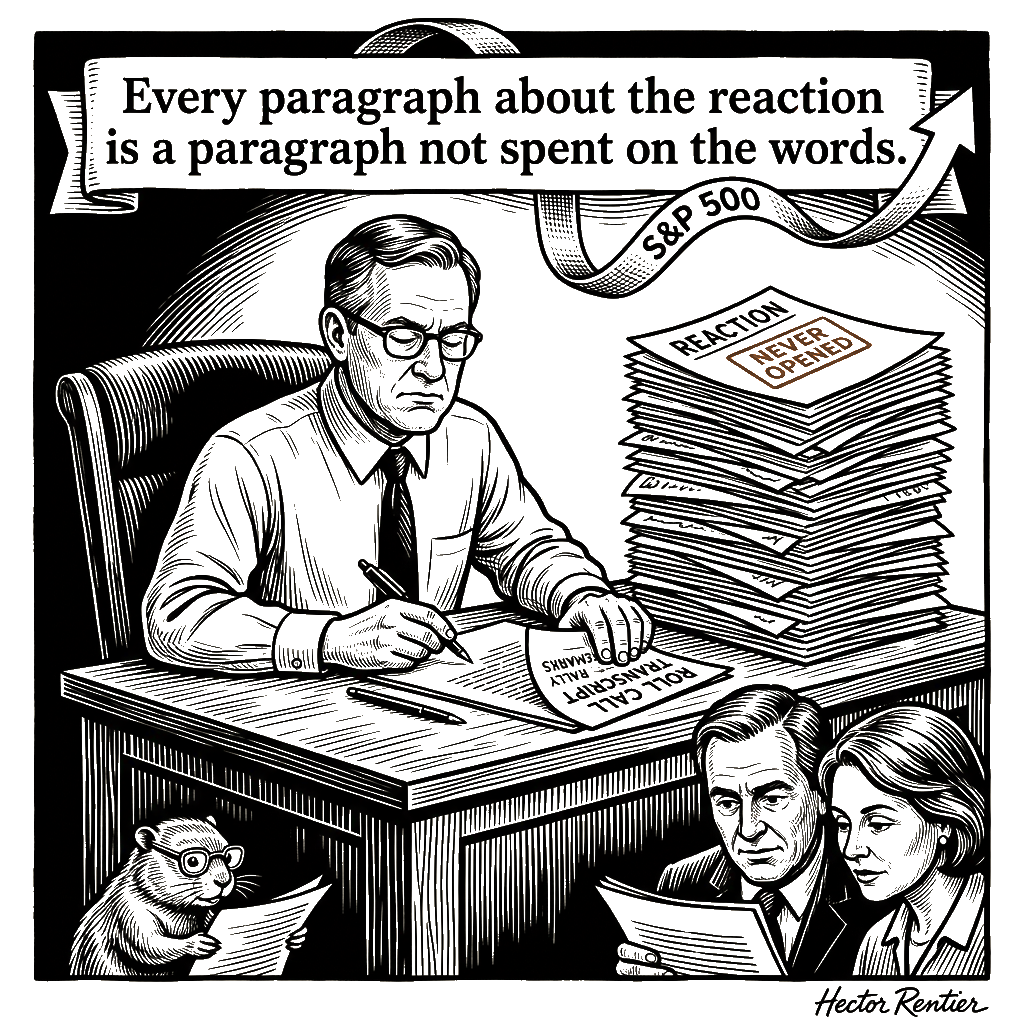
James Freeman put every reaction to Trump’s rally on trial, and never the words. The Wall Street Journal’s Best of the Web column of October 6, 2026 takes a Monday campaign rally in Nebraska and the S&P 500 as its subject and its verdict, and in between it examines exactly one kind of evidence: what people posted. Quoted first, annotated after, in the order the column runs them. I have written reaction columns of this species — the market close standing in for an argument, the opponent’s motive read off their posting schedule, the transcript cited and never opened. I built versions of it. It is a cheap trick, and it works, which is why it keeps coming back.
The leadership of the Democratic Party is so confident of success in November’s elections that they’ve launched an all-hands-on-social-media effort to promote an unbelievable characterization of President Donald Trump’s remarks at a Monday campaign rally in Nebraska. This is not the behavior of people who think they are coasting to victory. — opening paragraph
The first move is the projection play. The Bad-Faith Catalog files it as petitio principii — a frame-up in the first sentence, and it costs nothing — and as the circumstantial ad hominem, the move that discredits the objection by discrediting the objector’s state of mind. Read the first sentence literally and it says Democrats are so confident they launched an emergency campaign; nobody believes that, including the writer, and the reader is expected to catch the sneer rather than the sentence. “Unbelievable characterization” lands before the characterization does. Operators call this the projection play: attach a psychological condition to the other side’s message, and the message stops being a message and becomes a symptom. You never have to answer a symptom. The verdict precedes the file. The column also executes what the room calls the four-audience specification in a single sentence: the wealthy reader receives reassurance that the opposition is collapsing, the populist reader receives the grievance that the other side is hysterical, the political class receives the talking point. Three audiences serviced, one sentence spent, zero quotes from the rally included.
In his rambling way Mr. Trump was making the case that higher oil prices resulting from the Iran war are a small price to pay for protecting the country from a potential nuclear attack.
By rambling this column means long, tedious minutes dedicated to boastful asides. Roll Call has published a transcript. Around four minutes into his remarks Mr. Trump said: — paragraphs 3–4
The second move is the laundering concession. Frame-engineered relabeling — WSJ §4.1, the mother language of the catalogue — does double duty in these three sentences, and the column is honest about half of it. “By rambling this column means long, tedious minutes dedicated to boastful asides” is the definition working correctly: the writer names his own term so the reader can check the usage, and I’ll say plainly that most columns don’t bother. What the definition buys is the other half. The same paragraph that calls the remarks boastful asides also reports that Mr. Trump “was making the case that” oil prices are a small price for averting a nuclear attack — a coherent policy argument, summarized in the columnist’s own words, attributed to a speech described as incoherent. Both cannot be load-bearing. The gloss is Freeman’s composition; the transcript is Roll Call’s; and from this point to the end of the column the two are never set beside each other. The interesting document is under the cup and the show is on the table. This is the shell game: the one piece of evidence that could settle the question is the one piece the column never opens. The word “small” is the product. “Small price” is a salesman’s phrase for a cost somebody else absorbs; the column does not name who pays it. The Iran war itself is mentioned the way a weather report mentions rain. And the “potential nuclear attack” — the premise the entire bargain rests on — is asserted, not sourced.
Then the president touched on the country’s need for strong borders and honest media before boasting that Democrats wouldn’t want to run against him again. — the recap paragraph
The third move is the paraphrase racket. Watch which nouns Freeman’s recap loans the president: “the country’s need for strong borders and honest media.” Those are not neutral descriptions. “Strong borders” and “honest media” are the page’s own preferred frames, the unmarked vocabulary of its editorials, and here they are furnished as a colorless summary of the president’s remarks. The recap is an endorsement wearing a reporter’s vest. And the contempt has to live somewhere, so it goes into the verb: “boasting.” The nouns are the brochure, the verb is the sneer, and both arrive in a single sentence, neither quite traceable to a quotation. Read it again: a column that will spend its middle accusing Democrats of mischaracterizing the president’s words has already characterized the president’s words itself — in the president’s best vocabulary, with a sneer attached. Whatever the transcript says, it has been pre-edited by the recap.
Perhaps if Mr. Newsom and his party colleagues could gather in the center and spend their time assessing threats rather than legislating and regulating, many Golden State residents would feel much safer. — paragraph 8
The fourth move is the blue-state switch, a red herring with WSJ §4.9’s blue-state failure frame riding in behind it. What Newsom posted about a Nebraska rally is not what gets answered in these two sentences. What gets answered is California’s regulatory record. Watch the verb pair: “assessing threats rather than legislating and regulating.” Governing has been redefined as the thing you do instead of governing, which lets the column indict a state’s entire policy output inside a subordinate clause and move on. The function is displacement. The subject was a president’s remarks about oil and nuclear war; by the end of this sentence the subject is Sacramento’s permitting process, and Trump’s words have left the room for good. This is the switch: you sat down to read about a rally and you are being graded on California’s zoning code.
Conservative news consumers have often been angry with CNN’s Daniel Dale because they think he’s harder on the elephants than the donkeys. But he called this one pretty straight, responding on X: — source paragraph 6
The fifth move is the third-party credentialing, and the source builds the runway for it inside the same passage. The source opens by alerting the reader that CNN’s Daniel Dale is structurally suspect, “harder on the elephants than the donkeys,” and then turns to that same Dale for the validation it will not grant itself. The transcript is on the table at Roll Call. The fact-checker is on the table at CNN. Neither is opened by the column. What the column opens is the fact-checker’s name, lifted across the partisan line the source itself drew, and cited as if that crossing were not the credentialing act it plainly is. When the columnist says it, it is opinion; when the CNN man says the same thing, it is straight. The borrowed authority is the move.
Elected Democrats have been maintaining the same message discipline all day. — paragraph 11
Message discipline is shop vocabulary, and using it as an accusation is the insincerity inference — senators who watched the same event, in the same party, saying similar things, treated as proof that none of them mean it. The nearest catalogue entry is Bandura’s attribution of blame: the out-group’s conduct explained by what that group is, so it requires no examination, only a label. The operator’s reading is plainer than the mechanism. Discipline is what an organization runs when it trusts the conclusion; sameness of speech is what agreement looks like once it has been organized. The falsification test takes one sentence: are they wrong about the remarks? The column never asks. It reads the schedule instead of the substance and calls the schedule evidence. The page calls the other side coordinated because the page is coordinated and cannot imagine the difference. Agreement is not a conspiracy, and calling it one is the smear.
It’s hard to believe these partisan hacks actually believe that a deranged president is deliberately encouraging attacks on major U.S. cities, but it’s clear no one else does. — paragraph 13
Three operations in twenty-two words, and the one that travels furthest is the hitched ride. “Deranged” rides into the reader’s eye inside the belief-clause — grammatically the Democrats’ word, visually a word under Freeman’s byline. Put the insult in someone else’s mental clause and let it travel under your own name. Then “partisan hacks” — the ad hominem, the Bad-Faith Catalog’s own entry, a characterological adjective standing where the engagement should be, and Bandura’s attribution of blame running again, because a hack’s posts need no answer, only a name. Then “it’s clear no one else does” — the Journal’s dispositive-marker family (WSJ §3.4: “of course,” “obviously,” “it’s clear”) — consensus asserted with no data point attached. Three operations and not a quote. On the source’s own rendering, the Democratic claim is that a sitting president’s rhetoric invites violence against American cities — a claim whose truth or falsity is exactly what the Roll Call transcript the source cites but never opens would address. The reader is given the claim in the maximally discredited form the columnist needs (WSJ §4.6), with the document that could test it closed and held. This is the character assassination standing in for the argument.
The day after Mr. Trump’s remarks, here’s what rational people did with their money on Tuesday: They assigned the largest value ever to a big basket of American companies, sending the S&P 500 index to an all-time high. California-based companies joined in the rally.
While investors are expressing confidence, for some reason Democratic politicians are panicking. Why? — paragraphs 15–16
The sixth move is the index handwave, the inverse of the catalogue’s “study shows” ledger. Instead of a think-tank report, the column cites the tape. Grant the observation: stocks rose. The suppressed variable is what a rising index is evidence of. An all-time high in the S&P 500 is a fact about bids and asks on a basket of large companies — nominal prices, concentration, liquidity, earnings expectations, the mood of whoever holds margin. It has no grammatical relationship to whether a president’s nuclear-adjacent remarks were normal. Equivocation on the Bad-Faith Catalog carries the entire close, and the word is “confidence.” In the first paragraph it names a price: what investors will pay today for discounted corporate earnings over the coming years. In the next it names a belief about November’s elections. The column needs these to be the same thing, and they are not. A market at a record high is a statement about margins, interest rates and the price of money, and it will sit at a record high on the morning of a landslide for either party. “Rational people” completes the circle — whoever did the thing the writer wants to read as an endorsement is defined as rational, and the behavior is then cited as proof of rationality. WSJ §4.10’s common-sense pivot with the roles reversed: the reader is invited to feel rational for agreeing. The geographic extension does the same move in space: California companies, indexed by state, are made to carry a verdict on California voters — the blue-state failure move from the Newsom paragraph, lifted from Sacramento’s regulatory record to the trading floor of every California-listed firm, in a sentence that does no more than name the state. The market is not a moral witness. It is a tally of bids, and the column knows the difference — the column is betting the reader does not. One receipt, and it sits beneath the column he wrote — Freeman’s own bio line names him co-author of The Cost: Trump, China and American Revival.1 That does not disqualify him; writers are allowed stakes, and his is disclosed. It does make the motive-reading a one-way instrument: every Democrat’s post gets parsed for what it really reveals, and the one man in the piece with a documented stake in the verdict is the man holding the gavel. Run the stake test symmetrically and it lands here too — that is the standard, not a gotcha. Then “Why?” closes it, the Journal’s engineered closing line (§3.5), a question asked by a column that has spent every preceding paragraph removing the answers it doesn’t want. Three-card monte with one word: an earnings bet passed off as a verdict on an election.
So here is what the column is, taken together. The projection play, the laundering concession, the paraphrase racket, the blue-state switch, the third-party credentialing, the roundup racket, the index handwave — seven moves, one product. The product is a verdict delivered without argument. The defense will say the tape is the tape and coordination is coordination; the rejoinder is that this column reaches for the tape precisely because the transcript will not reach for it — the market says nothing about whether a president’s nuclear-adjacent remarks were normal, and this page knows the difference. It is a verdict delivered in the president’s vocabulary, with the sneer on the other side’s clause, and the morning tape as the witness. Call it the confidence racket. The operator’s trick in any confidence racket is choosing who counts as rational, and this column’s rationality test is a ticker. The reader whose account went up this week is invited to feel that his good fortune is his discernment. That is the con at its cleanest: nobody is robbed except the public record, and the public is the last to know.
Freeman has an instrument for panic and he applies it to behavior: all-hands on social media, the same line all day, posting instead of assessing threats, dispatching a CNN fact-checker to vouch for the column when the column won’t vouch for itself. Point that instrument at his own column and it returns a full-scale reading — hundreds of words about who was upset by the president’s remarks, not one sentence of argument about the remarks, and a closing question the piece declines to answer from its first paragraph to its last. The document it named is the document it never argues with. Every paragraph about the reaction is a paragraph not spent on the words. So take the label he printed for the other side and set it where he can see it: this is a column that could not be bothered to open the transcript it cited, lecturing the country on who is assessing threats.
There is a simpler name for the genre. A document that must call its opponents “partisan hacks” before it can answer them, that finds its clinching evidence in the morning tape, that treats a transcript as a rumor and a rally as a referendum — that is a brochure. The brochure is not written to convince anyone. It is written so that the people who already agree can believe the agreement was reached. The marker of it is the ticker at the close — green tape, no quote, no transcript, no argument. The label for all of it is one word, and it describes the document’s purpose, not anyone’s character. The purpose is not to inform. The purpose is to manage. Read it that way and the column finally makes sense — which is the one thing a brochure cannot survive.
The remarks walk, which was always the point. As long as the trial is about the audience, the words never have to be defended — and a writer with a book called Trump, China and American Revival gets to leave them that way.
— Phukher Tarlson
Footnotes
-
From the byline biography printed beneath the column. Section and entry references are to Main Street Independent’s WSJ Editorial Technique Catalogue and MSI Bad-Faith Techniques Catalog. ↩