
James Freeman invents the climate-dodge attribution he then accuses California officials of. His Thursday Best of the Web column, ostensibly about dam safety in California, builds its editorial framework around a foil — that “the relevant officials will… try to pin the blame on” global warming — that the reporting he cites does not contain, then treats the foil as though he had caught the state in it. The piece deploys five distinct moves across the climate-and-dams portion plus an appended pivot to the Biden special counsel; this column walks through them in document order.
I drafted columns on this same operating template for two decades, so I read the structure as the apparatus that built it. I drafted jokes of this kind for the page in the cable years. They are the easiest pieces to write and the easiest to deny as pieces, because nobody signed a position. The position was a punchline. The reflexive fabrication of an opponent’s position is among the cheaper moves available to an opinion page; it is also among the most reliable. You manufacture the argument, you refute the argument, and the reader has now seen both sides — yours and the one you assigned them. The reader does not check the assignment, because checking it requires holding up what you said the opponent said against what the opponent actually said, and that is more cognitive work than the editorial form asks of.
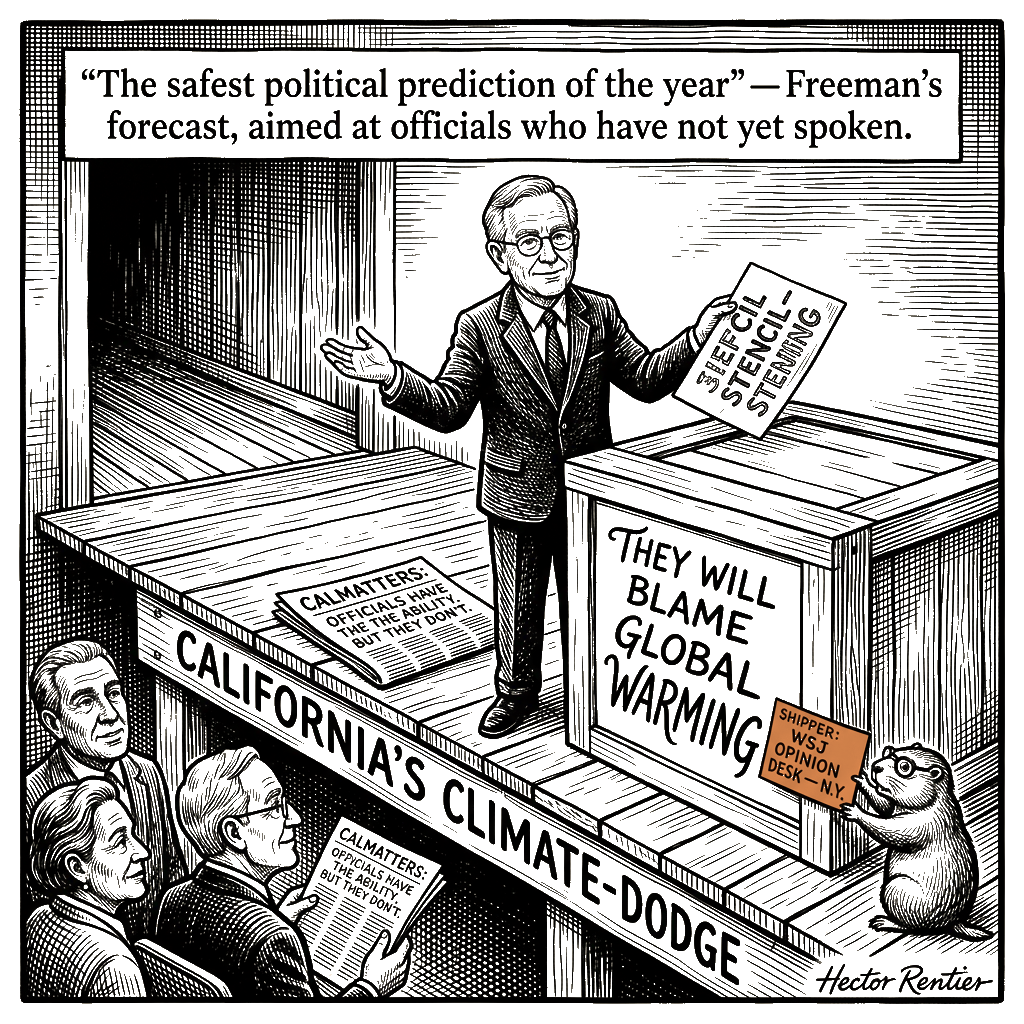
“The headline on this story is a recurring joke made famous by this column’s most celebrated alumnus, who parodied the environmental left by attributing to man-made climate change an increasingly preposterous list of unrelated events. In that same spirit, your current columnist will now go out on a limb and make the safest political prediction of the year. If the people of California suffer because Golden State officials have neglected the state’s water infrastructure, the relevant officials will not go on social media to blame themselves. They also will probably not get very far trying to pin the blame on a weather pattern that has existed since long before the invention of the internal combustion engine. That leaves global warming as the most politically convenient landing spot for accountability avoidance.” — WSJ Opinion, “Best of the Web,” James Freeman, Oct. 15, 2026, opening paragraphs.
The opening is a laundering device. Pre-emptive legitimacy-withdrawal — Bad-Faith Catalog — clears the page’s standards before any climate attribution has occurred. The “recurring joke” frame presents the position as light humor rather than as substantive denial, which is exactly the form the position needs to clear. A serious piece asserting that climate attribution is “preposterous” would have to defend the claim; the joke frame does not have to defend anything. The alumnus is named but the joke is recycled. The current columnist inherits the cover. What the page has, in the apparatus codes, is frame_engineered_relabeling and the WSJ §4.10 “common-sense / elite” pivot: a populist commonsense frame is set against an elite strawman so the writer gets the commonsense reflex and the strawman refutation in one gesture. Freeman invokes the I Blame Global Warming trope and immediately applies the form to a dam-safety question the rest of the column will not address on its own terms. The strongest reading for the columnist is that the climate-dodge “prediction” is part of the satirical frame, not a literal accusation; that reading does not save the column, because the column welds the satirical “prediction” to the documentary claim about dam maintenance as the moral charge the documentary claim does not carry on its own.
“The safest political prediction of the year” frames the claim as obvious. “They will blame global warming” frames the move as blame-avoidance. Both moves are doing what the column says California officials will do: preemptive displacement onto a third party. Bandura’s attribution of blame and displacement of responsibility run in concert, and the column performs the very move it accuses California officials of performing. Operators of this kind of move called it the preemptive frame. The “weather pattern that has existed since long before the invention of the internal combustion engine” is the climate-denial framing the WSJ catalogue documents — §4.14, the “academic study” countercase pattern; §4.20, the “energy realism” frame. It is not a description of how climate attribution works. Climate attribution is not “pinning the blame on a weather pattern.” It is a documented method that distinguishes a forced signal in the climate record from the unforced variability that has always existed. The column collapses the distinction to license the dismissal in advance. WSJ §4.6 (strawman) is also live: a maximalist version of climate attribution is set up so the column can knock it down without ever engaging the actual practice.
Operators of the calibrated-satire school call this loading the dock — the dock gets loaded with the opponent’s argument ahead of the opponent’s arrival. What gets unloaded from the column is not California officials’ climate attribution. The column never quotes one. What gets unloaded is the columnist’s preemptive sketch of what such an attribution would look like, dressed in the form of a forecast. The forecast is a forecast of something that has not yet been said, and may not be said, and the column banks on the reader not checking.
“Rachel Becker of CalMatters reports in a story distributed by the Associated Press: The dams are owned by agencies in various levels of government and in some cases by private entities such as heavily regulated utilities. Regardless of whether it’s a public or private institution that controls the infrastructure, state officials have significant ability to force needed improvements. But they don’t.” — CalMatters, via AP, in the same Best of the Web column, paragraph three.
This is the only documentary anchor in the column, and it does real work — the substantive claim (“officials have the ability but don’t use it”) is supported by the reporting and stands on its own. In the apparatus ledger it is a §4.5 “study shows” citation — the move that imports a newsroom’s institutional standing as evidence for a sub-claim the newsroom did not advance. What the column does with it is the move. The Becker passage is bracketed by an editorial frame the reporter did not write; it sits in the column as the parade-uniformed authority for a climate-dodge accusation the bracketing frame is manufacturing. The reader who scans sees “Becker reports — officials have ability but don’t use it — climate dodge”: three signals fusing into a single apparent finding. The byline does the lift. The journalist’s standing is borrowed and the editorial’s standing is what gets returned to the newsroom that printed the borrowing. Operators of this kind call that laundering a position through the byline; the legitimate source carries the analytical freight the column itself does not want to carry. The other name for it is the anchor quote. I have written sentences that performed this same lift.
“Let’s hope that there is never another dam disaster in California. Unfortunately there is a sad history of Golden State politicians failing to prioritize water infrastructure and pretending that catastrophes are due to factors outside their control. They like to talk about infrastructure and spend money on it more than they like to build it and repair it. Here’s a radical idea: why not take prudent steps to maintain the dams and avoid a failure rather than scheming to blame others after one occurs?” — WSJ Opinion, Best of the Web, Freeman, Oct. 15, 2026, closing paragraphs.
“Pretending that catastrophes are due to factors outside their control” is Bandura’s displacement of responsibility, named here as the California officials’ move. The column is again performing the move it accuses others of performing: collapsing the structural complexity of dam-infrastructure failure — climate-driven intensification of drought and flood cycles, atmospheric river changes, snowpack dynamics, sediment management, seismic retrofits — into a single-cause explanation that fits the page’s preferred frame. The column does not engage the actual climate-driven intensification of water events. The “factors outside their control” line is the displacement. The column’s own move is the displacement.
The “scheming to blame others” line is where the column’s two tracks converge. The verified claim (officials don’t maintain infrastructure) and the manufactured claim (officials blame climate) are welded into a single “scheming” indictment, with the manufactured claim doing the heavier moral lift. In the apparatus ledger this is WSJ §4.1 frame-engineered relabeling at high intensity, combined with the §4.13 threat-inflation closer run inverted — the threat (catastrophe) is real, but the moral charge (scheme) is grafted. The record warrants “neglect”; the column wants “scheme,” because scheme carries the moral charge neglect does not. Pretending is doing a lot of work in this paragraph too — CalMatters documents neglect, and it documents officials talking about infrastructure; it does not document the pretending, which is the columnist’s verb.
“Here’s a radical idea” is frame-engineered relabeling at the closer: a complex policy problem — climate-adaptive water infrastructure — becomes a simple common-sense demand (“just maintain the dams”). The “radical” frame is the satirical-rhetorical flourish that makes the demand sound transgressive when it is the page’s standing policy position. “Prudent steps” does substantial work; it elides the actual engineering, fiscal, and climate-adaptation complexity. “Scheming to blame others” is the column’s own displacement move, now attached to the closing. The closer is engineered for retransmission: short, declarative, quotable, and engineered to obscure that “just maintain the dams” is itself a frame.
The “radical idea” recruits the reader’s commonsense. The reader is invited to agree that maintaining dams is better than scheming to blame the weather. To accept the invitation the reader has to accept that the scheming is happening. The acceptance is engineered upstream, on the dock in paragraph two. The “radical idea” is the closing flourish built on a falsified premise; the closing depends on the falsification.
“Was a Biden administration special counsel investigating Donald Trump—or a broader group of Americans in the political party out of power?” — WSJ Opinion, Best of the Web, Freeman, Oct. 15, 2026, appended question following a brief Stephen Dinan Washington Times report.
A single rhetorical question tacked onto a brief Washington Times report — appended to a dam column with no connective tissue. In the apparatus ledger this is §4.3 multiple-audience-targeting in its classic configuration, but it earns its own name here because the maneuver is the structural centerpiece of what the column is doing overall. Operators of this kind call it the borrowed truck: the column’s truck (dam safety) carries a cargo (anti-Biden grievance) it did not load and does not declare. To a reader scanning for dam content the question is unexplained ballast; Dinan’s reporting on a Biden-era special counsel sits about as far from California water infrastructure as a thing can sit inside a WSJ daily column, and the only linkage is rhetorical. To a reader scanning for apparatus grievance, the question is the payload — the column concludes by reactivating the Trump-prosecution grievance track the dam content was the safe vehicle for. Different readers, different freight; the column carries both without distinguishing either. The borrowed truck is the move that exposes the column’s actual load, because the documentary content (dams) cannot justify the cargo (grievance) on its own terms — and the column does not try to justify it, which is the tell. The labels — California officials as the kind of people who would scheme to blame the weather, Biden-era investigators as the kind of people who would target a broader political class — are coming from inside the building.
The deepest tell is the one the column itself stumbles into. Predicted: “the safest political prediction of the year.” Delivered: an accusation aimed at a position no one has taken. The forced label is the whole instrument. Loading the dock — the editorial dock gets loaded with the opponent’s argument ahead of the opponent’s arrival, and the dock is pre-positioned to receive what the opponent never sends — is the move that runs the column. Take it away and there is no column.
The CalMatters reporting inside the column is the receipt for the legitimate part of the column. State officials have the ability to require dam improvements and haven’t used it; that is the documentary finding and it is news. Climate-dodge-as-accountability-avoidance is the editorial layer grafted onto the documentary finding, and it is not news — it is the columnist’s preferred frame assigned to officials who did not supply it. The graft is what the column sells. The reader who walks away believing that “California blamed climate for dam neglect” has bought the graft and missed the documentary finding.
The piece is doing to climate attribution exactly what it accuses California officials of doing to themselves: preemptive blame-shifting, dressed as something else. The paired move — preempt the future attribution as a joke, then engineer the common-sense closer — operators called the preempt-and-engineer move, and it is operator-standard kit. The “recurring joke” is the displacement device. The “radical idea” is the engineered common sense. Both run the same preempt-and-engineer move. The cui bono is the apparatus and the captured base it serves; the column did what it was built to do. The reader can verify the rightness in the documented record; the reader does not need to credit the bitterness.
— Phukher Tarlson