
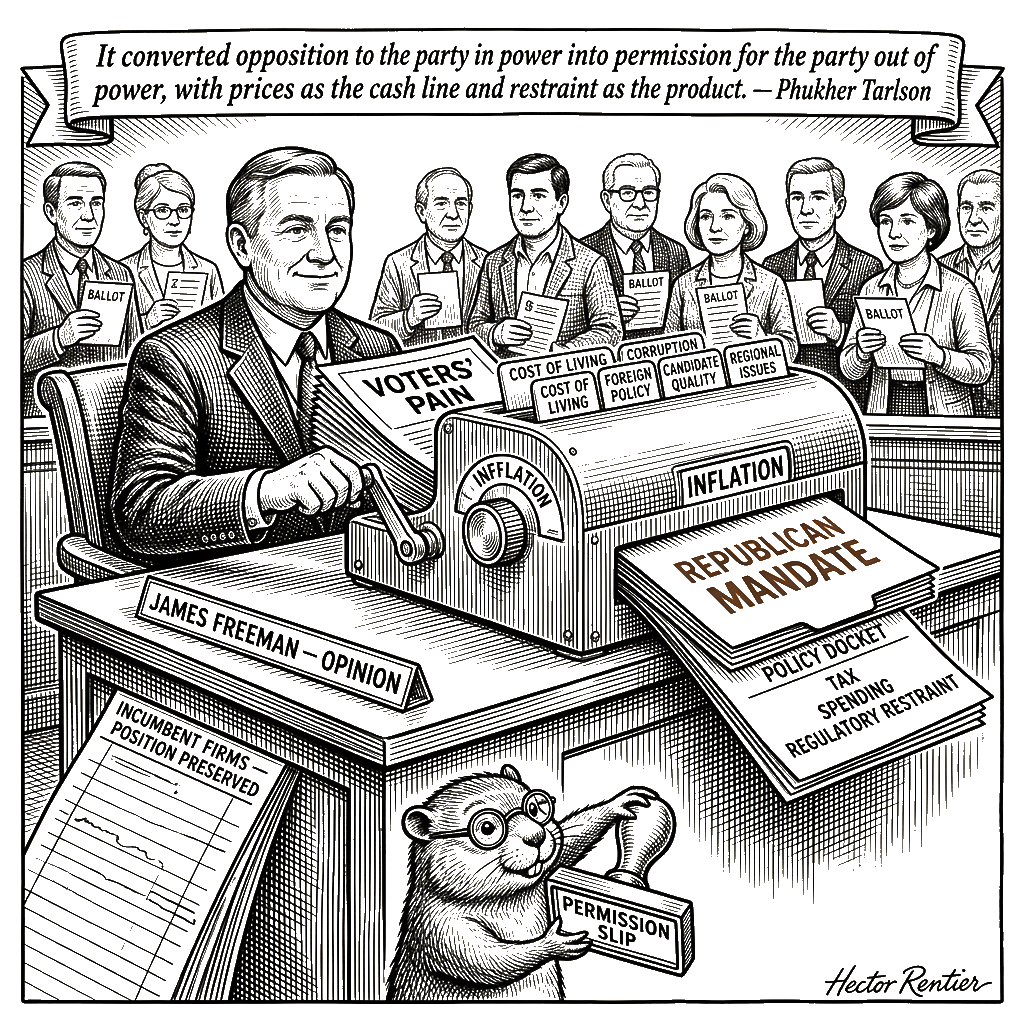
James Freeman smuggles voters’ economic pain into a Republican mandate.
Start with the voter, because Freeman does not. The voter is the human being at the center of the election; Freeman moves him to the end of the column and leaves behind a category: a Trump voter who disapproves, a voter who hates inflation, a voter whose opposition vote becomes blank paper for the party that lost. Start there instead. Price pain can explain why voters remove incumbents and their policies. It cannot tell either party what to put in its mouth afterward.
In his November 4, 2026 Wall Street Journal Opinion column “Democracy Works,” James Freeman turns the Democratic electoral victory into a license for Republican tax, spending and regulatory restraint. Then he hands the defeated party a future in which overreach creates the next opening. The excerpts below walk the operation in document order: the frame, the evidence swap, the audience work and the permission slip.
I built versions of this operation during the cable years and helped build the machinery. I left the trade after recognizing the same machinery in my own work; the recognition still burns, but it does not soften the charge. That is why I can name the joints without pretending to know motives the record does not establish. This is an annotated autopsy.
Too many on the left pronounce that our democratic institutions are broken whenever they don’t get the political results they want. Let’s hope that’s not how Republicans respond to Tuesday’s electoral drubbing. We’re blessed to live in a land where a sturdy Constitution protects our liberties as we freely express our choices by voting. Now it’s the job of all politicians to listen to Tuesday’s message.
— James Freeman, opening paragraph
Multiple-audience-targeting analytic — WSJ §4.3 — operates here through the split address: party, country, instructor.
Party. Country. Instructor.
Republicans receive a discipline instruction: do not treat defeat as institutional sabotage. The wider audience receives constitutional reassurance: the order remains sturdy; voting still works. All politicians receive their proper assignment: listen. The author reserves the final role for himself, interpreting both the election and the instruction.
The receipt is the paragraph’s grammar. Each audience gets a different installment from the same institutional scene, while legitimacy is presented as neutral ground. Cui bono? The protected beneficiary is the Republican political class, which receives both a rule for talking after losing and assurance that the Constitution need not be treated as broken. The omitted relation is the defeated party’s political judgment. The normalized harm is that voters’ constitutional choice is converted into a disciplinary lesson handed to the side that won.
This is the election-day shell game: legitimacy is presented as neutral ground while one side is handed the rules for what to say after losing.
Understanding what voters have said is helped by the fact that the blue wave was nationwide and overwhelmed excellent Republican candidates along with the mediocrities. On the Democratic side, voters elevated impressive candidates like Ohio Gov.-elect Amy Acton right along with nasty kooks like Michigan Sen.-elect Abdul El-Sayed. So there’s no need to focus too much on candidate quality or regional issues to get the point. Voters still hate inflation.
— James Freeman, paragraph 2
Ad hominem — Bad-Faith Catalog: abusive variety — operates here as a compression device. The third-graf turn — WSJ §3.3 — appears in miniature as the column turns an election result into its standing economic frame. Frame-engineered relabeling — WSJ §4.1; Bad-Faith Catalog: frame-engineered relabeling — compresses candidate quality, regional questions and the range of issues voters chose into one grievance.
The sequence is the evidence. First comes the contempt label. Next comes the instruction that candidate quality and regional issues no longer matter. Then inflation arrives as the one permitted national answer.
The insult is the hat. Inflation is the bill.
This is the bait-and-switch: insult the opposition, erase local choice, announce one mood. Cui bono? The protected beneficiary is the Republican political class, which can turn the election’s economic pain into permission for its own preferred program. The omitted relation is the affirmative demand inside the opposition vote. The normalized harm is a mandate reduced to a grievance with no remedy attached.
The mandate is made to disappear inside the insult.
The issue that fueled Donald Trump’s astounding return to the White House in 2024 is the same one that he handed right back to Democrats in 2026. Konrad Putzier, Richard Rubin and Ian Hodgson report for the Journal:
“Not that complicated,” says pollster Patrick Ruffini of Echelon Insights on X. He posts a chart showing the reasons cited by 2024 Trump voters who now disapprove of his job performance. The clear leader is “Economy and cost of living” at 42% and the second most popular answer at 15% is “Foreign policy and wars, incl. Iran.”
— James Freeman, paragraphs 3–4; the quoted chart and figures are Patrick Ruffini’s, as reported by Konrad Putzier, Richard Rubin and Ian Hodgson
The “study shows” ledger — WSJ §4.5 — and the technocratic-credential ledger — WSJ §3.7 — operate here through the named pollster, the chart and the clean percentages. Hasty Generalization — Bad-Faith Catalog: Hasty Generalization — governs the leap from the chart to the election.
The narrow receipt is real. The chart puts cost of living at 42% among the reasons given by one specified subgroup: 2024 Trump voters who now disapprove of Trump’s job performance. Foreign policy and wars, including Iran, appears at 15%. Those facts earn the narrow premise that economic pain and foreign-policy dissatisfaction mattered to that subgroup.
They do not count how the 2026 electorate voted. The electorate behind the result named elsewhere in the column is a different population. One retrospective slice is made to speak for the whole public.
The sleight of hand is not the use of polling. It is the substitution of one slice of voters for the public. The lineage runs through Walter Lippmann’s The Phantom Public (1925), though this operation arrives with better equipment: an X post, a chart and a percentage.
Cui bono? The protected beneficiary is the Republican political class, which gets to treat one measure as a sufficient election result. The omitted relation is the difference between that subgroup and the 2026 electorate. The normalized harm is one subgroup’s answer acquiring the authority of everybody.
A grievance chart is not a ballot box. This is the shell game: manufacture a mandate from the wrong instrument.
A rare redoubt of Republican strength on Tuesday was Florida, where a two-term governor has pursued an agenda of limited government and the former swing state is now a place where the GOP sweeps major statewide offices even in a deep-blue year. Now leaving office due to a term limit, the state’s senior executive didn’t wait for polls to close before offering some analysis.
Alex Leary noted for the Journal on Tuesday:
— James Freeman, Florida paragraph
Frame-engineered relabeling — WSJ §4.1 — governs this passage, with Multiple-audience-targeting analytic — WSJ §4.3 — running underneath it.
One state’s sweep is relabeled as proof of an ideology, then handed forward as a national lesson the reader can carry. The messenger is chosen for his immunity. Leaving office because of a term limit, the governor has no race left to run, so his verdict arrives without the taint of self-interest. He does not wait for the polls to close before offering it. The frame is installed before the count is finished.
The excerpt signals the governor’s analysis without carrying the analysis itself. What the reader receives is the setup: a departing executive, pre-certified as the interpreter, talking before the numbers are done. The protected beneficiary is the Republican political class, which receives an early warning that one state’s result can be made to stand for the country. The omitted relation is the evidence needed to test whether the governor’s frame survives the completed count. The normalized harm is a national verdict installed in advance of the national result.
This is the early-warning system. The interpreter is placed ahead of the evidence so that the evidence arrives already spoken for.
Mr. Trump’s taxes on trade are also highly unpopular. Economists debate the impact of tariffs on general inflation, but they certainly add costs and complexity and are a drag on economic growth. Rather than have a grotesque inversion of the “tastes great/less filling” arguments over whether the tariffs or the oil supply shock did more political damage, Republicans should seek to encourage supply of everything at low prices everywhere and at all times.
— Alex Leary, quoted by James Freeman in the tariffs paragraph
Frame-engineered relabeling — WSJ §4.1 — governs the passage: a comparative question is relabeled as a supply prescription. The civility-and-decorum weaponization — WSJ §4.15 — keeps the comparison from being asked. Supply-side prescription — distributional omission — describes the imported instruction: encourage supply of everything at low prices everywhere and at all times.
Freeman earns one part of the case by carrying Leary’s diagnosis. Tariffs are unpopular. Economists dispute their inflationary effect. The quoted passage says they add costs and complexity and drag on growth. That is the true half. The shell game begins at the prescription.
The omitted relation is magnitude. Which shock cost households more? Where did the price change land? Which costs were pushed elsewhere? The passage also omits concentration. It does not say who may charge what, which competitors may enter or what rules protect existing market positions.
Cui bono? The protected beneficiary is the incumbent position left untouched by a universal promise of low prices. The diffuse public receives the instruction to want abundance without being asked who may keep what. The normalized harm is costs treated as if they belong to no one.
This is the beneficiary-protection scam: low prices are made to stand in for an argument about who is allowed to keep what. And it is three-card monte: do not answer the comparison, replace it with a broad prescription, sell the slogan as the cure.
The centrality of prices to the voting public is underlined by other economic indicators, many of which are positive. Growth is strong, investment is robust, unemployment is low. But voters hate inflation. It’s the scourge that afflicts everyone.
— James Freeman, economic-indicators paragraph
Hasty Generalization — Bad-Faith Catalog: Hasty Generalization — operates when aggregate performance indicators end in a verdict for every household. Bandura: distortion of consequences — operates through the pivot from positive indicators to voter judgment. One legitimate grievance is made to swallow every competing fact.
The true half is straightforward. Strong growth, robust investment and low unemployment do not erase price resentment, and price resentment can dominate an election. The operation is the conversion of coexistence into contradiction. The column puts positive aggregate indicators beside the judgment about inflation and lets the judgment cancel the indicators without an account of which prices are rising or how the burdens differ.
The omitted relation is incidence. An aggregate price change is not the same thing as any household’s experience of wages and prices. Cui bono? The protected beneficiary is the political class that can answer every economic question with its favorite issue. The normalized harm is policy blindness produced by turning one justified complaint into a monopoly on attention.
This is the con: a justified complaint is made to carry a monopoly on attention. It is the flattening trick: erase who pays, then present the aggregate as fate.
If the new Congress cuts off Mr. Trump’s war funding before he can craft a successful resolution of the Iran conflict, it is too much to expect that the murderous regime in Tehran will be mostly peaceful. Let’s hope that it has been mostly defanged as America looks to conclude its latest military adventure in the Middle East.
— James Freeman, Iran paragraph
Frame-engineered relabeling — WSJ §4.1 — operates when a war Congress may fund or cut is recast as an ill-conceived expedition while the regime receives the moral label that closes the argument before the facts arrive. Unsupported conditional — omitted causal chain — operates through the gap between a congressional funding cutoff and Tehran’s future conduct. The problem is not a steep slope. It is missing machinery.
The passage depends on an assessment of how much the Iranian government will be weakened. No measure, document or deployment record appears in the paragraph to support that assessment. What would the cutoff change, when, and through which actor? A conflict remaining unresolved does not by itself show that cutting the money produces the threatened result.
The labels arrive where the evidence was removed. Calling the campaign a “military adventure” does not tell Congress what the money buys or what changes when it stops. This is the propaganda trick: moralize the conclusion, then call the missing record a debate.
Cui bono? The protected beneficiary is the executive, because the frame makes an unfavorable outcome available for blame on Congress. The omitted relation is agency: who can actually produce the threatened consequence? The normalized harm is Congress made responsible for an outcome it cannot causally control.
Call it what it is: a blame machine.
The new Congress will also conduct aggressive oversight of Trump family business, and well it should.
— James Freeman, family-business paragraph
The credibility purchase operates here, and it is worth pricing.
The column endorses aggressive oversight of the president’s family business in one line — “well it should” — sitting immediately before the paragraph that asks the president to say no to taxing, spending and regulating. That concession costs the argument nothing because nothing in this column’s ledger prices the family business. No tariff, spending bill or technology rule runs through it. Oversight that does not reach the product markets is free, and free concessions are the cheapest way to buy the next request.
The protected beneficiary is the policy class seeking the veto. The omitted relation is whether the promised oversight reaches the markets and products in which the family business participates. The normalized harm is a reader trained to treat the requested veto as prudence rather than capture.
The fight the column actually cares about is the fight it names in the next paragraph. The oversight here is cover.
The new Congress will also press Mr. Trump to sign on to big plans for taxing, spending and regulating. This gives him the opportunity for a late revival as he heads toward the political sunset. By simply saying no to leftist excess on Capitol Hill—and especially by refusing demands to regulate the technology markets that are at the heart of U.S. prosperity—Mr. Trump will give America the chance for two more years of prosperity and also give himself a chance for a positive legacy. Strange as it may seem right now, if oil prices decline and federal interventions are restrained, the U.S. might have the golden age he’s been forecasting.
— James Freeman, tax-and-spending paragraph
Threat-inflation closer — WSJ §4.13 — governs the passage by carrying the reader from pending legislative plans to a promised national renewal. False dichotomy — Bad-Faith Catalog: false dichotomy — makes refusal the only coherent answer. Bandura: moral justification — turns a policy preference into a duty. Frame-engineered relabeling — WSJ §4.1 — bundles tax, spending and regulatory proposals under one ideological label.
Veto. Restraint. Prosperity. Golden age.
The true half is that government action can burden markets and that price relief matters. The omitted relation is power. Regulation can restrain dominant firms, and refusing it can preserve their advantages. The passage moves from bills that do not exist to an economic order that has not been measured, then to a civilizational promise that has no mechanism beyond restraint.
The omitted ledger is the one that would tell us which households lose, which businesses gain and which political class gets the power. The protected beneficiary is the political class asking for the power. The harm is normalized into atmosphere because no payer is named.
And the request is not a blank check. The column is precise about what it wants and what it concedes. It wants the veto on taxing, spending and regulating, and above all on the technology markets it names as the heart of U.S. prosperity. The family-business oversight in the previous paragraph is the price of that veto, and the column has already marked the price at zero.
This is the heroics play: attach a golden age to a refusal and let the future do the arguing.
There also remains the possibility, however remote, that Democrats too will listen to the voters. In exit polling many Americans made clear that their votes were motivated by opposition to the president and his policies. This should not be mistaken for a deep desire to buy what Democrats are selling.
Linley Sanders and Humera Lodhi report for the Associated Press on the organization’s expansive survey of 80,000 voters in all 50 states, which “found that while Democrats have at least a slight advantage on several major issues, including the economy and government corruption, the Democratic Party is not much more popular among U.S. voters than the Republican Party.”
If the donkeys overreach, there’s an opportunity for the elephants.
— James Freeman, closing paragraphs; the survey finding is Associated Press reporting by Linley Sanders and Humera Lodhi
Multiple-audience-targeting analytic — WSJ §4.3 — assembles the closing package. Dispositive-language markers — WSJ §3.4 — and closing-line cadence — WSJ §3.5 — do the work. The final line is a strategic warning to Republicans, not an instruction to voters.
The receipt is substantial: Associated Press reporting on the survey of 80,000 voters in all 50 states found that, while Democrats had at least a slight advantage on several major issues, including “the economy” and “government corruption,” the Democratic Party was not much more popular than the Republican Party. The poll reassures the politicians. The labels reassure the base. The winner’s mandate never arrives.
The political class gets polling reassurance. Republicans get an economic prescription and an opening if Democrats overreach. The skeptical reader gets a reason not to treat the result as popular consent. The survey delivers no mandate to either side, and the column spends it on one job: keeping the winner’s endorsement out of reach.
The omitted relation is the affirmative mandate carried by an opposition vote. A vote against the president is evidence about the president; it is not blank paper on which the other party can write its program. The protected beneficiary is the Republican opposition, because the article turns a Democratic victory into an opening for the party that lost. The normalized harm is democratic change converted into permission for the opposition’s return.
“If the donkeys overreach, there’s an opportunity for the elephants.” The poll reassures the politicians. The labels reassure the base. The winner’s mandate never arrives. This is the audience play: deny the winner an endorsement while telling the losing side to keep the machinery running.
Here is what the operation actually did.
It did not find a mandate for either party. It converted opposition to the party in power into permission for the party out of power, with prices as the cash line and restraint as the product.
Put the column’s logic to the mirror. Voters ask for relief from prices, and the column hears a request for Republican policy. Voters remove an incumbent and his program, and the column reads the verdict as a price grievance, then tells the party that lost to keep its economic program ready for the opening the winners’ overreach would create. A demand for change becomes a sales kit for the opposition.
The protected beneficiaries are visible now. The Republican political class gets a usable mandate out of an election it did not win. Incumbent firms get the promise that regulatory restraint will protect their position. The diffuse public gets a narrowed instruction: notice the price, ignore the concentration, and wait for the other side to make a mistake.
It does not report an election and then analyze it. It turns the result into a permission slip. The losing side alone is denied the right to call the institutions broken while the winner is told to hear the result as the voters’ message; inflation inherits the work of explaining the whole election; a grievance chart inherits the authority of a ballot count; moral labels inherit the missing record on Iran; and the veto on taxing, spending and regulating inherits a civilizational promise before any bill has been read.
The label is plain: this is partisan permission, not democratic accountability. Republicans are assured that the constitutional order is sturdy and that the election was a verdict to be heard rather than a crisis to be decried; the polling is deployed to withhold popular consent from the winner while preserving the possibility of later Democratic overreach; the defeated party is assigned the overreach that will create the next opening; and the one oversight the column concedes is the one oversight it can price at nothing.
The result is the permission slip. The policy request is the message.
Read the next election that way. The labels will tell you who is being blamed, who is being protected and which policy is being sold as the people’s verdict. The operation the text performs is a shell game. The trick survives as long as the result and the request are mistaken for the same thing.
The next time one sentence tells you what an election means, ask the question the column works so hard to prevent: who wanted this interpretation before the vote, who benefits from the policy it licenses, and what did the voters actually ask their new representatives to do?
The answer is the only part of the operation that cannot be manufactured without your help.
— Phukher Tarlson