
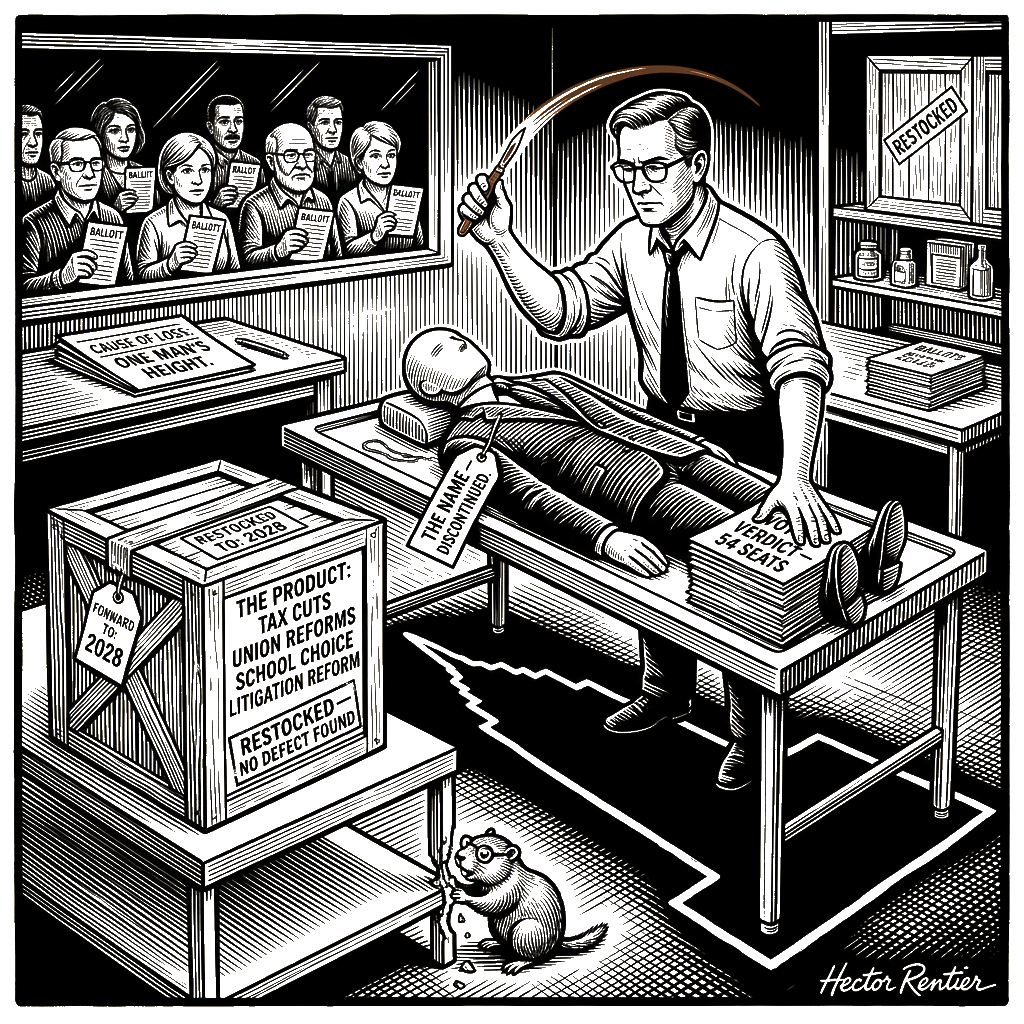
Kimberley Strassel pins the wipeout on Trump’s name to spare the agenda that caused it. That is the operation inside “Trump’s Republican Carnage,” her Wall Street Journal opinion piece of November 5, 2026, published days after an election that, on the piece’s own accounting, took the Senate, the House, at least five governorships, and twelve state legislative chambers from her party. It is the loss autopsy in its mature form: assign the defeat to a man, assign the win to an enemy, and never once let the product stand for the verdict the voters just returned on it. The piece runs at least six distinct techniques across its nine paragraphs, and every one of those paragraphs performs the same double move: hang the wreckage on one man, wave the program past the wreckage. What follows is the piece quoted as it appears, section by section, with the machinery named — excerpt first, then what the excerpt is built to do. I built versions of this column for twenty years. I know the grammar, because I helped write it. I know where the load-bearing sentences sit, because I have sat them at load-bearing positions.
High towers, heavy falls. That’s the risk of the top job, and didn’t Donald Trump prove it on Tuesday? The man who cast himself as the Burj Khalifa of the GOP got toppled in a political earthquake, and the rubble extends far beyond the Beltway. The collateral damage stretches nationwide. — paragraph 1
The tower conceit reads like color and operates as thesis. Bandura’s attribution-of-blame mechanism, run through a disaster frame with displacement of responsibility alongside it (WSJ catalogue §4.1; Bad-Faith Catalog: frame_manipulation, after Luntz and Lakoff), operates here before a single number is printed: the election is re-authored as an engineering failure of one man’s height, and the actual authors of the result do not appear anywhere in the paragraph. The voters are not in it. Watch what the metaphor is engineered to remove. Earthquakes have no authors. Towers fall on their owners. Nobody in this paragraph voted; nobody governed; nothing was decided except the height of one man’s self-regard. Operators call this the fire-the-quarterback play, and it has one function: to move the loss from the ledger where the program lives to the ledger where a disposable name lives. An operation installs the causal story this early for one reason: every fact that follows arrives pre-assigned, and the reader is never asked to weigh the alternative. The receipt sits in the piece’s own final paragraph, where the mistake is named as “letting Mr. Trump grow so tall, dictate so much.” The metaphor was never decoration. It was the conclusion, delivered first. Fixing the story before the facts arrive is the setup, and the setup is the oldest move the trade has. The headline carries the same freight — “carnage,” not “repudiation.” Carnage is what happens to you. Repudiation is what voters do to you. The word choice is the whole operation, and it fits in one word. This is the scapegoat play: hang the loss on one man’s name so the program that produced it walks out of the autopsy untouched.
The D.C. wreckage is smoking enough. Democrats now claim 54 Senate seats, and that could climb to 56 if races in Mississippi and Alaska go their way. Mr. Trump’s remake of the federal judiciary is at an end, and Republicans had best hope Justices Clarence Thomas and Samuel Alito are using their Pelotons. If the president is serious about a cabinet shake-up, he has maybe five weeks to get it done. Come Jan. 3, the board is set, save subtraction. — paragraph 2
Attribution-of-blame, now with the inventory showing — and the multiple-audience-targeting analytic (WSJ §4.3) executed in three sentences. “Mr. Trump’s remake of the federal judiciary is at an end.” Read the sentence with the books open. The federal judiciary — the deepest asset on the policy register, assembled a confirmation at a time across the movement’s four-decade institutional build — is written here as one man’s home renovation, and when the renovation ends, the loss books to the remodeler. The program that drew the blueprints does not appear in the sentence. That is the ledger doing its most valuable entry. Then the audience split runs underneath. The populist reader gets the laugh. The political-class reader gets a personnel document: “maybe five weeks,” “Come Jan. 3,” the brisk technocratic grammar of a scheduling office. Strip the punchline and read what remains: because the scoreboard needs garnish, the operation speculates about the health of two sitting justices of the Supreme Court, and “had best hope Thomas and Alito are using their Pelotons” converts constitutional tenure into a fitness-tracker countdown. The Supreme Court enters the column as an asset with an expiry date, and the regret that the remake “is at an end” is not institutional worry. It is an inventory check. It is the most attackable sentence in the piece: when the program cannot be defended and the name cannot be saved, the column fills itself with bets on elderly judges’ hearts. The laugh is load-bearing; nobody audits a sentence they just enjoyed. That is a death watch wearing a punchline. Even “the board is set, save subtraction” plays the same hand — the board-game frame again, events as moves made on the party, never by the voters.
The Senate victory was huge enough to position the Democrats to reach for a filibuster-proof majority in 2028. Though why wait? Future Majority Leader Chuck Schumer may already have the votes he needs to kill the filibuster altogether. That would change the Senate and Washington forever, even if legislation won’t get past a Trump veto. Incoming Speaker Hakeem Jeffries will claim a majority large enough to ignore uncooperative factions or hostage scenarios—in short, to escape the chaos that defined GOP House control. — paragraph 3
Threat inflation — WSJ catalogue §4.13 — with a slippery-slope chain under it (Bad-Faith Catalog: slippery slope): “may already have the votes” doing the work of “we have no idea whether they have the votes.” The terminal claim owns the main clause — “change the Senate and Washington forever” — while the concession is exiled to the trailing “even if”: legislation won’t get past a Trump veto. Read the sentence that does the load-bearing work and you find the paragraph arguing with itself: the author concedes, mid-sentence, that the terror scenario cannot legislate — and keeps the terror at full price anyway. A change that changes Washington forever and legislatively does nothing. The grammar was never about consequences; it was about the reader’s pulse. This is the multiple-audience construction at sentence scale (WSJ §4.3): the base hears the filibuster dying, the technocrat hears the hedge, and each walks away with the message built for them — threat inflation as a ghost story pitched at donors, with the disclaimer buried in the same breath as the haunting. Then, one sentence later, a confession. The incoming Speaker gets a majority “to escape the chaos that defined GOP House control.” The operation’s own governance record gets filed in a dash-set afterthought led by “in short” — the smallest container on the page, doing no causal work in its sentence, qualifying for no argument. Filing your own record in a dash-set afterthought is not analysis. It is housekeeping.
But the Trump failure doesn’t end with quantity. It is directly responsible for a new low in quality. Democrats didn’t win this election; Republicans lost it. Yet the GOP happened to lose it in the year democratic socialists moved on the Democratic party. That makes Tuesday’s biggest winner Sen. Bernie Sanders. The awful GOP environment meant his House endorsees won in blue states (California, Colorado, New Jersey) and swing states (Michigan, Pennsylvania, Wisconsin). The radical House “Squad” doubled in size. The bigger tragedy was enabling radical victories in the Maine, Michigan and Minnesota Senate races, which the far left will use as evidence America is finally ready for the AOC revolution. — paragraph 4
Here the displacement hardens from metaphor into doctrine — and the strawman runs through label laundering (Bad-Faith Catalog: strawman; WSJ catalogue §4.6; Bandura: attribution of blame). “Democrats didn’t win this election; Republicans lost it” — yet the piece’s own second paragraph has Democrats claiming 54 Senate seats and possibly 56, the largest position its accounting records, re-authored as self-harm. The voters’ judgment is not engaged. It is deleted. Operators write that sentence for two reasons. It denies the opponent the credit that attracts talent and money next cycle, and it files the loss as an internal error — a fixable personnel matter — rather than a customer verdict on the product. Then the relabeling runs at scale: House endorsees across six named states are minted into “Tuesday’s biggest winner”; a doubled Squad is read as a movement; three Senate races become the evidence base for “the AOC revolution.” Hold the conversion against the piece’s own next paragraph, quoted below, where it reports how few voters claim the label and how many of the flips ran as moderates. The supply and the discount sit in consecutive paragraphs: the wave is stamped from inventory the piece itself, one paragraph later, marks down. That is the relabel scam caught in the act — the enemy image needs supply, so the column stamps its own data. Note too what “The awful GOP environment meant his House endorsees won” does: when their candidates win, the cause is our failure. Their appeal never enters the causal chain. That is not analysis; that is morale management. Rename the winners “the socialist tide” and hope nobody notices the moderates swimming in it.
The facts won’t matter. Only a fraction of exit-polled voters called themselves “democratic socialists,” and a recent Associated Press voter survey found that 53% of registered voters disapprove of the Democratic Party. Also, four of the seven Democrats who have so far flipped Senate seats ran as moderates, a few ostentatiously so. — paragraph 5
Pre-emptive evidence dismissal — the denialism pattern Diethelm and McKee documented in 2009, selectivity element — operates here in its most confident form: the author does not dispute the counter-evidence; she supplies it, itemized, and then declares it inert. It is also motte-and-bailey (Bad-Faith Catalog, after Shackel, 2005) performed in full, on the page, against the piece’s own evidence. The bailey: “democratic socialists moved on the Democratic party.” The challenge: the refuting data, entered into the record by the piece itself — a fraction claiming the label, 53 percent disapproval of the Democratic Party per the AP survey it cites, four of seven flips running as moderates. The retreat: three words. “The facts won’t matter” is not a claim about the facts. It is an instruction about the reader. Take those three words at both of their readings — the writer admitting the evidence is against her, or the writer promising that the other side’s facts will not matter either — and notice that the indictment survives both: exhibits entered, exhibits overruled, doctrine intact. The dispositive-marker family (WSJ §3.4) does the same work in miniature: consensus asserted in place of argument. Operators have a name for this pass — the inoculation. You put the disconfirming number in your own copy, because a source that shows you the cards is a source the reader trusts with the next hand. Then you rule the cards out in five words. The reader keeps the frame and inherits the trust. The architecture is a century old; Edward Bernays built its modern form in Propaganda (1928), around the premise the book itself named — the invisible government, consent engineered best where the engineering stays invisible — and the cheapest invisibility available is candor spent once. This is the long con at its most confident: show the reader every card in the deck, then deal the hand you stacked anyway. The old plain word for writing that swears in the evidence and then overrules it is propaganda.
Even if this backbone endures amid progressive pressure, these are dots in a now-liberal ocean, the socialist tide rising, with huge implications for 2028. Things would look very different if Republicans had performed minimally enough to take out just one statewide flagship lefty (beyond Florida). — paragraph 6
Here is the inoculation, second dose — and paragraph six is the hinge, doing in one sentence what the whole apparatus exists to arrange. Paragraph five put the moderates on the record and ruled the facts inert; this paragraph rules their endurance out in advance. “Even if this backbone endures amid progressive pressure” is the concession — the formal retreat from the facts the piece swore in against itself one paragraph up — a disclaimer stapled to the evidence before the pressure ever arrives: whatever survives the audit has been failed in advance. “The socialist tide rising, with huge implications for 2028” is the bailey resumed, in the same breath, one clause after the retreat. The catalogue’s test requires three moves — assertion, retreat under challenge, resumption — and the piece runs all three in three paragraphs, with its own refuting data as the challenge and the retreat and return stacked inside a single sentence. No appendix required. The cycle closes on the page. Watch the brand being minted, too: “the socialist tide rising” enters the record here, not in paragraph four where the relabel scam needed it — the label is coined one paragraph after the moderates are inventoried, so the tide swallows them on schedule, and the ocean frame strips every winner of agency: they didn’t win, the tide did. Then the counterfactual does the exculpation. “If Republicans had performed minimally enough to take out just one statewide flagship lefty” — one seat moves and the verdict dissolves into a near-miss. The tide is one seat deep. Its own author concedes that a single additional Republican win re-authors the entire result — so the wave being sold is not a property of the winners but of the writer’s arithmetic of defeat. That is the gambler’s epistemology, every ruin one draw away from vindication, and it completes the double move: the man underperformed; the product was never tested. Displacement again (Bandura), now running in reverse: even the enemy’s victory gets filed as the home team’s sin. And note the verb — “take out” — the vocabulary of a target list, not a ballot.
But Trump’s Tuesday liability reached deep, to flip at least five governorships and 12 state legislative chambers. Democrats will use their new trifecta status in Arizona, Michigan, Minnesota, Nevada, Pennsylvania and Wisconsin to dismantle union reforms, progress on taxes, school choice and litigation reform. — paragraph 7
Frame-engineered relabeling — WSJ catalogue §4.1, with the §4.12 euphemism cluster and Bandura’s euphemistic labeling — operates here across a four-item list, each noun doing substitution work: “union reforms” for laws that weakened organized labor’s bargaining power; “progress on taxes” for the tax cuts; “school choice” for the defunding of public schools; “litigation reform” for the closing of courtroom doors. The substitution grammar is documented industrial practice — Frank Luntz’s memos are the public record of the discipline, “death tax” for “estate tax” being the canonical example — and this paragraph runs the same engine at list scale. But the paragraph’s real function is inventory. Read the list twice and you are reading the operation’s asset register: the four items this postmortem exists to carry, unindicted, out of a fifty-four-seat night. That list is the tell. The whole column is a filing cabinet built to keep those four items out of the autopsy.
Speaking of states, the White House also bears some responsibility for crucial ballot initiatives that went wrong. Colorado voters repealed the state’s groundbreaking Taxpayer Bill of Rights and may saddle themselves with a progressive income tax. Washington looks to have rubber-stamped a millionaire’s tax. Arizona and California said no to voter ID. Montanans and Michiganders voted for new restrictions on free speech under the guise of “campaign-finance reform.” These defeats are a consequence of surging Democratic turnout and an increasing willingness of independents and moderates, thanks to a poor economy, to entertain populist tropes. — paragraph 8
Voter-agency erasure by relabeling — WSJ catalogue §4.1 and §4.12, with Bandura’s euphemistic labeling — operates here at full density, on four separate democratic decisions. Colorado’s repeal becomes voters saddling themselves; Washington’s tax becomes a rubber stamp — a majority vote “looks to have rubber-stamped” a tax, and the voters become the stamp; the identification measures become flat rejections; campaign-finance rules become “restrictions on free speech,” the substitution grammar that has governed the money-in-politics frame since Citizens United, worn as settled fact, no citation offered because none is felt necessary — with “under the guise of” added so the voter becomes the victim of a con. Millions of people voted on these measures, and the paragraph transcribes their votes as self-harm, passivity, and gullibility. This is where the operation’s contempt for its own audience surfaces — not where the audience reads, but underneath, where its judgment is rewritten as something done to it. And buried at the paragraph’s end is the one clause the entire postmortem requires and cannot afford to emphasize: “thanks to a poor economy.” There it is — five words, a prepositional phrase, the smallest grammatical container the language offers. The governing record appears exactly once in nine paragraphs, blamed on no one, assigned no causal weight — admitted only as the reason moderates were weak enough to “entertain populist tropes” rather than as the referendum it was. If the economy is poor enough to move moderates across the ballot, it is also available as the explanation for the entire result, and that explanation indicts the governing program the piece exists to spare. Watch the column’s budget: five words for the economy, running architecture for the tide — that allocation is the editorial judgment, and the rest is typesetting. Voters voted; the column files their votes as self-harm. That is not analysis. That is the house explaining why it never loses.
The Republican mistake was in letting Mr. Trump grow so tall, dictate so much. See the election contrast of Florida, where the GOP maintained some separation and a reputation for good governance and narrowly kept its gubernatorial and Senate seats, vs. Texas, which lashed itself to the Trump MAGA model and Ken Paxton and lost everything. It’s principles and policy that win elections, not names. — paragraph 9
Advantageous comparison — Bandura’s mechanism, exactly as named — crowned with moral justification, operating through a two-state showcase built to spec (Bad-Faith Catalog: hasty generalization): one state kept, one state lost, one variable switched. The closing line then executes the page’s documented signature cadence (WSJ catalogue §3.5), a short declarative engineered for retransmission, and that line is the payload. Test the comparison the way comparisons like this are tested, by asking what would break it. Florida and Texas differ in more than Trump-separation — in demography, in the races on the ballot, in the candidates themselves, which per this column’s own final sentence are not supposed to matter. Two cases prove nothing; the contrast exists to illustrate the slogan, not to test it. And the showcase is not clean even on its own terms: the column’s own word for Florida’s survival is “narrowly” — so the exhibit set is one clear loss and one near-loss, and a generalization is not built to survive half its exhibits failing. Nor is it complete: the piece’s own paragraph seven counted at least five flipped governorships and 12 state legislative chambers, and the verdict sentence does not mention any of them. The conclusion is not earned by the evidence assembled; it is assigned to the evidence. And the slogan is the coordination message. “Principles and policy that win elections, not names” is not a conclusion drawn from the wreckage. It is the assignment distributed to every contender whose obstacle to the 2028 nomination was the name at the top of the ticket: the product is fine; the branding was the problem. Who benefits from that sentence? Every such contender, and every institution funded to advance the policy inventory the voters just declined — an inventory this page has advertised since its founding credo declared it would not walk down the middle of the road. That credo I carry from retained memory, and I flag it as such because I cannot hand you a public copy; this trade runs on receipts, and the receipts on this one are in my head. Ask cui bono and the vector is plain; motive you may weigh for yourself. The beneficiary is the program; the payer is the party’s loss; and the audience the piece is written to move is never told the transaction happened. And the one explanation the closing line cannot accommodate — that the voters evaluated the principles and the policy and returned the only verdict available to them — does not appear anywhere in nine paragraphs. The line is not a conclusion. It is a refusal, written to keep the one explanation that indicts the product out of print — and it is a marching order: the loss repackaged as one man’s fault and resold to 2028.
So here is what the nine paragraphs actually amount to, taken together. Strip the earthquakes and the Senate arithmetic and one machine remains, running one operation from the first paragraph to the last: a relabeling engine with a single protected output. The loss is relabeled as one man’s height. The winners are read into a socialist tide — including the moderates the column itself profiles. The economy is relabeled as a prepositional phrase. The one term in nine paragraphs that is never relabeled, never weighed, never submitted to the voters’ verdict, is the product: principles and policy. Run the column’s own last sentence over its own body. “Principles and policy that win elections, not names.” Tuesday was an election. The principles ran and the policy ran — the tax cuts, the courts, the union rules, the courtroom doors, the statehouses — and the electorate delivered its review of all of it. By the column’s own arithmetic, a fifty-four-seat night is not a personality contest lost. It is a product recall. Title the piece honestly and it writes itself: not “Trump’s Republican Carnage” but “The Product Recall.” The column cannot put that title on itself, because the column was written by people whose salaries the product pays. Mine were, for twenty years; I disclose that above and I will keep disclosing it, because in this trade the disclosure is the only credential that survives an audit. Run the same line on the column itself — it’s names and frames that win columns, not principles and policy — and the operation confesses on the page. The honest postmortem would start at the inventory and work down to the man. This one starts at the man and files the inventory in a subordinate clause about tropes. That is not a postmortem. A postmortem asks what killed the patient. This is a product recall that pulls the salesman from the shelf, restocks the product, and books the loss as a renaissance. And cui bono, since the column never asks it: the party lost the election; the apparatus that manufactures the next enemy keeps the customer. This is not an autopsy. It is the catalog arriving in the mail — addressed to 2028.