
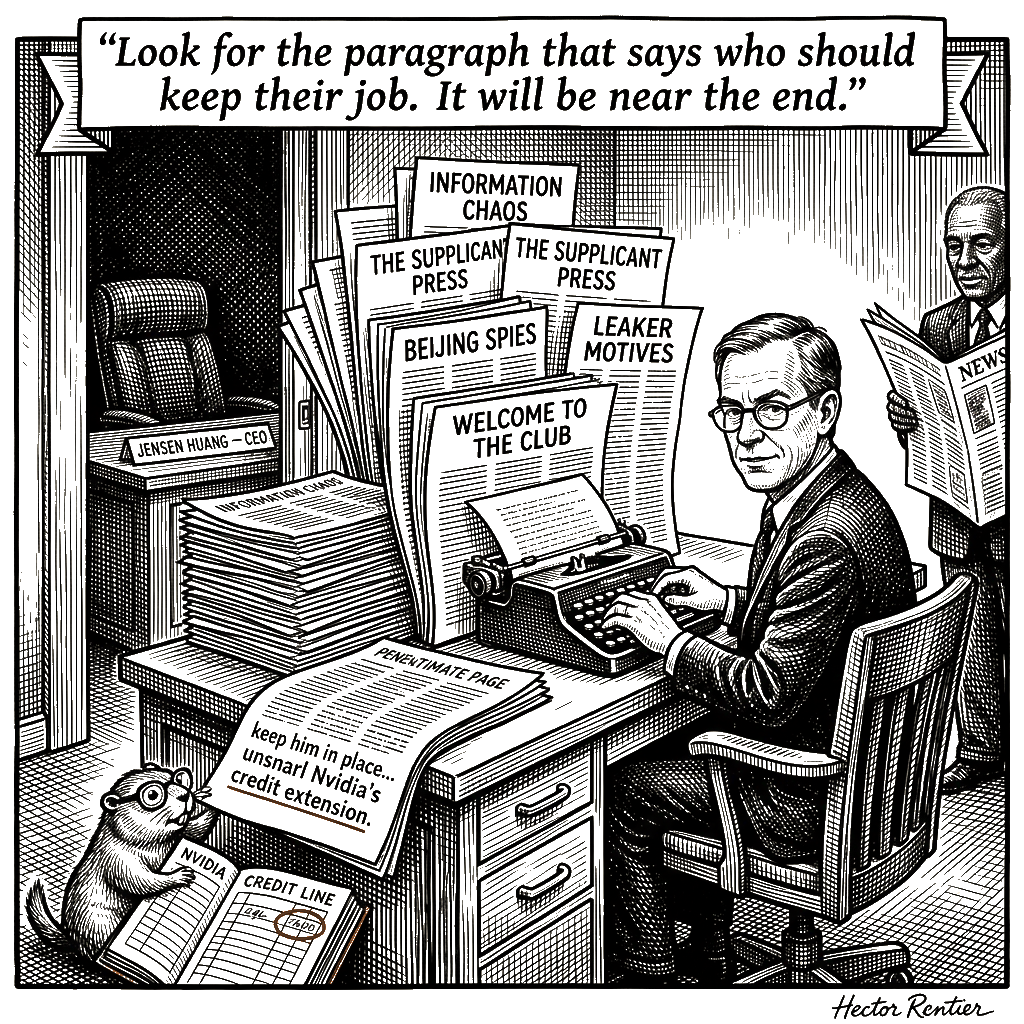
Holman W. Jenkins Jr. wrote a disinformation column about disinformation to protect Nvidia’s balance sheet. That is the operation, and what follows reads it as it deploys. The text under analysis: “Jensen Huang and the World’s Information Chaos,” his Business World column, Wall Street Journal opinion page — fourteen paragraphs that present a national-security scandal as an information-hygiene scandal. I built persuasion of this class for two decades, some of it as unsigned editorial-page copy on that very page; the credential is the confession, and I owe it on every column — weigh it accordingly. The piece runs eight load-bearing moves; this column walks through them in the order they deploy. Each blockquote is the exhibit; each commentary between is the autopsy.
If ever Donald Trump trampled a norm, he might have called up Nvidia’s board and told its members, “Jensen Huang stays.”
The most consequential intelligence activity in the world today is disinformation or quasi-disinformation. It is also quick to run out of control, and this seems one of those cases, which, frankly, the Trump administration never should have let happen, given the strategic importance Nvidia represents to the U.S.
— paragraphs 1–2
Frame-setting by irony — the thesis delivered as a joke before any fact has appeared [Bernays, Propaganda (1928), his “invisible government”: the manipulation works best where the hand working it is never seen; WSJ Editorial Technique Catalogue §3.2, dek-as-thesis: the page’s habit of delivering the thesis before the argument begins — a habit Jenkins runs inside his first line of body text]. Read the first sentence as a load-bearing beam rather than a pleasantry. It decides on line one whose side the reader is on: the scandal under coverage is not what a foreign intelligence service may have obtained through an executive’s personal life; the scandal is that an important executive was permitted to fall. It also pre-assigns the only villain the frame will tolerate — a norm-trampling president — so that the column’s own ask, keep the man seated, arrives later wearing the costume of norm-respect. Operators call this the brochure: every operation ships with one, and the brochure’s first page is always a laugh that installs the frame before the reader knows a frame is being installed.
Paragraph two then stretches the coinage “quasi-disinformation” — Bad-Faith Catalog: frame_engineered_relabeling, with Bandura’s euphemistic labeling underneath — until it covers the leak, the coverage and the accusation at once: everything, in short, except the column itself. The prefix is the working part. A term with “quasi” bolted on can cover confirmed fabrication, honest error, a rumor, a leak the speaker dislikes; the reader cannot falsify it, which is the point. In the trade this is the elastic category — the label stretches to whatever the piece needs inside it, and no one can prove it wrong because it never said anything definite. Note also “which, frankly” — the dispositive frankness marker (WSJ Catalogue §3.4), the tic that presents a judgment as candor and a blame assignment as analysis. “Never should have let happen”: the fault is assigned in paragraph two, before any evidence has entered the room. That is not a finding. That is the assignment. This is a con’s opener — a fuzzy term to stretch, a frankness cue to soothe, a verdict delivered before the exhibit is open, and a laugh that comes first so the reader never hears the ask arrive.
It’s hard to get past the feeling that the least substantive part of this mess, which has its roots in a contradictory Trump administration chip policy, is the claim that the Nvidia CEO’s supposed paramour was a Chinese agent.
— paragraph 3
The disclaimed-then-deployed structure — Bad-Faith Catalog: motte-and-bailey (Shackel, Metaphilosophy, 2005) — operates here through a single sentence that announces its own program. The column calls the paramour-spy claim “the least substantive part of this mess,” then builds its next four paragraphs on precisely that claim. The retreat position — this story is trivia; the real story is chip policy — is the motte. The advanced position — she fits the profile, the press is naive, somebody ran an op — is the bailey, and the column returns to it almost immediately and never leaves. “It’s hard to get past the feeling” is the tell: the sensation frame launders an editorial thesis as an involuntary response, the way operators convert a client’s message into news judgment. And “supposed paramour” is the attribution hedge — the claim retailed at second hand, framed as someone else’s, while the column does the retailing. In the trade this is the denial that names the thing: distance yourself from the allegation while repeating it in your own voice. This is the mouth-opening move of the con — declare the card unimportant, then deal it.
To be a Chinese citizen is to be a spy—first of all, a spy on yourself since there’s no data privacy in China. Further, an estimated 11 million Chinese citizens live and work outside of China. By the hundreds of thousands they attend foreign universities, land excellent jobs and then can find themselves, at any moment, subject to Chinese government requests they can’t refuse without endangering their families back home or their ability to return to China.
— paragraph 4
The categorical smear — a stereotype performing the work of evidence [Bad-Faith Catalog: hasty generalization; Lippmann, Public Opinion (1922): the picture in the head substituted for the person; Schmitt, The Concept of the Political: the enemy made total]. One sentence converts a nationality into an evidentiary category, and the conversion does two jobs simultaneously: it swells the accusation until it covers 1.4 billion people, and it empties the accusation of content, because a charge that applies to everyone cannot be news about anyone. Concede the kernel first, because the kernel is real: Beijing does run a coercion architecture over its diaspora — the Justice Department’s Operation Fox Hunt indictments document the pressure campaigns run against Chinese nationals living abroad, and the 2017 National Intelligence Law’s seventh article obliges citizens and organizations to assist state intelligence work. Operators stretch true kernels over whole populations precisely because the kernel buys credibility for the stretch. The “estimated 11 million” is the number-drape — a figure laid over the claim to lend it statistical gravity it does not carry, since the number counts people, not operations. “Coercible” is not “recruited”; a person who can be leaned on is not thereby an agent. The documented cost of this exact frame is on the public record: the Justice Department’s China Initiative, the profiling-by-nationality prosecutorial program, was shut down in February 2022 amid criticism that defendants were being charged on the strength of their passports, and an MIT Technology Review database found more than half of its defendants were never charged with economic espionage at all.¹ The people who pay for the stretch are the eleven million the paragraph itself counts — students, financiers, founders, exactly the class this story is about. Blanket suspicion is not realism in either direction. It is the oldest structure in the ethnic-surveillance trade — a smear dressed as sophistication.
Not that any actual evidence was offered that businesswoman Alice Huang was a Chinese agent. But we can assume if her government approached her, anything she gleaned was trivial next to the consequences to China of her exposure. In costing America one of its most important tech CEOs, it also cost China its most influential advocate for granting China access to America’s advanced AI chips. And no, this probably wasn’t China’s master plan but an artifact of our age’s information chaos.
— paragraph 5
Begging the question, loaded through a subjunctive [Bad-Faith Catalog: begging the question / petitio principii] — delivered through the “Not that… But” construction the catalog files as JAQing off, the workhorse of the modern smear. Hold the two sentences side by side. Sentence one announces the absence of any evidence. Sentence two reasons about what happened if her government approached her — an if that quietly installs the approach as the working premise. The dismissal requires the accusation to be true enough to be trivialized, so the column rejects the evidence and keeps the accusation’s architecture in the same breath, with the subjunctive doing the loading and the announcement of dismissal taking the credit. In the operator’s kit this is the too-small-to-matter pivot: when a story threatens the protected interest, shrink the story — deny vertically, insinuate horizontally, the horizontal deny. The receipt is the text itself. Nowhere in fourteen paragraphs does the column tell the reader what the reported basis for the spy claim was; the reader is instructed to dismiss a file they were never shown. That’s a shell game — the pea is under no cup, and you’re told the cup doesn’t count anyway.
Then “our age’s information chaos” — Bandura’s displacement of responsibility — is the responsibility sink: an abstraction with no street address absorbing the fault the column had been assigning to people. And “And no” is the dispositive register again (WSJ Catalogue §3.4): a question nobody asked is answered decisively, so the answer’s confidence rubs off on neighboring claims that earned none. This is the clean-hands apparatus running at full spec. It is not caution. Caution looks like not publishing the assumption.
In all this, don’t fail to note the role of a compliant, supplicant press. If Ms. Huang is the person of her public record, then she’s like millions of convivial, ambitious young people […] finally helping to launch a company in the booming Southeast Asia data-center racket, where she perhaps attracted the notice of Beijing intelligence officials.
The press now drips sarcasm over this work history as if it might be a “legend”—a decades-long concoction of China’s spy masters so she could one day snuggle up to a Jensen Huang.
— paragraphs 6–7
Poisoning the well — Bad-Faith Catalog: poisoning the well; press-as-standing-antagonist, WSJ Editorial Technique Catalogue §4.23, the pattern’s densest format-level deployment at Fox, reproduced here by a signed Journal column — operates here through a projection so clean it is almost elegant. In paragraph six the column plants the intelligence connection itself: “she perhaps attracted the notice of Beijing intelligence officials.” No sourcing; a “perhaps” doing the work of a fact. In paragraph seven the column mocks the press for entertaining the same idea — the work history treated “as if it might be a ‘legend’” — and the press’s sarcasm becomes the story, with a “compliant, supplicant press” now carrying the villain’s role. The operator plants the card, then ridicules the audience for noticing a card on the table. Once the press is the antagonist, the factual question — was there evidence? there was none, by the column’s own concession — never has to be answered; the reader is invited to condescend to the reporters instead. Accuse the other side of the operation you are currently running: it’s a plant, and the plant is the whole play. That is a bait-and-switch executed at the paragraph level.
Uh huh. Welcome to the club, China’s leaders more likely might be hearing from Vladimir Putin, Vladislav Surkov and the late Yevgeny Prigozhin. They saw their own trivial intelligence gamesmanship in our 2016 election explode into a U.S. domestic circus that did more harm than good for Russia’s interests.
Welcome to the club might say James Comey, John Brennan and James Clapper, U.S. intelligence officials. Their machinations against Donald Trump only helped loft him to his status as his era’s king of the world.
— paragraphs 8–9
Whataboutism with advantageous comparison running underneath [Bad-Faith Catalog: whataboutism; Bandura: advantageous comparison and distortion of consequences; WSJ Catalogue §3.4, dispositive register]. The Huang story is wobbling, so the column pivots to two other stories, and neither causal claim is sourced, cited, or argued. The documented record: the Mueller report found in 2019 that the Russian government interfered in the 2016 election in sweeping and systematic fashion, and federal grand juries indicted the Internet Research Agency and GRU officers for the operation. The column’s relabel files that documented operation as a backfired prank — same referent, smaller charge, chosen so the reader’s internal calibration shrinks — and then a second stroke: the claim that the operation embarrassed its authors more than it served them, an adversary’s-ledger argument deployed to shrink the event again, the way an operator describes a fraud as a misunderstanding that cost more than it gained. Both arrive in the dispositive register — “only helped loft him” carrying the confidence of a documented finding and the documentation of none.
Paragraph nine stacks attribution of blame on pre-emptive legitimacy-withdrawal [Bandura: attribution of blame; Bad-Faith Catalog: pre-emptive legitimacy-withdrawal; WSJ Catalogue §4.19, the weaponization frame generalized to intelligence-and-press processes]. Three named officials, one verb — machinations — and not one documented act attached to any of them. The checkable record runs in both directions and the column engages none of it: the Justice Department’s inspector general reported in December 2019 on the FBI’s Crossfire Hurricane investigation, finding an authorized purpose for opening it and what the report itself called serious performance failures in the surveillance work that followed. The catalogue names the pattern precisely: withdraw legitimacy from institutions on the grounds of who staffs them, before any specific conduct is engaged, and every future output becomes dismissible without examination. That’s blame by adjective — the indictment is the word, and the evidence for the word is the word.
Note which direction the column’s evidentiary sympathy runs. A TV-presenter résumé is presumptively innocent — if she is the person her public record shows, she is simply one of millions of ambitious young professionals — while a documented foreign influence operation gets the shrug. The relabel scam always points the small word at the thing it wants discounted. This is the equivalence con: when your story wobbles, point at the other team’s fumbles and run out the clock, dissolving the one question the column cannot answer — what, exactly, supports the spy frame it spent four paragraphs building. It is run here without a single receipt.
The press contribution, meanwhile, amounts to institutionalized disingenuousness, pretending not to notice its own errand-boy function. The corrective isn’t to stop reporting leaks. The corrective is to treat the actions and motives of leakers as part of the story. A belated place to start would be those administration officials and industry figures, likely at odds with the president’s own schizophrenic China strategy, who used iffy, unprovable intelligence to drive the Nvidia chief from his job.
— paragraph 10
The anonymous indictment — an accusation engineered so that no one can answer it [Bad-Faith Catalog: poisoning the well, in its anonymous-villain construction; WSJ Catalogue §4.24, person-as-policy detection test: remove the person and see whether an argument is left standing]. The prescription itself is defensible: leak coverage should include the leakers’ motives. I will grant it the strongest version, because the strongest version exposes the gap. A column that demanded motive-scrutiny would apply it at home. This one runs a spy frame on a woman it concedes there is no evidence against, plants “Beijing intelligence officials” behind a “perhaps,” and asserts a causal story about Comey, Brennan and Clapper without a citation — then names, as the belated first target of the new scrutiny, “those administration officials and industry figures” who leaked against the CEO. No name, no document, no checkable act. Watch the asymmetry, because the asymmetry is the technique: every suspicion aimed at the chief executive’s circle is waved off as press sarcasm, while the column’s own suspicion of an unnamed roomful of adversaries is a place to start. That is the machine’s standard division of labor — suspicion of the protected interest is a witch hunt, suspicion of the protected interest’s enemies is due diligence. “Schizophrenic China strategy” is the label doing frame work in the same sentence (WSJ Catalogue §4.1, frame-engineered relabeling, dysphemistic register): a clinical metaphor deployed to make policy incoherence sound like a diagnosis. Accountability aimed only outward is not accountability. It is protection. A newsroom that took the corrective seriously would have nothing to file — its lead subject does not exist on any record. That’s not a lead. That’s a hit with no return address.
No job is forever and Mr. Huang embarrassed himself. But if the AI correction is coming that I think is coming, it would benefit America—and Mr. Trump—to have him in place a while longer to help unsnarl the financial jumble Nvidia’s own credit extension for the AI build-out has been a key part of.
Oh well. The unemployment lines are full of indispensable men. May Mr. Huang’s departure at least be dragged out long enough to let him redistribute some of the three decades of knowledge he’s been hoarding since co-founding and running Nvidia in 1993.
— closing paragraphs
The suppressed variable, confessed in passing [Suppressed Variable Diagnostic, cui-bono register], delivered by the page’s signature cadence [WSJ Catalogue §3.5, closing-line cadence]. Strip the press critique and the intelligence chatter and what remains is the material claim the other paragraphs were arranged to protect: the company’s own credit extension keeps the AI build-out financed, a correction is coming, and the chief executive’s continued presence would benefit the country and the president by keeping that structure untangled long enough to be managed. Nvidia’s filings disclose a multibillion-dollar portfolio of investments in AI-ecosystem companies, including customers of its hardware, and the circularity question — a chipmaker financing the purchases that produce its own revenue — has been publicly aired since the build-out began.² A feared “AI correction” lands on that structure first, and the man the column wants kept at the desk is the man who can “unsnarl” it. Twelve paragraphs reposition a national-security scandal as an information-hygiene scandal — blame the leakers, blame the press, minimize the foreign operation — and the thirteenth says what the exercise was for. Note also the respectable concession, the admission that the founder brought embarrassment on himself: the small admitted fault that keeps a defense looking even-handed while the load-bearing ask, keep him seated, passes unopposed.
Then the closer. “The unemployment lines are full of indispensable men” is built for retransmission: short, quotable, carrying the take-home so a scanner who reads nothing else receives it. Watch what the aphorism does with the question the column spent fourteen paragraphs refusing to examine — it converts a live national-security question, was the intelligence iffy, who moved it, why, into a shrug about the inevitable scale of executive tenure, which is the emotional close the operation needs: the reader leaves tired rather than curious. The second sentence completes the ask with the softest verb available — the departure should be dragged out — which is the paragraph-thirteen request delivered as a sentimental postscript, so the reader can mistake it for generosity. There is nothing corrupt about a business columnist defending a company’s franchise. There is something operational about a defense whose path runs through a nationality-wide spy presumption, a press-villain frame, and an evidence-free insinuation — the scaffolding walked through above. The scaffolding is the tell. This closer is a maintenance job on a balance sheet, delivered as world-weary wit, and it ends the way these builds always end, with a line built to be repeated without inspection. That’s the exit line. This is not information chaos. This is a balance-sheet defense with a media critique stapled to the front.
So here is what the fourteen paragraphs actually are doing, taken together.
They install a side before any fact appears, and they do it with a joke. They swap a checkable person for a categorical suspicion stretched across a diaspora, borrowing a true kernel of coercion to buy credibility for the stretch — a smear of a nationality to save a stock. They dismiss a file they never show, while a subjunctive keeps the accusation’s architecture standing. They plant the intelligence card themselves and ridicule the press for noticing it. They relabel a documented attack on a presidential election as backfired gamesmanship. They convict three named officials with one word and no conduct. They point at a roomful of unnamed adversaries and call the pointing a corrective. And then, in the thirteenth paragraph, they say what all of it was for: the chair at Nvidia, kept warm, because the credit line underneath the AI market needs its occupant.
That is the cui-bono answer, and the column supplies it itself. Follow the benefit up and it lands at Nvidia — and, by the column’s own accounting, at an administration that prefers its China policy incoherent to a China policy it would have to defend. The reader does not need my characterization; the ask sits in the artifact, in plain sight, waiting for someone to count the paragraphs. Every factual kernel in the piece is real — the coercion architecture over China’s diaspora is documented, the administration’s chip policy has been contradictory in public, disinformation does change events. That is what makes the con run: a blanket half-truth is built from a true variable, and the dishonesty lives in the motivated stop — the argument follows a real chain and halts exactly where continuing would implicate the protected interest instead of the chosen target. Here the halt comes right before the column’s own standard — motives as part of the story — would turn inward.
I am bitter about this class of column. I am also right about it, and the rightness is checkable: every quoted span above is verbatim from the artifact, and every documentary receipt outside the artifact is dated and public. The bitterness is residue from the recognition that produced the change; the reader is free to discard it and keep the analysis, which stands without it.
For the reader still working through their own capture, take the portable test from this one: when a column about disinformation spends its anger on the press and its assumptions on the accused, ask the question that sorts every operation of this class — who stays in the job, and what does the job protect? Look for the paragraph that says who should keep their job. It will be near the end. It is always near the end. Here the answer is printed in the column’s own penultimate paragraph. The con always confesses at the end. That is the one part you can trust.
— Phukher Tarlson
¹ The China Initiative was announced by the Justice Department in November 2018 and ended by the department in February 2022 amid criticism that its prosecutions disproportionately targeted researchers of Chinese descent; the espionage-related case against MIT professor Gang Chen, brought in 2021, was dropped in January 2022.
² Nvidia’s annual filings disclose a multibillion-dollar portfolio of investments in AI-ecosystem companies, including customers of its hardware; concern about circular financing in the AI build-out has been widely reported.