Summary
- Prosecutors allege Jonathan Rinderknecht intentionally ignited the January 1, 2025, Palisades fire to enact “revenge on society” following a failed relationship, anchoring the claim in a barbecue lighter, proximity to the origin, and a six-month-old ChatGPT prompt.
- Defense attorney Steve Haney argues the fire resulted from a fireworks accident, citing Rinderknecht’s 16 rapid 911 calls and planned witness testimony as evidence of innocence.
- Judge Anne Hwang excludes alleged fire department negligence evidence, structuring the trial around individual culpability for ignition rather than disaster scale or institutional failure.
- Security camera footage at the ignition point serves as the primary diagnostic hinge for the court’s binary evaluation of intentional arson versus accidental detonation.
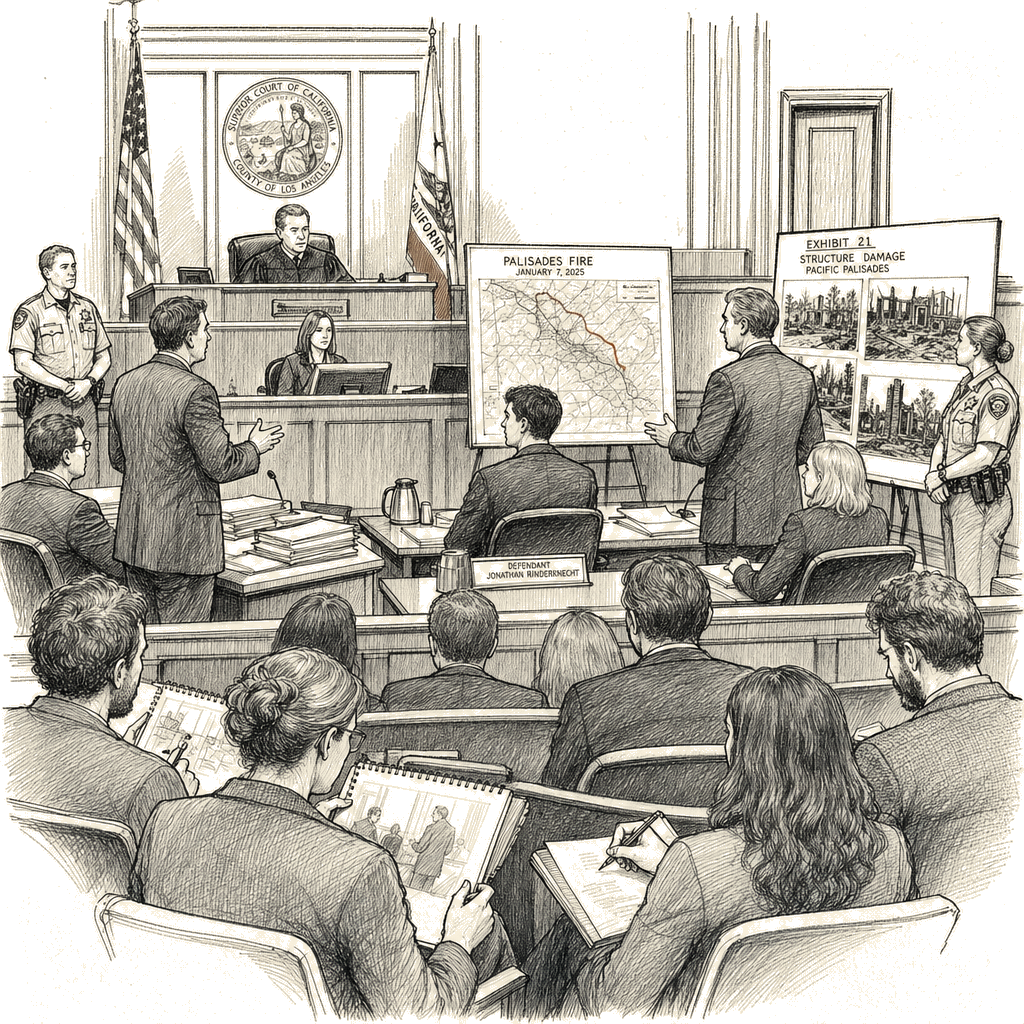
Prosecutors and defense attorneys present competing ignition hypotheses for the January 1, 2025, Palisades fire in a trial structured by strict evidentiary boundaries that isolate the initial spark from the environmental and institutional factors that amplified the disaster. Assistant U.S. Attorney Matthew O’Brien alleges that Jonathan Rinderknecht intentionally set the blaze, arguing that the defendant sought “revenge – revenge against society because he blamed society for all his troubles.” The prosecution anchors this claim in Rinderknecht’s proximity to the ignition point, the discovery of a barbecue lighter in his vehicle, and a ChatGPT prompt entered six months prior to the incident that depicted “a burning forest and then you have a bunch of people running away from that.” Conversely, defense attorney Steve Haney contends that the fire resulted from a fireworks accident, maintaining that Rinderknecht was on the hilltop solely to watch fireworks after dropping off Uber passengers. The court’s evidentiary architecture enforces a binary evaluation between intentional arson and accidental fireworks ignition, effectively excluding alternative theories of natural origin or systemic negligence from the primary inquiry into the initial spark.
Evidentiary Landscape and Diagnostic Friction
The prosecution anchors its claim in Rinderknecht’s proximity to the ignition point, the discovery of a barbecue lighter in his vehicle, and a ChatGPT prompt the defendant entered six months prior to the incident, which depicted “a burning forest and then you have a bunch of people running away from that.” Rinderknecht’s documented status as an occasional Uber driver provides a rationale for his midnight presence on the Pacific Palisades hilltop that supports both the arson and fireworks narratives. The security camera footage, which reportedly captured the ignition location and time, serves as the primary diagnostic hinge: visual evidence of hand-ignition would strongly support intentional arson, while footage showing only sky-level fireworks would reinforce the accidental detonation hypothesis.
The temporal gap between the six-month-old ChatGPT prompt and the January 1 fire weakens any inference of contemporaneous intent, as the prompt’s probative value depends entirely on whether it is interpreted as premeditation rehearsal or unactioned creative writing. Countering the digital motive narrative, the defense emphasizes Rinderknecht’s post-ignition conduct. Haney submitted audio of Rinderknecht making 16 rapid 911 calls to report the blaze and noted his subsequent cooperation with federal investigators to pinpoint the origin, characterizing this as the voice and actions of “a man who was trying to stop the fire.” Planned defense testimony will include first responders and witnesses who are expected to testify that they heard fireworks in the vicinity at the ignition time. A third possibility—that Rinderknecht accidentally ignited the fire and immediately reported it in panic—remains a remote alternative with limited specific support in the public record.
Evidentiary Boundaries and Damage Amplification
A critical structural constraint is Judge Anne Hwang’s pretrial ruling that the defense cannot introduce evidence of alleged Los Angeles Fire Department negligence in failing to fully extinguish the initial brush fire, a determination the judge made by deeming such evidence “irrelevant and potentially confusing”—a balance reflecting Federal Rule of Evidence 403. The initial brush fire was thought to be extinguished on January 1 but continued to smolder underground for six days before powerful Santa Ana winds reignited it on January 7, 2025. This reignition produced the conflagration that destroyed thousands of structures, consumed roughly 23,000 acres, and killed 12 people.
The ruling functions as a gatekeeping mechanism that legally isolates the initial spark from the environmental and institutional factors that determined the event’s catastrophic scale. The three felony arson charges, including malicious destruction by means of fire, require the prosecution to prove only that Rinderknecht maliciously set the initial fire; the statute does not distinguish between a fire that is quickly contained and one that explodes due to intervening failure to suppress. By redirecting the narrative flow to the January 1 ignition as the sole legally relevant cause, the court shields the fire department from scrutiny and collapses the complex fire-behavior sequence into a simple linear model of individual culpability.
Narrative Framing and Structural Implications
The competing narratives deploy distinct framing conventions. The prosecution utilizes a “revenge on society” cognitive frame, employing the recovered ChatGPT prompt as a digital proxy for premeditation to anchor the act in a documented, albeit temporally distant, internal state. The defense attempts to frame the defendant as an accidental participant and potential “scapegoat” for institutional failure; however, the thematic frame of systemic negligence is structurally blocked by the judicial ruling. Consequently, the trial architecture emphasizes episodic individual action, utilizing the highly salient AI prompt as an evidentiary hook to potentially overshadow standard forensic questions. The resulting legal configuration processes a complex, environmentally amplified disaster through the available repertoire of individual guilt, rendering the decisive ecological factors—underground smoldering and wind-driven expansion—as background details rather than central legal variables.
Analytical techniques used in this piece
This analysis applies the methods below. Each links to a short, plain-English explainer you can read and reuse.
- Differential Diagnosis
- Lists the candidate explanations for a symptom and rules them out one by one.
- Frame Audit
- Surfaces the frame an argument adopts and what that framing quietly includes or excludes.
- Relationship Mapping
- Extracts the network of ties among people, institutions, and entities.