Summary
- Japan’s restart of Unit 6 at the Kashiwazaki-Kariwa plant collides with finite spent-fuel storage capacity as cooling pools approach saturation.
- The Ministry of Economy, Trade and Industry reported that 17 plants held more than 17,000 tons of spent fuel as of December 2025, utilizing nearly 80% of total storage.
- Industry Minister Ryosei Akazawa proposed Minamitorishima as a final disposal site, selecting a government-owned island that circumvents standard local consent procedures and intersects with existing military infrastructure and mineral deposits.
- A projected two-decade review process creates a fifteen-year operational gap between the five-year pool capacity deadline and potential repository approval, forcing reliance on interim dry-cask storage strategies.
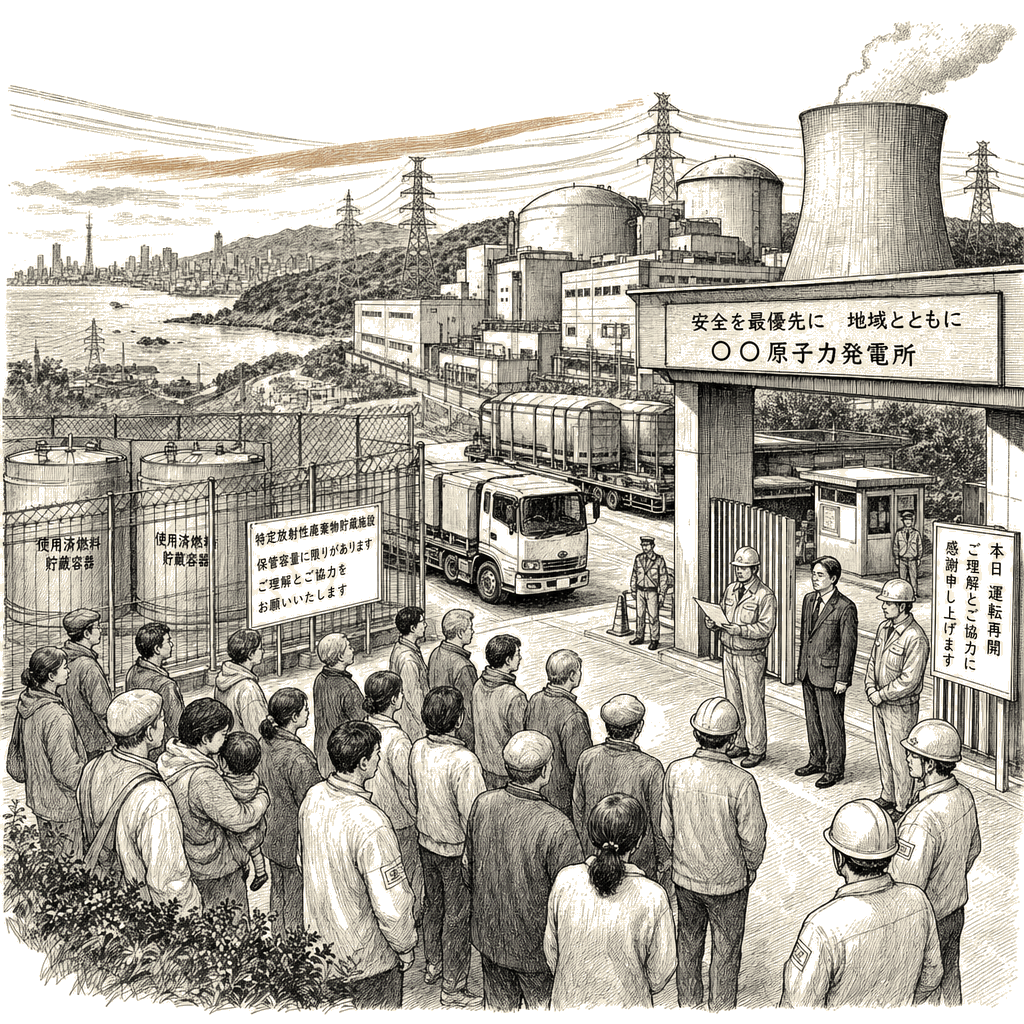
The restart of Unit 6 at the Kashiwazaki-Kariwa Nuclear Power Station has activated a structural constraint in Japan’s energy policy: reactor restart momentum collides with finite spent-fuel storage capacity. Kashiwazaki-Kariwa General Manager Takeyuki Inagaki stated, “Without solid (fuel management) plans, our power generation will stall sooner or later.” According to the Ministry of Economy, Trade and Industry, cooling pools at 17 plants held more than 17,000 tons of spent fuel as of December 2025, utilizing nearly 80% of total capacity. The Federation of Electric Power Companies of Japan indicated that three facilities, including Kashiwazaki-Kariwa, will reach pool capacity within five years. Weeks after the restart, Industry Minister Ryosei Akazawa requested a feasibility study for a final disposal facility on Minamitorishima, characterizing permanent waste management as “a crucial challenge that must be resolved.”
Stakeholder Incentives and Site-Selection Dynamics
Minamitorishima, an uninhabited government-owned island located approximately 2,000 kilometers south of Tokyo, presents a convergence of strategic factors for the proposed disposal site. Some experts noted the island sits on a geologically stable tectonic plate, suggesting technical suitability for deep geological disposal. Concurrently, the island hosts ongoing military construction for a long-range missile firing range and sits atop deep-sea deposits rich in rare earth minerals. This convergence establishes a compounding sovereign asset dynamic where a remote, state-controlled location with existing military infrastructure and resource-extraction value may reduce the political cost of siting a controversial waste facility.
Government ownership of Minamitorishima circumvents the local consent requirements that have delayed previous Japanese site-selection efforts. Satoshi Takano, a member of a government panel studying final disposal, observed that selecting a government-owned remote island “seems political,” adding, “There will be little opposition from a government-owned remote island.” Administrative resistance is emerging from the Ogasawara village government, which oversees the island. Ogasawara assembly member Yusuke Hirano told an assembly meeting he was “baffled” by the plan, stating, “I think nuclear waste is incompatible with islands that are a UNESCO Natural World Heritage site.”
Senshu University professor Lila Okamura identified the broader scope of the waste challenge, citing the large volume of routine reactor waste alongside the “massive and largely unknown high-level nuclear waste from the Fukushima disaster.” Okamura noted that selecting and constructing a final disposal site requires generations of monitoring and warned, “Japan should plan carefully and not rush the current plan that is full of uncertainties.” Civil activist Mie Kuwabara described accelerating restarts without a final destination as “irresponsible,” adding, “It’s like saying that it’s OK to put a facility there because nobody is around to complain if there is a problem. It’s scary.”
Reprocessing Failure and Fuel Cycle Constraints
The accumulation of waste is compounded by structural failures within Japan’s closed fuel cycle strategy. Reporting indicates that a reactor designed for plutonium reuse has failed, and the existing reprocessing infrastructure cannot handle all accumulated spent fuel. This shortfall contributes to a plutonium stockpile that experts report is already large enough to arm thousands of atomic bombs. The collapse of the intended reprocessing loop shifts the burden of volume reduction onto direct disposal pathways, which remain undeveloped.
Operational Pathways and Timeline Mismatch
The proposed timeline contains a structural mismatch. The Minamitorishima review process projects an approximate duration of two decades, creating a gap of roughly fifteen years between the five-year cooling pool capacity deadline and the earliest potential repository approval. During this interval, reactor operations depend entirely on interim fuel management. TEPCO has begun transferring spent fuel from the No. 6 reactor to other units at Kashiwazaki-Kariwa with available space, while other utilities have announced plans to construct on-site dry-cask storage facilities. This interim shift extends the operational timeline by reducing immediate pool pressure but commits operators to a multi-decade monitoring regime for above-ground storage.
The disbursement of government subsidies serves as an indicator for the proposal’s trajectory. Municipalities participating in the first review stage are eligible for up to 2 billion yen, with up to 7 billion yen available for subsequent stages. The flow of these funds and corresponding administrative engagement will signal whether local negotiation transitions from objection to conditional acceptance. Without a parallel expansion of dry-cask capacity at or away from reactor sites, the pool capacity deadline will force reactor shutdowns regardless of the Minamitorishima study’s status.
Global Reference Class and Risk Assessment
Japan’s siting trajectory operates against a subdued global reference class for permanent geological disposal. Reporting notes that the world’s first final disposal site for spent nuclear fuel is scheduled to open in Finland later this year. Britain, Germany, and the United States have abandoned reprocessing-centric strategies without establishing operational final repositories, setting a near-zero global base rate for completed projects. Domestically, Japan has initiated feasibility studies at four locations since the early 2000s without advancing any location beyond the preliminary study phase, establishing a historical precedent for prolonged procedural delay.
Adjusting from these reference classes, the probability of an operational repository by mid-2046 falls within the 5–15% range. This range reflects the deliberate pace of previous site studies, the technical hurdles of demonstrating geologically stable containment in a seismically active archipelago, and the absence of a consent-based siting framework. The upper bound accounts for the possibility that sustained energy demand pressures compel an accelerated political timeline, though such a scenario would require a level of institutional trust not currently demonstrated in public proceedings. Relying on an expedited site-selection process for a government-owned island without parallel investment in interim storage infrastructure creates operational dependency on a pathway that lacks technical validation and local authorization. This dynamic increases the risk of regulatory delays or programmatic reversal if procedural shortcuts face legal or public challenge.
Analytical techniques used in this piece
This analysis applies the methods below. Each links to a short, plain-English explainer you can read and reuse.
- Decision Clarity
- Articulates the real stakes, stakeholders, and interests behind a decision facing a third party.
- Probabilistic Forecasting
- Puts calibrated probabilities on what happens next.
- Process Tracing
- Reconstructs the step-by-step causal pathway of a specific historical event.
- Mutually Assured Destruction
- Deterrence by guaranteeing that any attack is suicidal for the attacker.