Summary
- The Trump administration’s closure of 56 Forest Service research stations transfers wildfire forecasting costs from federal accounts to state and local jurisdictions.
- Consolidating the Seattle Pacific Wildland Fire Sciences Lab risks the loss of decades of institutional knowledge essential for real-time smoke tracking.
- Forest Service leadership defends the reorganization as a fiscal consolidation measure while acknowledging contingency plans to pivot if Congress zeroes out research budgets.
- State officials report a communication breakdown with federal partners, creating operational uncertainty ahead of a potentially severe Western wildfire season.
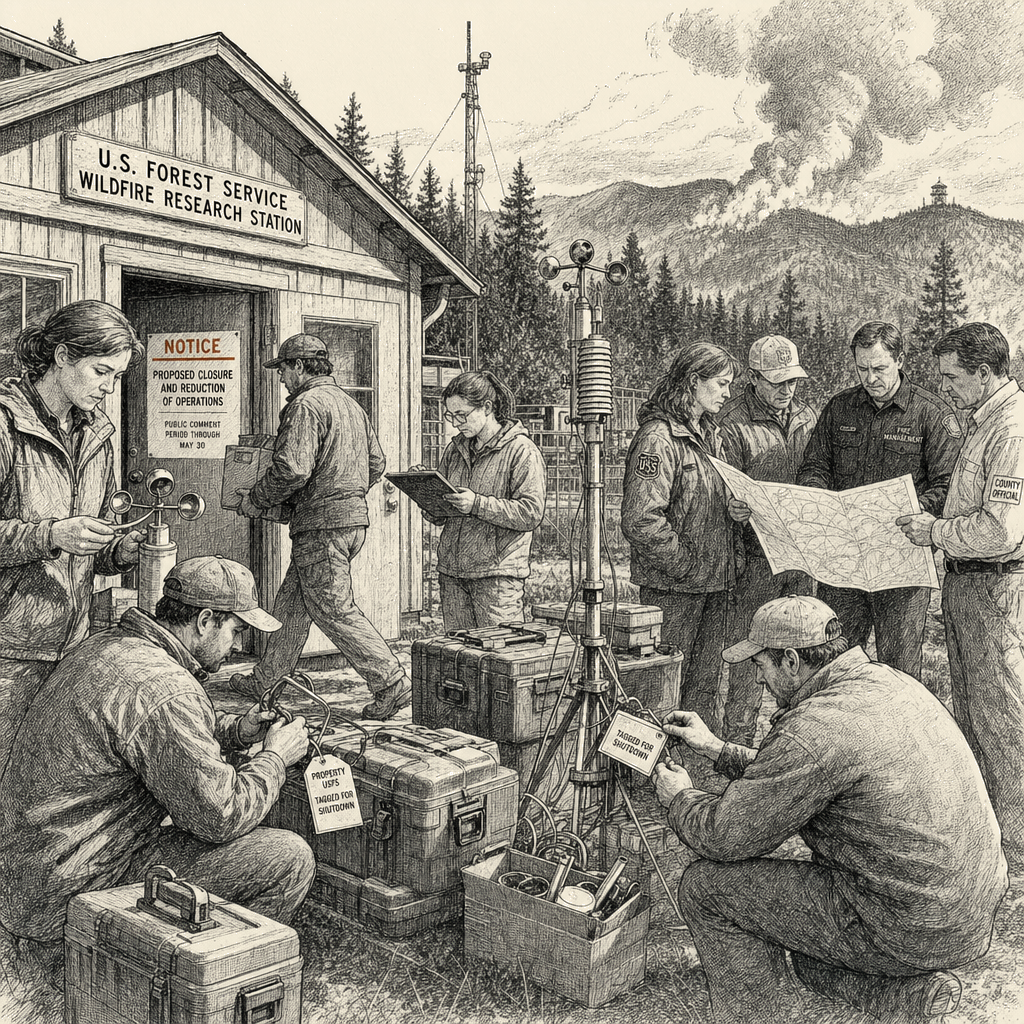
The Trump administration’s proposal to close 56 of 90 U.S. Forest Service research stations and eliminate the agency’s research budget transfers long-term wildfire management costs from federal accounts to state, local, and commercial entities, jeopardizing the institutional knowledge required for real-time smoke forecasting as the West enters a high-risk fire season. The reorganization consolidates facilities to address a $3 billion deferred maintenance backlog, a move agency leadership characterizes as a thoughtful fiscal consolidation. However, the dismantling of specialized research nodes like the Seattle Pacific Wildland Fire Sciences Lab threatens to sever the data streams state agencies rely on for evacuation planning and fire suppression, creating a fragile operational landscape where administrative savings accrue to the federal government while tail-risk management falls to local jurisdictions.
Who Benefits from the Restructuring
The Trump administration has proposed closing 56 of 90 U.S. Forest Service research stations—including the Seattle Pacific Wildland Fire Sciences Lab—zeroing out the agency’s research and development budget for 2026 and 2027, and relocating the Forest Service headquarters to Utah. When the budgetary narrative is separated from the operational consequences, the closures constitute a risk transfer. The capped financial savings from shuttering facilities accrue to the federal balance sheet, while the potential costs of degraded forecasting—such as delayed evacuations, mismanaged controlled burns, and health impacts from unanticipated smoke exposure—are displaced onto state agencies, local jurisdictions, and the commercial sector. As Washington state Public Lands Commissioner Dave Upthegrove notes, Pacific Northwest forests are “once thought immune from major fires” but are now vulnerable to becoming “flammable or choked in smoke within weeks,” underscoring the asymmetry between federal maintenance savings and the tail risks borne by local populations.
State officials initially viewed the reorganization with optimism because it included a proposal for a state-level director similar to the Bureau of Land Management. That optimism has shifted to uncertainty, and the counterframe identifies the closures not as budget repair, but as a via-negativa removal of a critical buffer against fire-season tail risks.
Operational Fragility and Workforce Attrition
The Seattle lab produces taxpayer-funded, real-time smoke and particulate tracking maps utilized by federal firefighting teams, state agencies, and commercial applications relied upon by millions during wildfire season. Fire ecologist Ernesto Alvarado, a co-creator of the technology, states the capability is the product of “institutional knowledge developed through years of Forest Service research,” concentrated within a single team over decades and situated in Seattle for its proximity to a major research university and an international airport.
Schultz maintains that “we aren’t closing research” and that scientists will be accommodated through relocation to nearby state offices or commutable locations within the agency. Closing this node represents structural fragility: the trading of small, certain administrative savings for an unbounded, tail-heavy downside. While personnel transfers are theoretically possible, the non-codified institutional memory and location-specific infrastructure cannot be seamlessly replicated elsewhere. Morgan Varner, a former fire behavior scientist at the lab, characterizes the broader headquarters relocation to Utah as having “a haphazard to it that I think is troubling from a scientist standpoint.” The geographic and institutional decoupling risks eroding the specialized workforce; anticipated efficiency gains are offset by operational blind spots resulting from the departure of senior staff who decline to relocate or accept alternative roles. This attrition is compounded by pre-existing workforce depletion: the agency has already lost thousands of staff last year to layoffs, buyouts, and early retirements connected to the Department of Government Efficiency team, reducing its capacity to absorb further restructuring shocks.
Framing the Reorganization
The framing of the closures pivots on a divergence between managerial efficiency and operational readiness. The administration employs a thematic frame focused on budgetary discipline and long-standing administrative challenges, utilizing terms like “thoughtful” reorganization and “getting [the] budget into control.” In contrast, the reporting and state officials utilize a conflict frame, positioning the administration as “taking aim at” research capabilities as western states stand “poised to burn.”
Forest Service Chief Tom Schultz defends the reorganization as a fiscal consolidation measure aimed at a $3 billion deferred maintenance backlog, characterizing it as a “thoughtful” administrative step contemplated since 2006. The agency’s messaging presupposes that the dismantling of these facilities does not equate to a loss of scientific capability, asserting that ongoing engagement with employees mitigates the friction of the move. However, the absence of coordinated communication with state partners directly contradicts this participatory narrative.
Consequences and Sequel
The uncertainty generated by the reorganization has triggered immediate coordination failures between federal and state bodies. Upthegrove reports that the Forest Service has gone “radio silent” regarding the reorganization’s impact on critical fire research, creating a systemic vulnerability in the federal-state data streams necessary for wildfire suppression. Without coordinated information channels, state agencies face the prospect of managing suppression responses with degraded intelligence.
Compounding this operational silence is the legislative standoff surrounding the proposed budget zeroing out. Chief Schultz acknowledges that “Congress has so far declined to approve the cuts” following bipartisan opposition during Capitol Hill hearings, but notes the agency will “pivot accordingly” if the budget is adopted. This contingency-driven planning compresses long-term research continuity and acts as a fragility accelerant: even if Congress ultimately blocks the formal budget elimination, the persistent uncertainty regarding the agency’s direction and funding pivots erodes institutional continuity. The research capability can be lost through attrition and workforce exodus before any final appropriation is passed, leaving the West to brace for a severe fire season with a predictive buffer degraded by policy ambiguity.
Analytical techniques used in this piece
This analysis applies the methods below. Each links to a short, plain-English explainer you can read and reuse.
- Fragility / Antifragility Audit
- Asks whether a system gains or loses from volatility, shocks, and disorder (Taleb).
- Frame Audit
- Surfaces the frame an argument adopts and what that framing quietly includes or excludes.
- Red-Team Assessment
- Models a capable adversary probing a plan for the seams they would exploit.