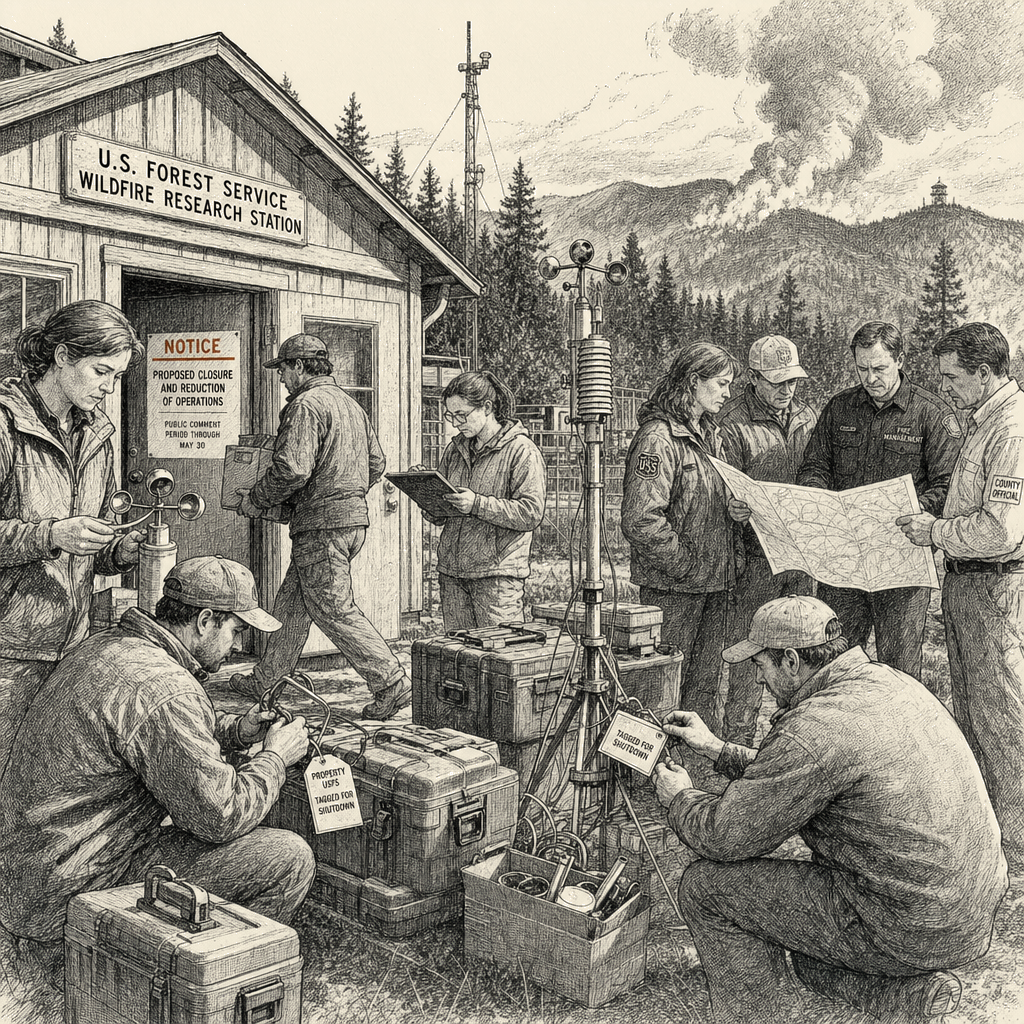
SEATTLE — The Trump administration has proposed closing more than half of the U.S. Forest Service’s research stations and zeroing out the agency’s research and development budget, a move that scientists and state officials warn will cripple wildfire forecasting as the West prepares for a potentially severe fire season.
The Seattle lab run jointly by the Forest Service and the University of Washington produces real-time smoke maps used by federal firefighting teams, state agencies and commercial apps that millions of people rely on during wildfire season. The lab is one of 56 of the agency’s 90 research stations identified for closure as part of a larger Forest Service reorganization that also relocates the agency’s headquarters from Washington, D.C., to Utah.
“We have a wildfire crisis in the West and in the United States,” said Ernesto Alvarado, a fire ecologist and associate professor at the University of Washington’s School of Environmental and Forest Sciences, who helped create the smoke mapping technology. “We need to bring new technology fast.”
Alvarado said the taxpayer-funded technology is the product of “institutional knowledge developed through years of Forest Service research,” including decades of work by a single Seattle-based team. He demonstrated the maps in his office, zooming in on a wildfire burning in New Mexico to show where smoke and harmful particulates were forecast to drift.
Morgan Varner, a fire behavior scientist who worked at the Seattle smoke lab until 2019, expressed doubt that many current staff would relocate or take other jobs within the agency. The lab was placed in Seattle because of its international airport and proximity to a major research university, he said. “There’s a haphazard to it that I think is troubling from a scientist standpoint,” Varner said.
Current lab employees did not respond to interview requests, according to NPR.
Forest Service Chief Tom Schultz, speaking from the agency’s Washington headquarters, defended the reorganization, saying it had been considered by previous administrations going back to 2006. He noted the Forest Service has a $3 billion deferred maintenance backlog and that closing or consolidating buildings will save money. In some cases, he said, scientists may move to nearby state offices or other locations within commuting distance.
“This administration is trying to be thoughtful as we move forward,” Schultz said. “We involve the employees in so much of our discussions. But we’ve got to get our budget into control. We knew we had a big shortfall coming in.”
Schultz pushed back on the notion that the agency is abandoning science. “Research is important, science is extremely important in this organization,” he said. However, President Trump’s proposed 2026 and 2027 budgets zero out all Forest Service research and development funding. “If Congress were to adopt the president’s budget then we will pivot accordingly,” Schultz said.
Congress has so far declined to approve the cuts. Recent Capitol Hill hearings showed bipartisan opposition to the president’s plan, Schultz acknowledged. The agency already lost thousands of staff last year to layoffs, buyouts and early retirements connected to Trump’s Department of Government Efficiency team, the source reported.
In Washington state, Public Lands Commissioner Dave Upthegrove said the initial optimism his office felt about the Forest Service reorganization — which included a proposal for a state-level director similar to the Bureau of Land Management — has given way to uncertainty. “Recently the Forest Service has gone radio silent, and we’ve not been able to get updates on the progress and the status and the outcome of this work, so we are nervous,” Upthegrove said.
Upthegrove said the state relies directly on Forest Service fire and smoke research to coordinate its wildfire suppression response, especially in rural areas. He spoke at a trailhead reopening ceremony in the Mt. Baker-Snoqualmie National Forest east of Seattle, describing the Pacific Northwest woods as “once thought immune from major fires” but now at risk of becoming flammable or choked in smoke within weeks.