Summary
- The Trump administration selects Penn Transformation Partners to redesign Pennsylvania Station using a roughly $8 billion public-private concession model that bypasses historical Madison Square Garden relocation requirements.
- Architect Vishaan Chakrabarti and former Transportation Department official Peter Cipriano structure the winning proposal around the removal of a 5,600-seat theater beneath the arena to enable a single-level concourse and increased natural light.
- The governance model consolidates capital-spending and air-rights authority into a 50-year performance-based concession for Halmar, insulating capital streams from sequential legislative veto points.
- Former New York City Transit President Andy Byford attributes a departure from historical project stall dynamics to design quality, financial structuring, and centralized presidential involvement.
- Architectural features include Paul Cret-inspired modernist framing and a monumental presidential seal explicitly crediting Donald J. Trump, diverging from the defeated neoclassical coalition’s proposal.
- Operational degradation indicators—including mobile cooling units for transit waiting areas and a structural capacity utilization exceeding 300 percent—establish the documented baseline driving the redevelopment mandate.
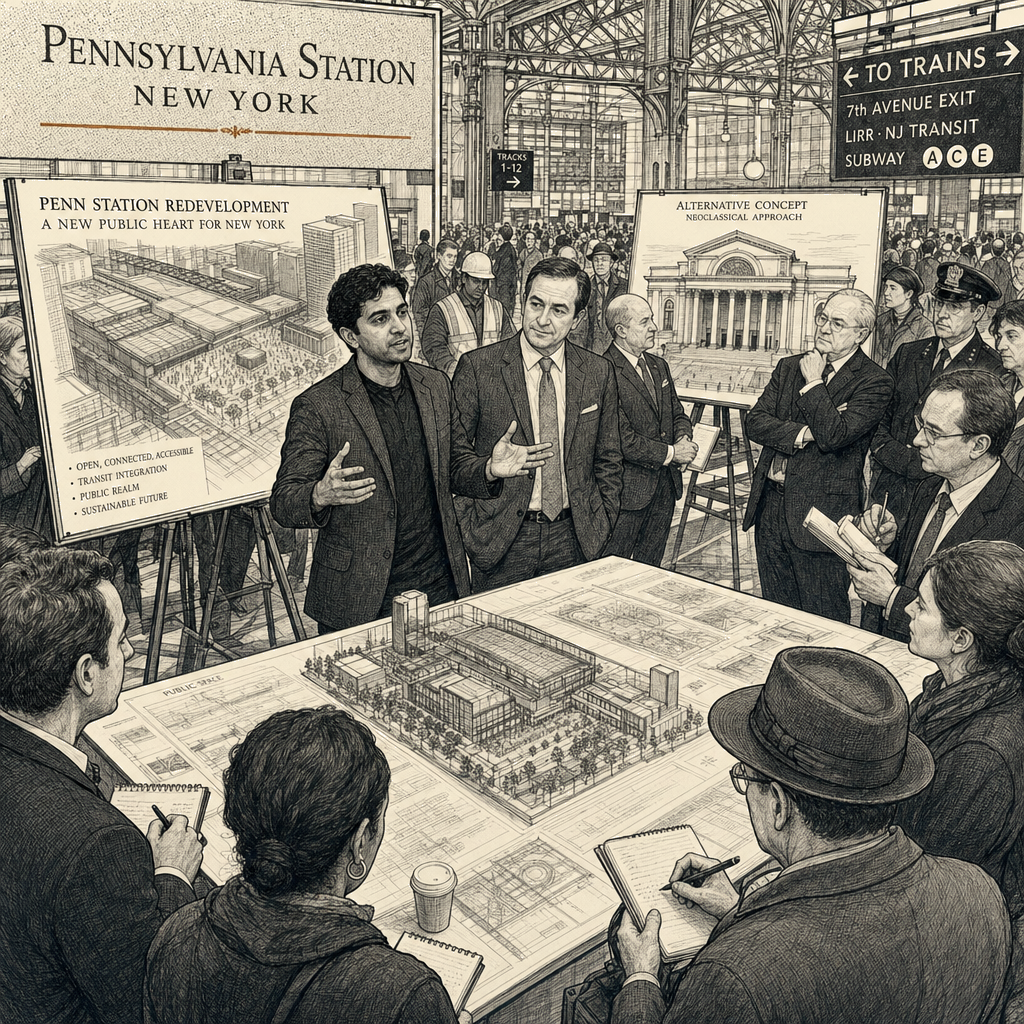
The Trump administration’s selection of Penn Transformation Partners to redesign New York’s Pennsylvania Station concludes a federal competition addressing one of the most chronic infrastructure failures in the United States. The winning consortium, structured around a roughly $8 billion public-private partnership, bypasses the historical necessity of relocating Madison Square Garden by proposing structural modifications that remove an underlying theater and reclad the arena’s exterior. Former New York City Transit President Andy Byford, recruited by the administration to oversee the initiative, described the quality of the design and financial plans, combined with presidential involvement, as a departure from previous failed efforts. The project proceeds against a documented baseline of operational degradation where the facility processes more than 600,000 passengers daily against a design capacity of 200,000, a strain amplified by the arrival of more than one million World Cup fans.
Structural Reconfiguration and Governance Consolidation
The proposed governance structure shifts operational accountability from sequential state legislature veto points to a consolidated private entity under a 50-year performance-based concession. According to Peter Cipriano, who worked for the first Trump administration in the Transportation Department before joining Halmar’s U.S. subsidiary, the financial plan aggregates real-estate air-rights negotiation and capital-spending authority into a single framework. This model partially insulates funding streams from annual appropriations cycles and binds the concessionaire’s financial returns to the station’s operational performance and revenue generation.
Historical project governance exhibited characteristics of symptomatic fixes and incremental state responses rather than resolution of root capacity deficits. Previous iterations include Governor Andrew Cuomo’s Moynihan Train Hall, which handles approximately 10 percent of the station’s traffic, and Governor Kathy Hochul’s cancellation of Cuomo’s planned office towers. The Metropolitan Transportation Authority under Janno Lieber pursued incremental improvements prior to this federal selection. The current consortium’s retention of the Madison Square Garden footprint circumvents the political and financial friction of relocation, a requirement that defeated prior redevelopment attempts and a rival Klingenstein/Washburn neoclassical proposal.
The design’s primary physical intervention removes the 5,600-seat theater situated beneath the arena. According to Cipriano, this removal opens structural possibilities for increased natural light, improved loading dock configuration, fewer columns crowding train platforms, and a single-level passenger concourse. The retention mandates structural modification of the arena itself, including recladding the exterior with vertical fins and tall windows.
Architectural Framing and Coalition Dynamics
The selection process reflected competing visions of the hub’s civic purpose. The winning coalition, which includes construction firm Skanska and architects HOK, evolved the design after the federal takeover was announced by Transportation Secretary Sean Duffy. The coalition studied the works of French-American architect Paul Cret, adopting horizontal dimensions mirroring the 1910 Beaux-Arts terminal and contemporary fluted columns.
Key architectural features include a coffered Eighth Avenue main hall ceiling depicting a Manhattan street map using blue tiles for the Hudson River, positioning of four original granite eagles, sweeping staircases, and a parabolic main hall featuring retail space and the world’s longest bar. The design also incorporates a monumental presidential seal carved into a stone wall crediting Donald J. Trump. Vishaan Chakrabarti stated that the inclusion acknowledges the commissioning authority, describing the style as an attempt to transcend partisan politics.
The defeated neoclassical faction, backed by donor Thomas Klingenstein and architecture critic Justin Shubow, called for full Garden relocation and proposed a facade of Doric columns along Seventh Avenue. Shubow dismissed the winning design as “ho-hum” and “lacking the grandeur of full-blown classical architecture.” The rejection of the neoclassical model narrowed the winning scope to theater removal and exterior recladding.
Operational Baseline and Systemic Degradation
Current operational conditions at the terminal reflect systemic normalization of degraded infrastructure. The facility handles more than 600,000 passengers daily against an original design capacity of 200,000. Documented indicators of this operational degradation include the “Pit” area where NJ Transit passengers wait for trains cooled by mobile air conditioning units. Recent security incidents, including a stabbing near the facility, further illustrate the operational environment that project leadership characterizes as a condition requiring corrective capital investment.
The arrival of more than one million World Cup fans in New York City this month amplifies passenger flow against the stagnant infrastructure capacity. Andy Byford, whose reputation was established through subway stabilization efforts in 2018, characterized the current selection as the “best chance yet” to address what he identified as decades of failed redevelopment attempts. Byford stated that the project represents his crowning achievement, noting in an interview with the Wall Street Journal that the involvement of a president with development experience serves as a “game-changer.”
Execution Windows and Structural Precariousness
The project configuration introduces an 18-month pre-construction window for design finalization, budget determination, and securing federal appropriations, with construction targeted before 2028. Federal executive attention establishes a reinforcing dynamic where presidential backing reduces stakeholder resistance to the Garden-retention model, facilitating a credible funding pathway and ground-breaking.
However, embedding a presidential seal and explicit political markers introduces structural precariousness linked to the incumbent executive identity. Historical precedents demonstrate that political reliance affects project continuity, as evidenced by the derailment of Governor Eliot Spitzer’s federal funding pursuit during a concurrent scandal and subsequent administrative cancellations of surrounding development projects. The dominance of the current reinforcing dynamic depends on measurable milestones within the 18-month window. Delay risks re-empowerment of historical funding uncertainty or administrative shifts.
The redevelopment functions as a coordinated intervention across capacity failure, aesthetic judgment, and public safety governance. Stated optimism from project leadership operates as a system variable that accelerates initial commitment. Vishaan Chakrabarti reflected on potential execution risks by stating, “No one can sit here and say nothing can go wrong,” while noting he has never been more optimistic. The project’s outcome depends on sustaining political attention across the execution delay, managing reliance on a solitary financial partner under the concession model, and navigating the physical constraints of the arena infrastructure.
Analytical techniques used in this piece
This analysis applies the methods below. Each links to a short, plain-English explainer you can read and reuse.
- Relationship Mapping
- Extracts the network of ties among people, institutions, and entities.
- Systems Dynamics (Structural)
- Maps a system’s structure — stocks, flows, and the architecture that shapes its behavior.
- Wicked Problems
- Treats a problem as wicked — no stopping rule, no clean test of success, every attempt consequential.