Summary
- Canada’s Ambassador Mark Wiseman and chief trade minister Dominic LeBlanc have positioned tariff relief as the precondition for broader trade engagement, a strategy that channels negotiations away from the USMCA’s institutional dispute-settlement framework and toward bilateral dynamics that the evidence suggests favor the larger party.
- Trade lawyer Mark Warner has observed that investors and traders will use the annual USMCA reviews as their primary reference frame for risk assessment, creating a structural disconnect between Ottawa’s characterization of the review’s importance and the market’s information architecture.
- William Ury, co-founder of Harvard’s Program on Negotiation, has described the surrounding community of actors capable of preventing, resolving, or containing a dispute as the “third side”; in the current Canada-U.S. standoff, the mediator, bridge-builder, and healer roles within that framework remain unoccupied.
- Five consecutive quarters of declining Canadian business investment demonstrate that the USMCA’s containment function — maintaining baseline terms through 2036 — is preserving institutional continuity at the cost of chronic economic injury.
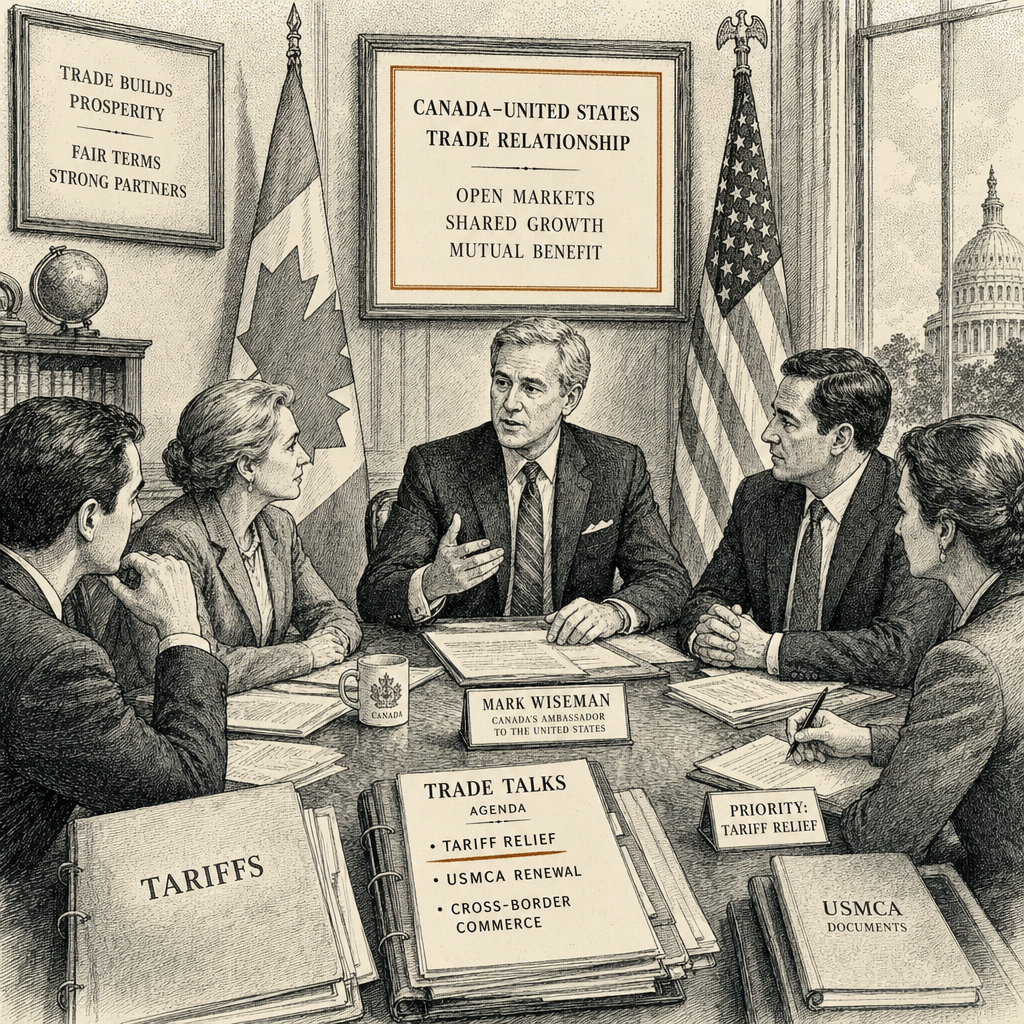
Canada is signaling that its immediate priority in trade talks with Washington is relief from sector-specific U.S. tariffs on steel, aluminum, and automobiles — duties that have reached 50% on steel and that Ambassador Mark Wiseman described as “incredibly, incredibly painful to wide sectors of the Canadian economy” — rather than the formal review of the United States-Mexico-Canada Agreement scheduled for July 1. The strategic reorientation, articulated by Wiseman in Toronto on June 15 and reinforced by LeBlanc’s refusal to agree to USMCA changes or other policy concessions until tariffs are eased, carries an analytical consequence: it channels a dispute that could be adjudicated through institutional mechanisms into bilateral negotiation dynamics where leverage is asymmetric.
The tariff landscape
The U.S. sector-specific tariffs — some reaching 50% on steel imports from Canada under Section 232 authority, as confirmed by Blakes, tariffstool.com, and PwC Canada, with additional tariffs on automobiles also imposed under Section 232 — have produced measurable economic injury. Canada is the largest foreign supplier of steel and aluminum to the United States and, according to the Wall Street Journal’s reporting, among the largest foreign suppliers of light-motor vehicles. Business investment in Canada has declined for five consecutive quarters, a trend confirmed by Statistics Canada’s Q1 2026 GDP data. Policymakers have identified the investment decline as a pattern that must reverse to support economic recovery. The tariff uncertainty has prompted many Canadian businesses to cancel or delay spending and hiring plans — markers of a trade conflict generating its own momentum, independent of the original policy dispute.
Wiseman’s Toronto remarks positioned tariff relief as the immediate priority, framing the July 1 USMCA review as secondary. “We need to find a path forward on quickly” on the sectoral tariffs, Wiseman said, “because unlike everything else under USMCA, the default is they’re staying in place.” His public de-emphasis of the review could be read as a deliberate negotiating posture: by signaling that Canada can rely on the USMCA’s baseline protections — terms remain in force through 2036 regardless of review outcome, as confirmed by Congressional Research Service reports R48787 and R48964 and by Brookings — Ottawa may be denying Washington the leverage of a deadline.
The institutional architecture and its underuse
The USMCA’s institutional framework binds both parties symmetrically. Chapter 31 provides for dispute-settlement panels convenable without consensus; Canada has invoked these mechanisms in prior disputes over U.S. trade measures. The same mechanisms constrain U.S. conduct, and Washington faces institutional reputational costs if panel rulings against its tariff measures were issued and not honored. The agreement’s built-in review maintains terms through 2036 even absent agreement, providing a containment function.
By signaling that the July 1 review is secondary to bilateral negotiation, Canada risks converting a multilateral institutional process into a backdrop for bilateral haggling. The formal review is the structure through which rights and obligations are publicly negotiated and through which disputes acquire legitimacy. Trade lawyer Mark Warner, who practices in both the United States and Canada, observed that “for investors and traders, the annual USMCA reviews will likely be what they focus on, when they try to calculate and assess risks and uncertainties as they make significant strategic decisions.” Ottawa’s characterization of the review’s importance does not control how the investing and trading community will use it as their reference frame.
Wiseman echoed comments made last month by Prime Minister Mark Carney, who said in a video address in April that Canada’s economic ties to the U.S. had become a source of weakness. Wiseman said Canada had become too complacent about its economy, relying too heavily on trade with the U.S. as its main engine of growth. “We need to diversify our sources of demand for our products,” Wiseman said. At the same time, he played down any suggestion of a rift, saying Canada’s strategy of pursuing new trade markets should not be interpreted as turning its back on the U.S. economy. “We, as Canadians, are privileged to be next door to the world’s most dynamic economy,” he said during a question-and-answer session with Bank of Montreal Chief Executive Darryl White. “We should not seek to trade that for anything.”
The absence of third-party roles
William Ury, co-founder of Harvard’s Program on Negotiation and author of Getting to Peace (1999), has described the surrounding community of actors that could prevent, resolve, or contain a conflict as constituting the “third side,” comprising ten roles across three clusters: prevention, resolution, and containment. In the current Canada-U.S. standoff, few of those roles are occupied, and many of those that are sit with interested parties whose neutrality is in question.
Prevention. Wiseman’s statement that Canada must diversify demand — echoing Carney’s April remarks — surfaces the provider role. That is a long-term preventive domestic policy step, not a structured third-side intervention. The teacher role has no visible occupant: no institution is playing a credible public educator role about de-escalating tariff disputes without conceding core interests. The bridge-builder role is nominally filled by the daily bilateral contacts Wiseman described as “productive, serious, informed, and respectful,” but a genuine bridge-builder sits outside the negotiating table. No evidence exists of an active, neutral convener from business, academia, or a cross-border body.
Resolution. The mediator role is absent: no third party is facilitating communication between Ottawa and Washington; governments are talking directly. The arbiter role is partially embedded in the USMCA itself, through its Chapter 31 mechanisms and its review provisions, but the arbiter function does not address the immediate economic injury from tariffs. The equalizer role receives passing mention only in the context of Canada diversifying trade, which would strengthen its hand over time, but no near-term equalizing measure is identified. The healer role is nowhere in evidence; the rift is described in economic terms, but the underlying sentiment — particularly from U.S. tariff actions that contradict the spirit of a trade pact — goes unaddressed.
Containment. The witness role is partially filled by the business audience and media covering Wiseman’s speech. The referee role is the USMCA itself, but LeBlanc’s refusal to agree to changes until tariffs are eased is a direct challenge to the pact’s perceived fairness as a level playing field. The peacekeeper role is not yet relevant; the conflict remains diplomatic and economic.
Among the absent roles, three are most consequential for the current dynamic: the bridge-builder, the mediator, and the healer.
Why the third side is thin
The thinness of third-party engagement is not mere oversight. Ottawa may resist mediation that inserts a third party into a bilateral negotiation and risks being perceived as requiring assistance. Washington’s preference for direct, leverage-heavy engagement — using tariff uncertainty as a strategic tool, as Warner’s assessment implies — makes an independent mediator unattractive to the stronger party. The USMCA’s built-in review, while insufficient to ease immediate pain, provides an institutional forum that reduces the immediate pressure to construct an external arbiter. The third side’s absence is, in part, a reflection of the strategic landscape itself.
Sub-federal and multilateral dimensions
No visible bridge-building function is operating at the sub-federal level. The province-led ban on U.S. wines and spirits — a retaliatory measure Ottawa will not lift until tariffs ease, as LeBlanc has stated — suggests that provincial actions are part of the conflict’s machinery rather than a site for independent relationship maintenance. In past Canada-U.S. trade disputes, sub-federal actors — governors, premiers, cross-border business coalitions — have occasionally served as independent voices creating space for federal negotiators. No such function is evident in the current record.
The U.S. tariff posture is not limited to Canada. Sector-specific tariffs have been applied across multiple trading relationships, suggesting that the driver is not a bilateral grievance but a broader U.S. trade-policy orientation. If that structural assessment is correct, bilateral negotiation alone may be insufficient, and Canada’s leverage would come partly from coalition-building with other affected trading partners and partly from the institutional channels that constrain unilateral tariff imposition. Neither avenue is prominently represented in Canada’s current public posture.
Containment without resolution
Wiseman is right that the USMCA’s default structure — terms in force for a decade — provides a containment function that prevents an immediate rupture. Daily bilateral talks provide a working-level communication channel. But containment without resolution produces a chronic pattern visible in long-running trade standoffs: businesses adapt to uncertainty, investment shifts to other jurisdictions, and the cost is borne by the economy that can least absorb it. The five-quarter investment decline in Canada suggests this process may already be underway.
The July 1 review is not an endpoint — Wiseman’s framing of its continuity function is accurate — but it is the most visible institutional opportunity to convert bilateral momentum into a structured outcome. Treating it as a formality to be downplayed, rather than a mechanism to be used, may leave Canada with bilateral negotiations that proceed at Washington’s pace and institutional channels that remain under-leveraged.
The absence of a robust third side leaves the standoff with few channels for de-escalation that do not require either party to make a unilateral concession.
What would shift the dynamic
The resolution function most consequential for the current dynamic is a formal move into the USMCA’s dispute-settlement process for the tariff measures — not as a replacement for bilateral talks, but as a parallel channel that creates institutional accountability and raises the cost of maintaining tariffs that the agreement’s terms may not support. The bridge-building function would benefit from visible cross-border business and sub-federal coalitions articulating the shared cost of prolonged uncertainty. The witness function — transparent, public documentation of the tariff measures’ economic effects — would constrain the space for indefinite maintenance by making the costs legible beyond the negotiating rooms.
Canada’s stated ambition to diversify trade relationships makes structural sense, as Carney acknowledged. In the medium term, the U.S. market remains, as Wiseman put it, “the world’s most dynamic economy” next door. The central analytical question is whether engagement is being channeled through institutions designed to constrain asymmetric leverage, or through bilateral dynamics that tend to favor the larger party.
Wiseman added that talks with U.S. officials are proceeding on an almost daily basis, describing them as “productive, serious, informed, and respectful.” Behind the scenes, he said, “stuff is getting done.” Most trade watchers do not expect the U.S. to agree to a USMCA renewal on July 1, arguing that the current policy uncertainty gives Washington negotiating leverage. Informal cross-border contacts among business leaders that model cooperative problem-solving may, over time, create conditions under which both governments can exercise resolve without inflicting lasting damage. Those conditions remain largely unmade.
Analytical techniques used in this piece
This analysis applies the methods below. Each links to a short, plain-English explainer you can read and reuse.
- The Third Side
- Takes the vantage of the surrounding community that has a stake in resolving a conflict (Ury).
- Bayesian Reasoning
- Starting from base rates and updating beliefs proportionally as evidence arrives.