Summary
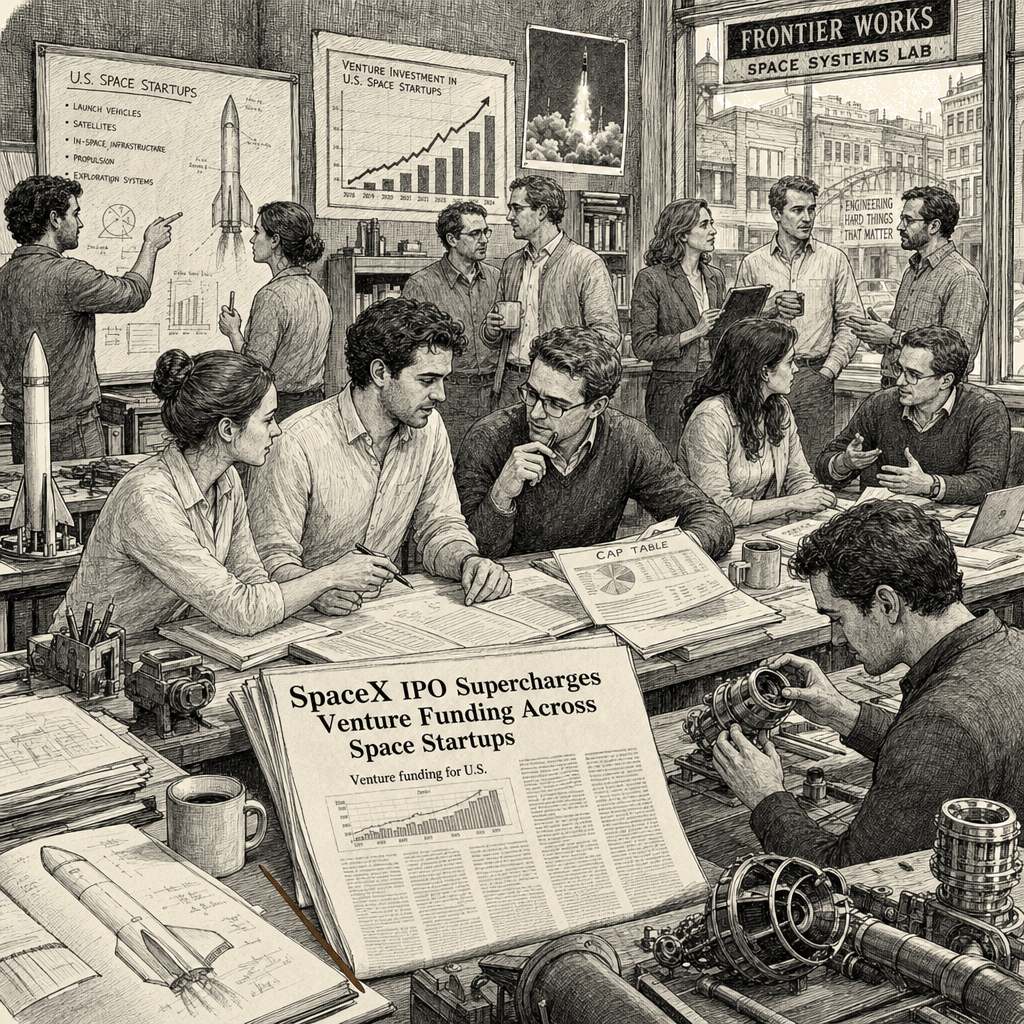
- SpaceX’s $75 billion June 2026 IPO amplified venture-capital flows into U.S. space-technology startups that had already accelerated to $7.1 billion in 2025 — nearly triple the prior year’s $2.5 billion — according to PitchBook data reported by The Wall Street Journal.
- A hub-and-spoke credibility network centered on SpaceX alumni transferring operational experience into new ventures operates alongside the IPO’s capital-dispersal effect, with both structural and sentiment channels contributing to the funding surge.
- The presence of contract backlog and diversified commercial-government demand pathways at several funded startups, contrasted with the 2021 blank-check cycle that ended in bankruptcies such as Virgin Orbit’s, represents the key uncertainty over whether the current cycle proves more durable.
The June 2026 initial public offering of SpaceX attracted $75 billion from public-market investors, per the company — a milestone for a firm that nearly went out of business during its early years, and one that appears to be directing new capital into startups across the broader space sector. Yet the data indicates the IPO amplified momentum that was already building: U.S. space-technology venture funding excluding SpaceX reached $7.1 billion in 2025, the sector’s strongest year since companies raised nearly $4 billion in 2021, according to PitchBook figures reported by The Wall Street Journal. The IPO’s catalytic effect, the sector’s technological maturation, and the expanding credibility network of former SpaceX engineers and executives operating as founders and investors are converging to produce the largest funding wave in the space-technology startup ecosystem’s history — one whose durability remains the subject of significant uncertainty among the participants themselves.
Pre-IPO Momentum: Technological Maturation as the Leading Driver
The $7.1 billion raised in 2025 — a year before the June 2026 IPO — exceeded the sector’s prior peak and provides the strongest evidence for the hypothesis that technological maturation, independent of any single catalytic event, is the primary structural driver of the current cycle. The space sector had reached operational milestones — reusable rockets, commercial satellite demand, demonstrated revenue models — that justify increased funding allocation on fundamentals, according to industry executives.
John Gedmark, CEO of Astranis, a maker of smaller satellites orbiting more than 22,000 miles from Earth, told the Journal: “There’s just so much more you can do from space” and “Investors are finding there are real business models in space and money to be made.” Astranis recently raised capital from Franklin Templeton and others, broadening the investor base beyond specialist space venture firms into public-market crossover territory.
Andrew Rush, CEO of Star Catcher Industries, a startup developing a power grid in orbit, told the Journal that many large venture investors in the past “would not touch space-related deals unless a company was led by someone like Musk, who had generated returns.” Rush said that constraint has relaxed because the space sector has demonstrated it can deliver.
The implication from the funding data: the 2026 post-IPO wave rests on a foundation that was established before public-market capital entered the picture. If the maturation thesis holds, the current cycle has structural underpinnings that distinguish it from sentiment-driven predecessors.
The SpaceX Alumni Credibility Network
SpaceX occupies a central position in a hub-and-spoke credibility transfer network. Engineers and executives who worked at the Musk-led company have been fanning out as space-industry founders and investors, and the IPO is expected to prompt newly wealthy staffers to make similar leaps, former employees told the Journal.
Tom Mueller, a former top SpaceX executive who founded Impulse Space, the in-space mobility company, recently raised $500 million. Mueller told the Journal that space was already attracting significant investor interest before the SpaceX IPO, and that the listing intensified that trend further. K2 Space, co-founded by brothers Karan Kunjur and Neel Kunjur — the latter of whom spent more than five years working on SpaceX’s Dragon spacecraft — is building satellites weighing roughly 2 tons and had $500 million in signed contracts across commercial and government clients at the end of 2025, according to CEO Karan Kunjur.
The network’s mechanism operates through at least three channels. First, a causal channel: the IPO distributed wealth to SpaceX shareholders and employees, some portion of which is expected to flow into founding or investing in space ventures. Second, an influential channel: the $75 billion IPO signals sector maturity to institutional investors who previously lacked a public-market reference point for space-technology valuations, reducing the perceived risk premium across the sector. Third, a structural channel: the demonstration effect induces more engineers to leave and start companies, expanding the venture pipeline.
Cross-links amplify these pathways. Founders Fund has portfolio exposure across multiple space companies, including Varda Space Industries, which conducts pharmaceutical experiments in low-Earth orbit. Delian Asparouhov, a Founders Fund partner who co-founded Varda, told the Journal: “I do think it helps to be in this current moment as a mature company.” Franklin Templeton’s Astranis investment connects public-market crossover capital to private venture rounds, meaning a sentiment shift at one node could propagate through multiple pathways simultaneously.
Post-IPO Amplification: Specific Raises and Capital Channels
The 2026 wave has produced specific large raises across the sector: Observable Space raised $90 million focused on laser communications and sensing; Northwood Space pulled in $100 million for ground systems; CesiumAstro recorded $470 million in equity and financing for space systems and electronics; and Impulse Space closed $500 million for in-space mobility, per the Journal’s reporting.
The breadth of subsectors receiving funding — spanning satellite makers, ground systems, orbital mobility, in-space power, and communications — indicates that capital is not concentrated in a single thesis but distributed across the space-technology value chain. This diversification may represent a structural difference from prior cycles where capital clustered around narrower launch-vehicle narratives.
Demand Pathways and the Pentagon Variable
The presence of demonstrated demand at several funded companies functions as a potential structural differentiator from the 2021 blank-check cycle. K2 Space’s $500 million contract backlog represents the most visible traction signal in the current cohort. Astranis’s established satellite manufacturing operations and Franklin Templeton’s crossover investment suggest commercial revenue pathways exist alongside speculative ones.
A critical external variable is Pentagon spending. The Journal reported that a target customer for many space startups is the Pentagon, “which might be in line for a historic budget increase that would shower space programs with billions of dollars in new funding.” The Pentagon variable operates as a cross-link between otherwise independent companies: if defense spending increases, multiple startups benefit simultaneously; if the budget increase does not materialize, demand contraction would affect the sector broadly. The article does not quantify what fraction of current contracts and pipeline revenue traces to government versus commercial demand, making the magnitude of this dependency difficult to assess from available reporting.
2021 Precedent: The Cautionary Frame
Investors and executives cited the 2021 blank-check company wave as a cautionary reminder of the sector’s risks. Virgin Orbit, which used a plane to launch satellites, went public via a blank-check merger in 2021 and filed for bankruptcy less than 18 months later before shutting down. The blank-check wave prompted regulatory scrutiny and demonstrated that space-technology companies face risks heightened by the challenges of building devices capable of operating in orbit — a harsh environment where the margins between success and failure are thin, as executives told the Journal.
Some business models in the current cycle are expected to face similar investor skepticism. Asparouhov told the Journal: “People can go look at a lunar hotel but there’s no revenue, there’s no path to revenue.” The distinction between revenue-bearing and speculative models represents the key fork in the current cycle’s trajectory.
Dependency Risk and Structural Vulnerability
SpaceX’s central position in the credibility network creates a structural dependency for the broader sector. A significant adverse event at SpaceX — a public-market valuation decline, a high-profile mission failure, or a strategic pivot — would propagate inward through the same network, potentially re-raising the risk premium that investors demand of alumni-founded companies. Well-capitalized companies with independent revenue traction, such as K2 Space’s contract backlog, would be better positioned to weather such repricing; companies whose valuations rest primarily on the SpaceX halo would be more exposed.
Blue Origin’s situation illustrates that even large, well-capitalized space companies face operational risks. The company is racing to rebuild a Florida launchpad wrecked by an explosion, as the Journal reported. Sector giants such as SpaceX and Blue Origin can survive a big setback; smaller startups often cannot, investors told the Journal.
Time Horizons: What the Cycle Produces Next
In the immediate term — 0 to 12 months — the IPO’s wealth-creation effect will seed new angel investments and startup formations. Venture rounds for multiple companies have already closed. Competition for talent, launch contracts, and spectrum rights will intensify as capital chases finite infrastructure.
Over 1 to 5 years, capital concentration in well-funded companies will produce operational survivors alongside a cohort that fails to secure follow-on funding. The existence of both commercial and government revenue pathways, in contrast to the 2021 wave’s reliance on speculative demand, may provide greater structural resilience, though this remains to be demonstrated. The influx of capital will stress launch infrastructure and supply chains, potentially creating bottlenecks that raise costs for smaller players. Well-capitalized firms will absorb underperforming competitors; speculative business models without a demonstrated path to revenue will fail.
The key discriminating uncertainty over 12 to 24 months is whether current recipients demonstrate revenue growth that validates the maturation hypothesis. K2 Space’s contract backlog shifts the posterior probability toward structural-maturity and liquidity-spillover explanations and away from a purely sentiment-driven cycle. The Pentagon budget increase operates as a critical conditional variable: if it materializes, it provides a fiscal tailwind absent in 2021 and reinforces the maturation thesis; if it does not, demand contraction raises the probability of cyclical reversion.
Over 5 or more years, the sector’s trajectory depends on whether the ecosystem diversifies its credibility base beyond SpaceX’s halo. If SpaceX continues to perform and the IPO’s wealth-creation effect seeds a new generation of well-capitalized founders with independent operational experience, the ecosystem may mature toward the diversified structure that the technological-maturation hypothesis describes. If the ecosystem remains a network of spokes dependent on one hub, a significant adverse event at SpaceX would represent a systemic rather than isolated risk — and the structural parallels to the 2021 cycle would become harder to dismiss.
Analytical techniques used in this piece
This analysis applies the methods below. Each links to a short, plain-English explainer you can read and reuse.
- Bayesian Hypothesis Network
- Updates the probabilities of competing hypotheses as evidence accumulates.
- Consequences & Sequels
- Plays a decision forward to its first- and second-order consequences.
- Relationship Mapping
- Extracts the network of ties among people, institutions, and entities.
- Bayesian Reasoning
- Starting from base rates and updating beliefs proportionally as evidence arrives.