Summary
- The U.S.-Iran memorandum of understanding begins dismantling the sanctions regime against Iran before nuclear negotiations conclude, granting oil market access projected to generate over $60 billion in annual revenue according to former senior U.S. sanctions official Richard Nephew.
- Three causal accounts compete over the deal’s revenue terms: the administration frames relief as reversible inducement; Michael Singh, former National Security Council senior director, warns the cash infusion strengthens the regime regardless of compliance; and the Wall Street Journal reports the broad permissions reflect pressure on the Trump administration to produce an agreement.
- The MOU’s contingency language provides no documented snapback mechanism, revenue-ring-fencing from sanctioned entities, or enforcement architecture, leaving the reversibility question unresolved until follow-up nuclear negotiations either proceed or stall.
- Market actors appear to have priced in the deal’s durability: three Iranian tankers carrying over 5 million barrels crossed the U.S. blockade line before the agreement was signed, with Vortexa’s Claire Jungman characterizing the movements as anticipatory positioning.
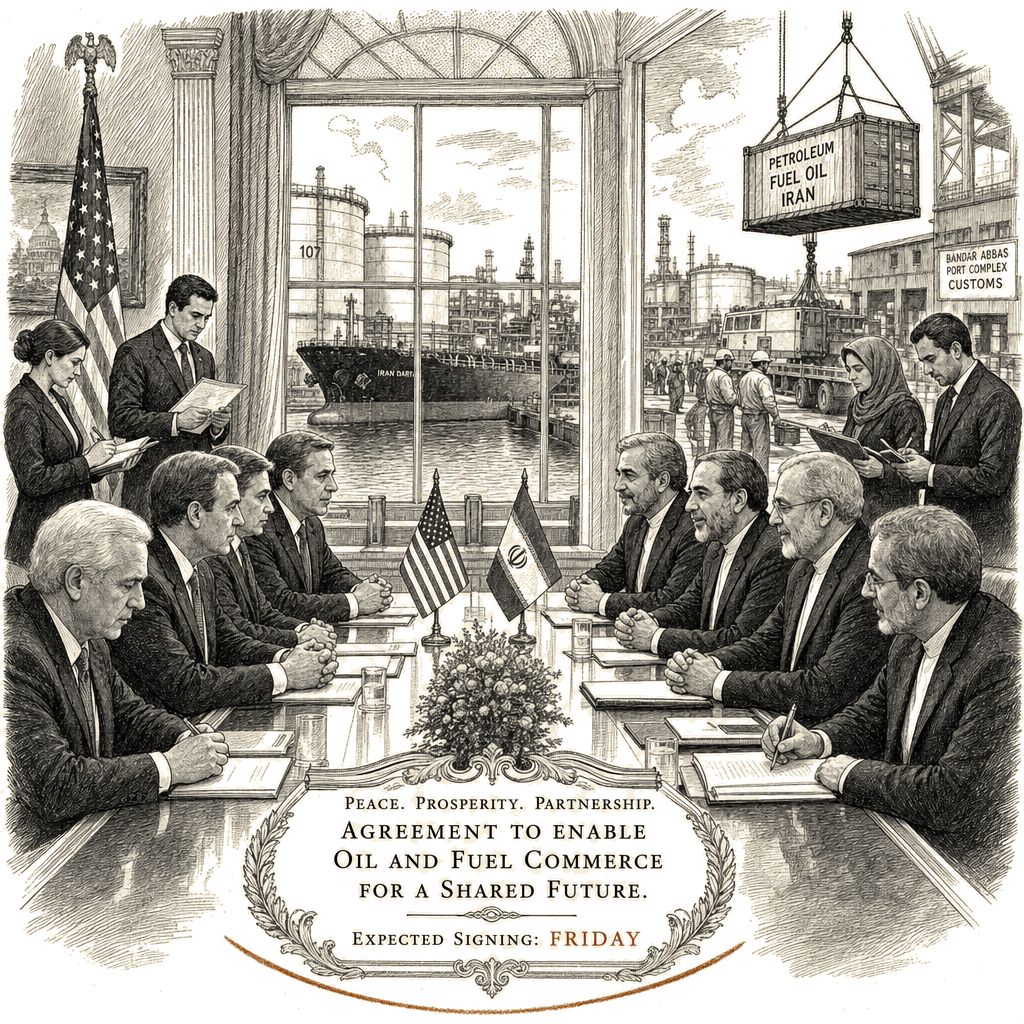
The U.S.-Iran memorandum of understanding, scheduled to be signed Friday, will allow Iran to sell oil and fuel on international markets and open banking connections enabling Tehran to repatriate revenue, a senior U.S. administration official told the Wall Street Journal. The agreement begins dismantling the core of the sanctions regime built against Iran over the past decade before the administration has secured a broader deal on the country’s nuclear program—a sequencing decision that raises the central analytical question of whether the arrangement’s reversibility provisions will prove operative or decorative once revenue flows.
The sequencing problem
The agreement’s contingency language makes relief reversible in principle; whether reversibility holds in practice depends on the administration’s willingness to bear the political and economic costs of reimposition, a condition the current evidence does not resolve.
A senior U.S. administration official told the Journal that the oil-market pledge could be rolled back if follow-up talks on Iran’s nuclear program and other issues are not productive. U.S. officials stressed that sanctions relief is contingent on Iran meeting requirements concerning its nuclear activities and reopening the Strait of Hormuz. A senior U.S. official said Tuesday that continuing the relief depends on Tehran’s compliance.
The sequencing—relief flowing upfront, nuclear bargaining deferred—means Iran can extend negotiations while extracting revenue. The scale of revenue, once flowing, creates structural costs to reimposition: trading partners would face disruption, and the administration would face pressure to maintain the arrangement, eroding the option value of reversibility. The MOU includes a potential $300 billion investment plan; the article provides no detail on disbursement conditions or guarantees. If disbursed, such investment creates a constituency for preservation, structurally raising the political cost of reversal. The absence of described snapback provisions and compliance mechanisms for revenue flows strengthens the argument that relief is not easily reversible, though the article does not detail monitoring or enforcement architecture, making a definitive assessment premature.
The evidence currently available does not provide a doubly-decisive test between the competing hypotheses. A swift reimposition with clear triggering criteria would support the reversible-inducement hypothesis; a vague warning followed by continued revenue flows would support the structurally-difficult-to-reverse hypothesis.
How the deal is being read
Three competing causal accounts explain why the agreement’s revenue terms are as broad as they are.
The first—the administration’s stated rationale—frames sanctions relief as a reversible inducement intended to purchase a broader nuclear settlement. On this account, the contingency language and compliance conditions are substantive, and the administration retains credible leverage.
The second account holds that the revenue transfer will strengthen the regime regardless of compliance outcomes. Michael Singh, former senior director for the Middle East at the National Security Council under President George W. Bush, articulated this concern: “The risk is you strengthen the regime by providing it with an infusion of cash. Supporting the proxies and even building missiles and drones is to some extent cheap. What’s really expensive for Iran is properly running their country.” On this reading, the regime can allocate freed revenue to destabilizing activities while using the civilian economy as cover.
The third hypothesis holds that the broad permissions reflect pressure on the Trump administration to produce a visible agreement, suggesting the revenue provisions were a concession extracted by Tehran rather than a calibrated inducement. The Journal reported that the broad permissions granted to Iran’s oil complex reflect the pressure the administration was under to get a deal done. The agreement, the Journal noted, is a bet that money will soothe Tehran’s destabilizing inclinations.
Richard Nephew, the former senior sanctions official now at Columbia University, qualified his assessment with language that does significant analytical work: “This MOU won’t necessarily open a free-for-all in Iran’s economy. But, Iran will generate considerable revenues and likely be able to access those revenues.” The qualifier “likely” registers the gap between what the agreement promises and what implementation will deliver.
The dominant narrative—that sanctions relief will reliably produce both economic restoration and strategic change—rests on a chain of links that the available information does not fully substantiate. None of the three accounts has been foreclosed by evidence.
Revenue flows and regime access
The agreement opens banking connections that will allow Iran to repatriate revenue from oil sales—revenue that has largely been trapped abroad due to financial sanctions, according to the Journal. Nephew estimated Iran could generate $8 billion in revenue in the first two months of the deal and over $60 billion in a year based on prewar production levels. The $60-billion projection rests on assumptions about unimpeded export routes, sustained investment, favorable oil prices, and effective nuclear conditionality that the current reporting cannot confirm.
The U.S. naval blockade, which began in April, slashed Iran’s oil exports from roughly 1.1 million barrels per day in March to 65,000 barrels per day in May, according to United Against Nuclear Iran. As storage filled, Iran turned off some wells, with crude production slipping by a third to 2.3 million barrels per day in May from roughly 3.5 million before the war, according to the International Energy Agency.
Signs of loosening emerged this week. Three tankers—the Sonia I, Diona, and Hero II—carrying more than 5 million barrels of Iranian crude left the port of Chabahar and crossed the U.S. blockade line since Tuesday, according to UANI and ship-tracking data from MarineTraffic. Claire Jungman, director of maritime risk and intelligence at Vortexa, said “the timing is significant,” adding that the vessels appeared to be positioning in anticipation of a potential agreement. The movement of these vessels suggests market actors assess the reversal threshold as unlikely to be crossed.
The article does not address how oil revenue flowing through newly opened banking channels will be ring-fenced from entities under U.S. sanctions, including the Islamic Revolutionary Guard Corps. The article does not discuss the IRGC’s relationship to Iran’s oil sector, leaving a material gap in evaluating whether the revenue will reach the civilian economy or flow to security apparatuses.
The oil-market overhang
The International Energy Agency warned Wednesday that a lasting resolution could trigger an oil-supply overhang next year. Global supply is expected to surge by around 8 million barrels per day in 2027, heavily outpacing a 2 million barrel per day recovery in demand. The United Arab Emirates, which recently quit OPEC effective May 1, 2026, has promised to boost output, adding competitive pressure.
Iran’s crude production costs are reported as $10 to $30 per barrel—compared with U.S. shale break-even prices of $60 to $70 per barrel, according to unnamed analysts cited in the article. Independent verification of the specific Iran cost range was not available in the source material. A price collapse would pressure U.S. domestic producers, whose break-even prices exceed Iran’s reported production costs, generating domestic political costs for the administration—costs that would further reduce the political appetite for reimposing sanctions even if Tehran failed to meet compliance conditions.
Before the 1979 revolution, Iran produced between 5 million and 6 million barrels per day. That output dropped due to infrastructure damage from the Iran-Iraq War, the loss of foreign expertise, and chronic underinvestment. Analysts said that if infrastructure is intact and export routes reopen, Iran could recover lost production relatively quickly, but increasing output materially above pre-conflict levels would require foreign capital, technology, and oil-field services.
The full reintegration of Iran into global oil markets will depend on the waivers becoming permanent. That, according to the MOU, depends on a broader deal on Iran’s nuclear activities—the very negotiations whose outcome remains uncertain.
External actors and omitted dynamics
External actors with leverage over Tehran hold distinct interests that the source article does not address. A major oil exporter benefits from constrained Iranian output and higher prices. A major Iranian crude buyer benefits from discounted flows. The deal creates a decision node for such actors to accept reintegration or deepen bilateral arrangements bypassing U.S. financial architecture.
The revenue provisions are asymmetric: Iran can extend negotiations while extracting revenue, while the administration controls the revenue tap, but reimposing it is costly. The question the available evidence cannot yet answer is whether the administration will bear that cost when the moment arrives.
Analytical techniques used in this piece
This analysis applies the methods below. Each links to a short, plain-English explainer you can read and reuse.
- Process Tracing
- Reconstructs the step-by-step causal pathway of a specific historical event.
- Red-Team Advocate
- Argues the adversary’s case in full to expose what a plan underrates.
- Red-Team Assessment
- Models a capable adversary probing a plan for the seams they would exploit.
- Mutually Assured Destruction
- Deterrence by guaranteeing that any attack is suicidal for the attacker.