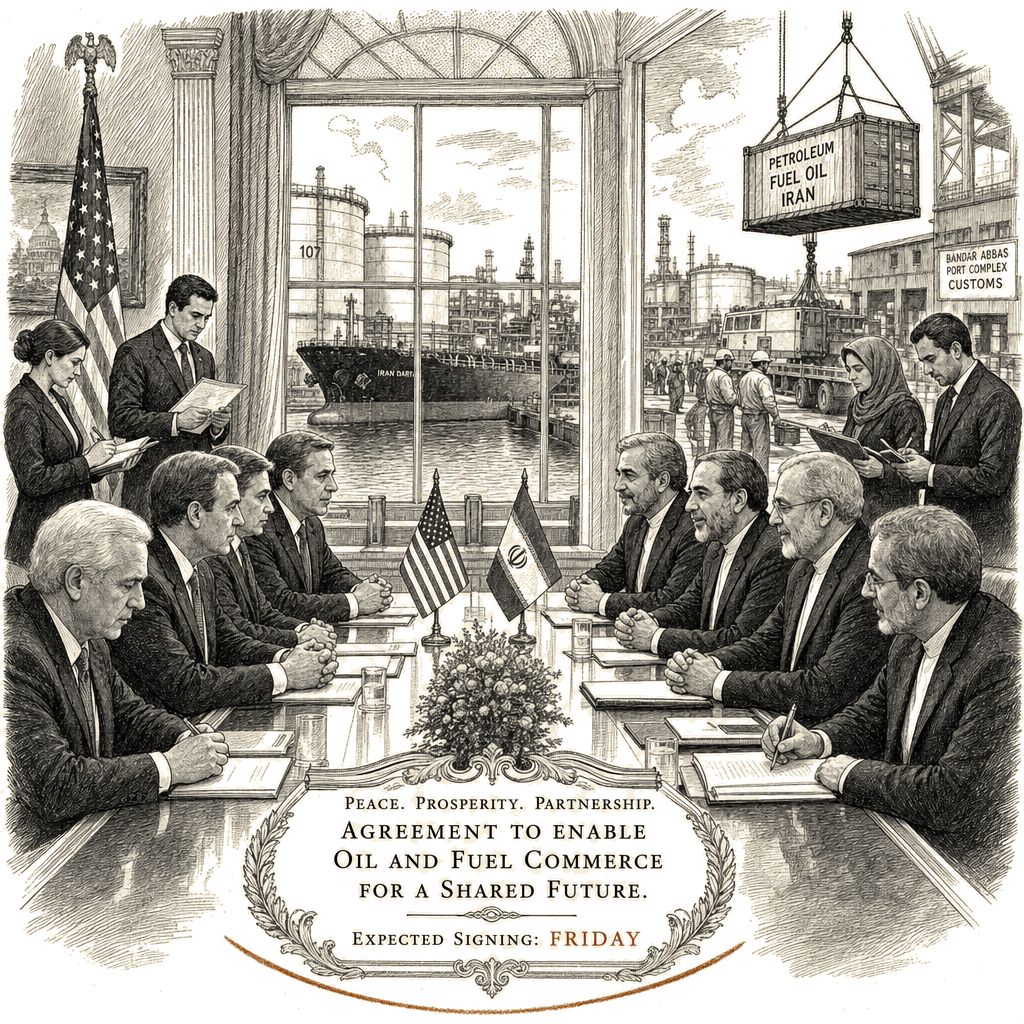
The memorandum of understanding, scheduled to be signed Friday, will allow Iran to sell oil and fuel on international markets, a senior U.S. administration official told the Wall Street Journal. The official said the pledge could be rolled back if follow-up talks on Iran’s nuclear program and other issues are not productive.
The agreement begins to dismantle the core of the sanctions regime built against Iran over the past decade to isolate the regime and halt its nuclear ambitions. According to the Journal, the U.S. also promised to open banking connections that will allow Iran to repatriate revenue from oil sales—revenue that has largely been trapped abroad due to financial sanctions.
U.S. officials stressed that sanctions relief is contingent on Iran meeting requirements concerning its nuclear activities and reopening the Strait of Hormuz. A senior U.S. official said Tuesday that continuing the relief depends on Tehran’s compliance.
“This MOU won’t necessarily open a free-for-all in Iran’s economy. But, Iran will generate considerable revenues and likely be able to access those revenues,” said Richard Nephew, a former senior U.S. sanctions official now at Columbia University. He estimated Iran could generate $8 billion in revenue in the first two months of the deal.
The broad permissions granted to Iran’s oil complex reflect the pressure the Trump administration was under to get a deal done, the Journal reported. The agreement, which includes a potential $300 billion investment plan, is a bet that money will soothe Tehran’s destabilizing inclinations.
Critics warn the cash infusion will strengthen the regime. “The risk is you strengthen the regime by providing it with an infusion of cash,” said Michael Singh, former senior director for the Middle East at the National Security Council under President George W. Bush. “Supporting the proxies and even building missiles and drones is to some extent cheap. What’s really expensive for Iran is properly running their country.”
The U.S. naval blockade, which began in April, slashed Iran’s oil exports from roughly 1.1 million barrels per day in March to 65,000 barrels per day in May, according to United Against Nuclear Iran, a nonprofit. As storage filled, Iran turned off some wells, with crude production slipping by a third to 2.3 million barrels per day in May from roughly 3.5 million before the war, according to the International Energy Agency.
Signs of loosening emerged this week. Three tankers—the Sonia I, Diona, and Hero II—carrying more than 5 million barrels of Iranian crude left the port of Chabahar and crossed the U.S. blockade line since Tuesday, according to UANI and ship-tracking data from MarineTraffic. “The timing is significant,” said Claire Jungman, director of maritime risk and intelligence at Vortexa, adding that the vessels appeared to be positioning in anticipation of a potential agreement.
The full reintegration of Iran into global oil markets will depend on the waivers becoming permanent. That, according to the MOU, depends on a broader deal on Iran’s nuclear activities.
The IEA warned Wednesday that a lasting resolution could trigger an oil-supply overhang next year. Global supply is expected to surge by around 8 million barrels per day in 2027, heavily outpacing a 2 million barrel per day recovery in demand. The United Arab Emirates, which recently quit OPEC, has promised to boost output.
Iran’s crude production costs are low—between $10 and $30 per barrel—compared with U.S. shale break-even prices of $60 to $70 per barrel. Analysts said that if infrastructure is intact and export routes reopen, Iran could recover lost production relatively quickly, but increasing output materially above pre-conflict levels would require foreign capital, technology, and oil-field services.
Before the 1979 revolution, Iran produced between 5 million and 6 million barrels per day. That output dropped due to infrastructure damage from the Iran-Iraq War, the loss of foreign expertise, and chronic underinvestment.