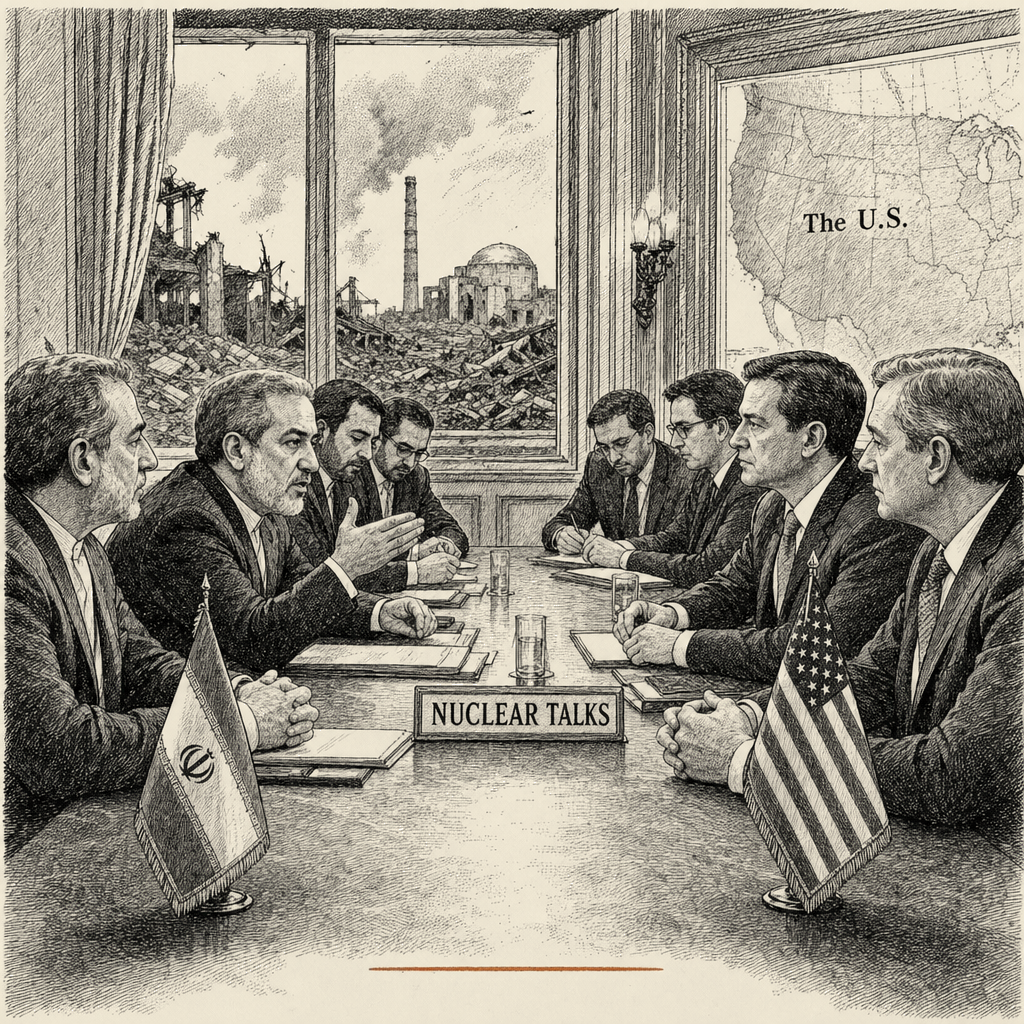
The U.S. and Iran are preparing for difficult nuclear negotiations after a three-month U.S.-Israeli bombing campaign failed to force Iranian concessions, with analysts and former officials describing Tehran as emboldened and Washington’s military leverage severely degraded.
President Donald Trump and Israeli Prime Minister Benjamin Netanyahu launched a campaign of airstrikes on Feb. 28 that lasted 40 days, according to the Wall Street Journal. The campaign was intended to overthrow Iran’s theocratic regime or force major concessions, the Journal reported. Neither outcome was achieved.
The strikes killed much of Iran’s senior leadership, including Supreme Leader Ayatollah Ali Khamenei, and decimated the country’s navy, air force and other military assets. Despite those losses, the regime has survived and consolidated under new commanders, analysts told the Journal.
“Iran is leaving this war with a sense of euphoria. They are managing the Strait of Hormuz, nobody was able to force them to back down militarily,” said Meir Javedanfar, an Iran expert at Israel’s Reichman University. He predicted Iran will now see the Persian Gulf’s oil-rich monarchies as its own sphere of influence.
The war consumed a large part of U.S. precision munitions and inflicted damage on key U.S. military facilities in the region, the Journal reported. Analysts said the experience has undermined Washington’s main argument in attempting to wring nuclear concessions from Tehran, which retains a stockpile of highly enriched uranium and has yet to agree to renewed international inspections.
“When it comes to nuclear negotiations, we are back at the prewar stage, but with the U.S. leverage removed,” said Dania Thafer, director of the Gulf International Forum think tank. “Pandora’s box has already been opened, everything has been tested, and Iran feels it doesn’t have much more to lose or to fear. The worst has already happened, from the Iranian perspective, and they have survived it.”
Daniel Shapiro, who served as deputy assistant secretary of defense in the Biden administration and as U.S. ambassador to Israel from 2011 to 2017, said Iran has proven it can “take the United States’ and Israel’s best punch, survive, and land some very effective counterstrikes, imposing global economic chaos and economic and political harm to President Trump and the United States.” He said there is “a high likelihood that these talks will be inconclusive.”
While the military threat may have diminished, the economic incentive for Tehran to negotiate remains, analysts said. The Iranian economy was already struggling with runaway inflation and a water crisis before the conflict, and the bombing destroyed important industrial sites.
“Iran is still in a vulnerable position, given the economic pressure that the country will face, and the incredible cost of undergoing reconstruction after this war,” said Esfandyar Batmanghelidj, chief executive of the Bourse & Bazaar Foundation think tank. “Iran cannot undergo a full reconstruction after this war without broad sanctions relief.”
Vali Nasr, a professor at Johns Hopkins University who has been involved in informal contacts with Iran, said key figures in the regime do not believe the U.S. will ever relax or remove sanctions, which is why Tehran sought up-front payment in the deal due to be signed Friday. “The carrot is extremely powerful and extremely important to them if they don’t want to face another January uprising in Iran,” Nasr said. “But the issue is creating trust that the carrot is actually there.”
Neither side has published the text of the memorandum of understanding negotiated with Pakistani and Qatari mediation, the Journal reported. Conflicting accounts remain on key issues, including how much money Iran would receive, when, and under what conditions, and whether Iran will collect fees for maritime traffic through the Strait of Hormuz.
Alex Vatanka, a Tehran-born senior fellow at the Middle East Institute, described the planned agreement as “an extremely frail ceasefire.” He said many in Iran “don’t think this is a done deal yet” because they believe regime change remains on the agenda for the U.S. and especially for Israel.
Zohar Palti, a former head of the Mossad intelligence directorate at the Washington Institute for Near East Policy, said that once Iran receives billions of dollars in cash, it may create new obstacles to delay progress in nuclear talks. “From their perspective, the Americans gave them what they wanted, and perhaps even asked for too little,” he said. “Therefore, they see no reason to offer anything meaningful in return.”
The U.S. and Iran negotiated the memorandum without Israel, the Journal reported. The planned memorandum commits Israel not to fight Lebanon’s pro-Iranian Hezbollah militia, effectively establishing Iran’s right to target the Gulf if Israel does so.
Ksenia Svetlova, a former Israeli lawmaker from the center-left opposition and a Middle East analyst, said the “whole pro-Iranian axis is emboldened now.” She said that while that may be “hubris” or “a false sense of superiority,” for the time being “we will suffer from the consequences.”