Summary
- R. Evan Ellis’s CSIS analysis identifies partner consent as the critical interface through which all five risk categories of U.S. lethal strike policy in Latin America cascade, with observable stress indicators already present in Mexico’s refusal to permit strikes, Guatemala’s denial of contemplated operations, and Dutch-British curtailment of Caribbean intelligence sharing.
- Adversary adaptation, network fragmentation, and intelligence degradation form a self-reinforcing cycle: strikes intended to degrade narco-terrorist organizations simultaneously reduce the cooperative resources needed to map increasingly decentralized and less observable adversary networks.
- China’s diplomatic positioning through the Global Development Initiative, Global Security Initiative, Global Civilization Initiative, and Global Governance Initiative exploits perceptions of U.S. unilateral coercion, creating an emergent strategic vacuum that accumulated kinetic action generates but no single operational decision produces.
- The doctrinal template applied to Latin America was calibrated for post-9/11 environments where state sovereignty over targeted territory was often nominal; in Latin America, sovereignty is real, politically contested, and electorally consequential, making formal consent a structurally fragile operating condition rather than a durable one.
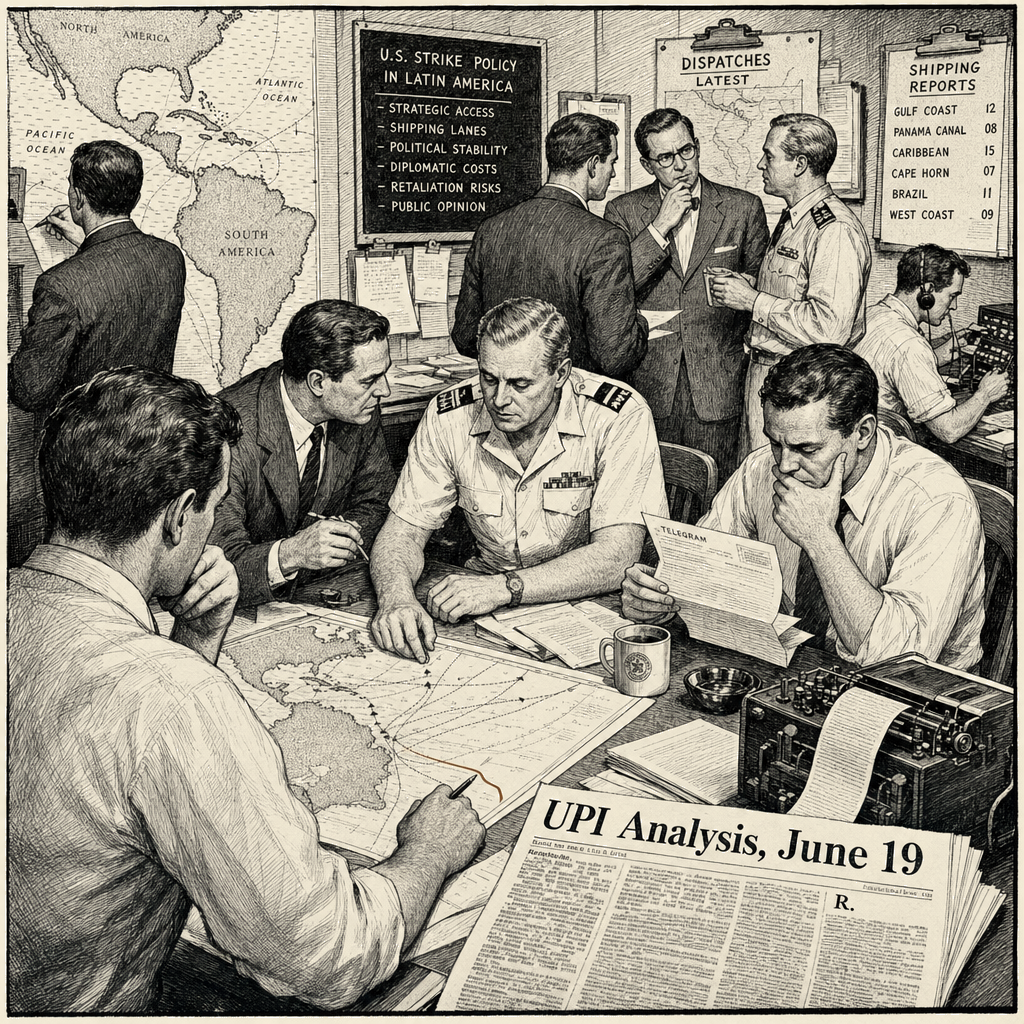
R. Evan Ellis, a senior non-resident associate at the Center for Strategic and International Studies and author of China Engages Latin America: Distorting Development and Democracy, argued in a June 19 United Press International op-ed that U.S. lethal strikes against narco-terrorist organizations in Latin America carry five interconnected categories of strategic risk—adversary adaptation, fragmentation and violence, partner trust erosion, political blowback, and erosion of U.S. strategic positioning—that share a single structural dependency: genuinely voluntary host-nation consent. The analysis, published in the wake of the strike that killed Tren de Aragua founder Héctor “Niño” Guerrero Salazar in Venezuela’s Bolívar state and Secretary of War Pete Hegseth’s subsequent public comments, examines how the United States can pursue security objectives in an environment where every action carries consequences well beyond the immediate target. Ellis wrote that while such strikes “superficialally resemble tactics used against key figures in extremist groups during the post-September 11 global war on terror,” the strategic pitfalls of applying them in the Latin American context “are greater and deserve serious consideration by U.S. policymakers.”
The Consent Interface as Structural Criticality
The policy’s operational viability depends on a chain of partner actions—host-nation consent, intelligence sharing, operational coordination—already under documented stress. Mexico’s Sheinbaum government has maintained “sustained refusal to permit U.S. strikes on Mexican soil.” Guatemala’s Arévalo government “swiftly denied that such strikes were being contemplated.” Dutch and British counterparts curtailed intelligence sharing on “legal, political, or other principled grounds” following U.S. lethal operations in the Caribbean. These represent partners most critical to operational intelligence in the highest-threat zones already reducing cooperation. Ellis cautioned that where partner coordination is imperfect, “a strike may degrade a partner’s knowledge of the network more than it degrades the network itself.” The joint between U.S. operational capability and host-nation sovereignty constitutes an interface fragility—the failure surface exists at the boundary between components, not within either.
A critical assumption traceable to this failure point is the treatment of formal consent as durable consent. Formal consent obtained under asymmetric power dynamics is a structurally fragile condition, not a stable operating state. Ellis’s warning that a “compliant partner” could be replaced “by a government actively hostile to Washington” turns on this distinction: formal consent in one political moment does not survive the electoral cycle that follows. The interface fails when the political cost of perceived sovereignty violation exceeds the strategic benefit in the host nation’s domestic politics—a threshold that varies by country, governing coalition, and public mood, and that is not under U.S. control. Ellis noted that “even strikes with genuine host-nation consent can feed opposition narratives of sovereignty violation.”
The Cascade Failure Mechanism
When consent is not genuine, “the trust essential to effective cooperation erodes,” Ellis wrote. The failure cascades through a self-reinforcing cycle: trust erosion degrades intelligence flow; degraded intelligence reduces strike precision; reduced precision increases collateral damage; collateral damage feeds “opposition narratives of sovereignty violation,” magnified by targeting errors; political blowback risks “the political ouster of a compliant partner and its replacement by a government actively hostile to Washington”; that replacement further erodes trust. Each component failure accelerates the next. The intervention of reducing collateral damage through improved intelligence discipline would weaken the political blowback component—but that discipline depends on the very partner cooperation the cycle erodes, creating a dependency loop that resists unilateral remediation.
The policy’s internal logic treats each successful strike as evidence of viability; the external political environment treats each strike as an increment in a grievance accumulation that crosses thresholds unpredictably. Ellis wrote that “a sustained pattern of perceived unilateral conduct erodes U.S. goodwill in Latin America and beyond”—the fragility resides in the accumulated state, not in any single event. Each individual operational decision may appear locally defensible; the cumulative trajectory moves the system toward a partner-relationship inflection point from which recovery requires more than a change in messaging. This pattern matches what Scott Snook, in his study of the 1994 friendly-fire shootdown over Northern Iraq, characterized as “practical drift”: locally rational decisions that collectively carry a system past a recovery threshold. The structural pattern generalizes to policy domains where feedback loops are slow relative to decision tempo.
Adversary Adaptation and the Decapitation Paradox
Narco-traffickers have demonstrated adaptive capacity in response to U.S. operations, shifting from fast boats to commercial cargo containers and more southerly routes in the Caribbean. Trust erosion accelerates this adaptation: as partner intelligence dries up, the surveillance gaps that strikes create widen, giving adversary networks more room to reorganize into less observable forms. The strike program’s intended deterrent effect is partially negated by the adaptation it provokes, and the acceleration effect compounds as cooperation degrades.
Simultaneously, decapitation strikes have historically accelerated fragmentation within adversary networks, accompanied by increased violence “as less-seasoned subordinates and competing organizations struggle for control,” Ellis wrote. He traced this pattern across Mexico’s Sinaloa, Gulf, Zeta, and CJNG cartels, as well as dismantled crime families in Guatemala and Honduras. The paradoxical outcome: the strike program, intended to degrade networks, produces a more decentralized, less observable, and more violently competitive adversary landscape, while simultaneously reducing the cooperative resources needed to map that landscape.
The China Opportunity Structure
No single U.S. action tips the strategic scales, but the sustained pattern creates an emergent failure mode—one no single operational decision produces but that arises from the interaction of U.S. actions with regional political responses and third-party strategic positioning. China is exploiting perceptions of U.S. coercion through its public statements and diplomatic engagements, building consensus around alternative governance structures—the Global Development Initiative, the Global Security Initiative, the Global Civilization Initiative, and the Global Governance Initiative—that “advantage Beijing and undermine Washington,” Ellis wrote. U.S. kinetic action creates a political demand signal for alternative partnerships in the hemisphere, and China supplies that demand. As partner trust fails, intelligence-sharing agreements lapse without renewal, partner nations decline joint exercises, and the region’s countries step into alternative governance and security frameworks offered by a strategic competitor. This dynamic is not reversible by a single policy adjustment because it depends on accumulated perceptions rather than discrete events.
Doctrinal Mismatch and Load Fragility
The current strike approach applies a doctrinal template designed for the post-9/11 operational environment, where, as scholars of counterinsurgency have characterized the terrain, state sovereignty over frequently targeted territory was often nominal and partner coalitions were structured around expeditionary commitments. In Latin America, sovereignty is real, politically contested, and electorally consequential. Partner relationships are ongoing diplomatic dependencies, not expeditionary coalitions assembled for a single theater. The doctrinal load is calibrated for conditions the current operating environment does not present.
Where Fragilities Are Removable
The structural vulnerabilities are not inherent to counter-narcotic operations as a category; they reside in specific dependencies, interfaces, and accumulation dynamics the current approach activates. Three intervention points emerge from the fragility map. Intelligence degradation is mitigable by building a sharing architecture resilient to partner political pressure—one that does not require every partner to remain aligned at every moment. Threshold crossings are addressable by calibrating operational tempo to explicit political-consequence indicators rather than to operational capability alone. The China-opportunity structure is the hardest to remediate because it is emergent, but its preconditions—a perceived absence of respectful partnership and an alternative-providers gap—are partially addressable through diplomatic strategy calibrated to offset the political cost of kinetic action.
The consent interface is the component that, under sustained load, will yield—and its failure cascades across the entire architecture, leaving the United States with fewer cooperative partners, degraded intelligence, more violent and fragmented adversary networks, and a strategic vacuum that China is already positioned to fill. The system’s design tolerated individual strikes but had no load-balancing mechanism for the political fallout across multiple operations. The leading indicators—public distancing by Mexico and Guatemala, the Caribbean intelligence-sharing precedents—were visible before the current cycle of strikes began. Ellis’s conclusion that the five risks “are not arguments against action—they are arguments for fully accounting for the consequences before committing” describes the stress test the policy never received: an assessment of what happens when partner consent, the single interface holding the entire risk architecture together, is no longer voluntary.
Analytical techniques used in this piece
This analysis applies the methods below. Each links to a short, plain-English explainer you can read and reuse.
- Pre-Mortem (Fragility)
- Imagines a system has already broken and traces the structural fragilities that let it.
- BATNA
- Your best alternative to a negotiated deal — the walk-away that sets your leverage (Fisher & Ury).