Summary
- China’s yuan-based payment architecture — chiefly the Cross-Border Interbank Payment System (CIPS) and the mBridge central-bank platform — lets sanctioned trade settle outside U.S.-cleared dollar channels, structurally degrading Washington’s ability to monitor and cut off flows.
- The mechanism is jurisdictional, not merely commercial: dollar dominance gives the U.S. leverage because dollar transactions must clear through American banks; yuan settlement removes the chokepoint rather than the trade.
- The erosion is visible in the numbers the source supplies — Iran earned up to $43 billion in oil revenue in 2024 mostly settled in yuan; Russia now settles more than 90% of its China trade in yuan and rubles, up from 2% yuan use in February 2022.
- The same system that blunts sanctions also weakens U.S. leverage at the negotiating table: the White House’s offer of sanctions relief is worth less when Tehran already has a working workaround.
- The source frames this as deliberate Chinese strategy with a defined ceiling: Beijing wants specific sanction-proof trade lanes, not full yuan-for-dollar replacement, which would require politically costly reforms.
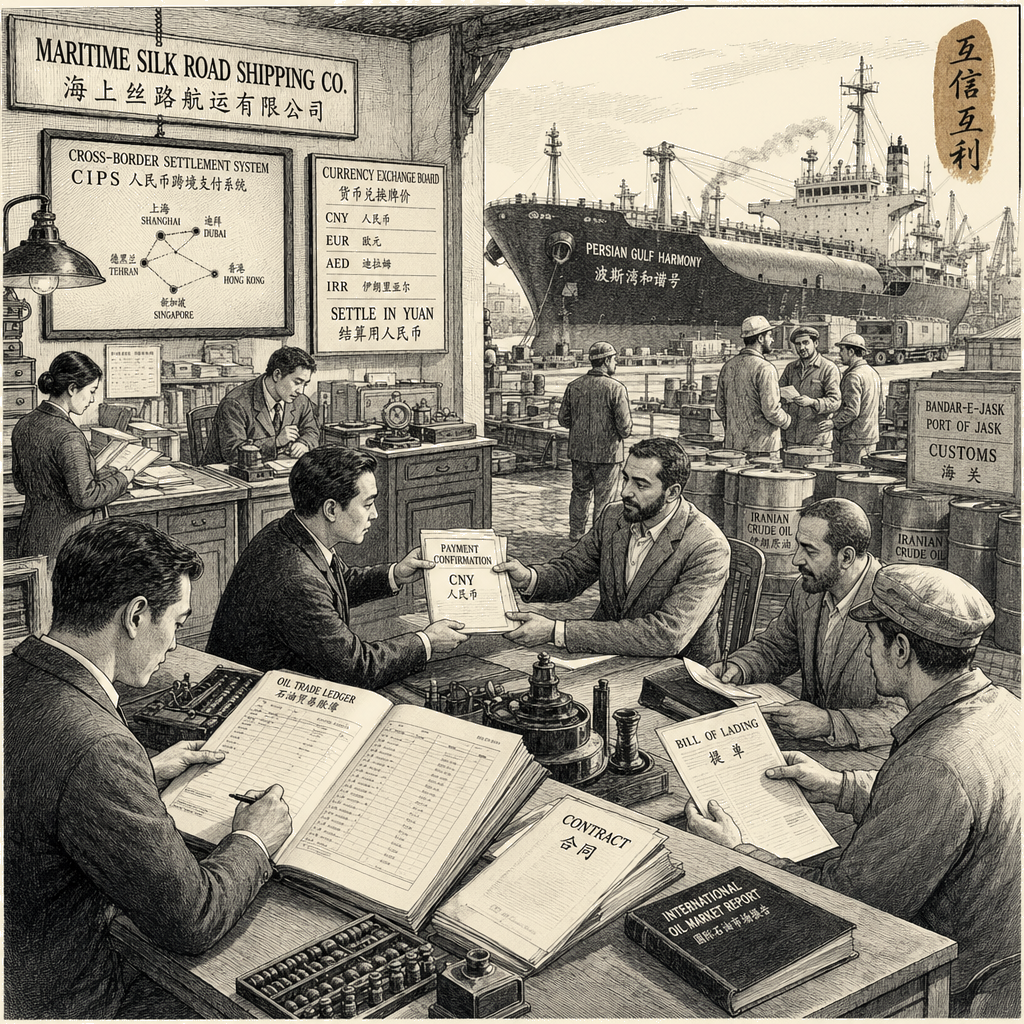
China’s yuan-denominated financial architecture is enabling Iran, Russia and others to conduct sanctioned trade beyond the reach of U.S. monitoring and enforcement, weakening Washington’s long-standing ability to police global business through control of the dollar. The dollar is used in roughly 80% of international trade finance, and because most dollar transactions must be settled by American banks, the U.S. has historically been able to watch those flows and sever access to them. When adversaries settle in yuan through systems such as CIPS and mBridge, the transactions never enter the U.S.-led banking system — neutering, in the words the source uses, Washington’s powers. What matters here is not the volume of yuan trade, which remains small against the dollar, but the structural fact that a parallel, unmonitorable lane now exists for exactly the transactions sanctions are meant to stop.
The Mechanism: Removing the Chokepoint, Not the Trade
Sanctions enforcement against Iran and Russia has rested on a single structural fact: the dollar’s centrality forces transactions through American banks, where they can be seen and stopped. The source is explicit that “most international transactions denominated in U.S. dollars must be settled by American banks, giving Washington the ability to monitor them—and cut off users’ dollars if necessary, crippling their operations.” Yuan settlement does not defeat this enforcement on its own terms; it relocates the trade out of the jurisdiction where enforcement operates. As Josh Lipsky, a former International Monetary Fund staffer now at the Atlantic Council, put it, the yuan-based systems “make it easier to work around U.S. sanctions” and “cloud the U.S. intelligence community’s ability to see financial flows.”
The infrastructure carrying this is concrete. CIPS, set up by China in 2015 as a yuan-denominated alternative to the Swift messaging network, “can’t easily be monitored by the U.S.” mBridge, launched in 2021, settles cross-border payments between central banks using digital versions of the yuan “without the money passing through U.S. financial institutions.” The April escalation against the Chinese refiner Hengli Petrochemical illustrates the loop closing in real time: sanctioned over Iranian oil purchases, Hengli said future oil purchases “would be settled in yuan instead of U.S. dollars,” which the source notes makes the flows harder for outsiders to track. The enforcement action did not stop the trade; it accelerated its migration out of view.
What the Numbers Establish — and What They Don’t
The source supports the erosion claim with figures, but they are best read as evidence of a working alternative rather than of dollar displacement. Iran “earned up to $43 billion in oil revenue in 2024,” per the U.S. Energy Information Administration, before unspecified discounts that averaged about 13% in 2025 according to U.S. lawmakers — and “most of the sales were paid for in yuan, according to the U.S. Treasury.” The Russia case is more dramatic: Russian officials say more than 90% of Russia-China trade now settles in yuan and rubles, against a yuan share of just 2% of Russian trade in February 2022, per the Centre for Eastern Studies. CIPS daily volume has risen to roughly 790 billion yuan (around $115 billion) over three recent months, up from about 680 billion yuan ($100 billion) last year, per the Atlantic Council.
The source is careful to bound these figures, and the bounding is analytically important. Swift still moves “an estimated more than $5 trillion a day,” dwarfing CIPS. The yuan’s share of global trade finance “tripled over the past five years to 6% in April” — meaning it remains a sixth of the dollar’s share at most. The claim the evidence actually supports is therefore narrow but serious: not that the dollar is being replaced, but that for the specific high-friction trades sanctions target, a parallel rail now reliably exists. The source does not establish how much sanctioned trade still depends on dollar access, beyond noting that Iran-linked front companies moved “nearly $4 billion, or around 10% of Iran’s estimated 2024 oil sales, through the U.S. financial system in 2024” — implying the remaining roughly 90% did not.
The Negotiating-Leverage Collision
The piece’s sharpest claim is that the same infrastructure that blunts enforcement also hollows out U.S. leverage in active diplomacy. The White House entered nuclear talks with Iran “relying on a traditional strength: the promise of sanctions relief and access to some of roughly $100 billion in frozen assets.” But that promise is worth less precisely because Tehran has already built a way around the pressure it would relieve. The source states the problem directly: Iran “had already figured out a way to use its yuan earnings under sanctions,” routing oil proceeds through entities such as Chuxin to pay Chinese contractors building airports and refineries inside Iran, or through special-purpose vehicles that ship Chinese auto parts back to Iran — all without the yuan ever leaving China. As former Treasury official Kerri Bitsoff put it, “The bulk of this money is just staying in China.”
This is a leverage-erosion dynamic: the value of a concession is set by what the other side’s fallback is worth, and Iran’s fallback has materially improved. The source does not claim the fallback is costless. Sanctions “still give the U.S. leverage over Tehran,” having “increased the cost of selling Iranian oil” — the roughly 13% discounts and the shadow-fleet apparatus of shell companies and switched-off tracking devices are the friction premium Iran pays for operating off-channel. Steve Yates, a former White House national security official, says Iran “has the ability to play for time, to obfuscate, to make trouble,” but is “profoundly degraded militarily” and “profoundly degraded economically.” The honest reading the source allows: the workaround is real and load-bearing, but it is a discounted, costlier substitute, not a free one — which is why sanctions relief retains some, diminished, value.
Deterrence Logic and the Bounded Strategy
The source attributes the buildout to deliberate Chinese strategy with an explicit ceiling, and the distinction matters for forecasting where this goes. Beijing’s aim, per former Treasury officials cited, “is to build up specific lanes of trade that work outside the U.S. dollar” — not to replace it. The source spells out why full replacement is off the table: it “would require Beijing to make painful changes to its economy, such as giving up capital controls and allowing its currency to freely float, which could spark capital flight and destabilize the country.” China’s central bank chief, Pan Gongsheng, framed the goal as a world where “a few sovereign currencies coexist and compete,” arguing the dollar’s dominance is a liability because in geopolitical crises “the global dominant currency tends to be instrumentalized or weaponized.”
There is a mutual-vulnerability logic underneath this. The source notes Beijing “hopes to insulate China from the type of economic assault” the West launched on Iran and Russia and “would also likely unleash if Beijing ever made a move on Taiwan.” Read structurally, China is not just helping clients evade sanctions; it is pre-building its own sanctions-proof channel against a future confrontation, reducing the deterrent value of the dollar weapon before it can be turned on Beijing. The U.S. response described — new sanctions on Hengli and other refiners, threatened penalties on Chinese banks servicing Iranian fronts — operates inside the dollar system the adversaries are exiting, which is the core asymmetry: each enforcement action gives counterparties a fresh reason to migrate to the rail enforcement cannot reach.
Reversibility and the Ratchet
A feature of this dynamic the source illustrates without naming is that the migration is sticky. Infrastructure adoption tends not to reverse: the Russia precedent shows a jump from 2% to over 90% yuan/ruble settlement after 2022 sanctions, and the source reports CIPS daily transactions doubled and participating institutions “more than doubled from the beginning of the war to mid-2025.” Once shell-company networks, shadow fleets, exchange houses (the Iranian rahbars described operating through Hong Kong, the U.A.E. and Turkey), and central-bank settlement rails are stood up, they remain available even if a given sanctions regime is later eased. A nuclear deal “could allow Iran to re-enter the global financial system,” the source notes, but Tehran has already built the off-ramp — meaning relief restores an option, it does not dismantle the alternative.
The U.A.E. case shows the ratchet can pull in U.S. partners. Emirati officials told U.S. counterparts that if the Gulf state “runs short of dollars, it may be forced to use Chinese yuan for oil sales and other transactions.” The U.A.E. — described as “a major U.S. defense partner” — is already central to mBridge, having “initiated the first ever government-to-government payment to Beijing on the platform” in November. The forward risk the source surfaces is that adoption spreads not only among adversaries but among hedging partners, each marginal joiner making the network more useful and harder to isolate.
Additional Considerations
The source flags several limits the analysis should preserve. China’s Foreign Ministry said it was “unaware of the situation” regarding China-Iran oil trade and that relations are conducted “within the framework of international law” on “principles of equality and mutual benefit” — the only on-record Chinese rebuttal, and the piece does not independently adjudicate it. Several specifics are explicitly bounded or unestablished: the discounts on Iranian oil are “unspecified” in the EIA figure; a “total prewar figure couldn’t be determined” for Russian yuan use; and the mechanics by which some ships settled Strait-of-Hormuz transit fees are “unclear.” The piece also notes the BIS withdrew from mBridge after talk of a sanctions-immune “Brics Bridge,” though BIS “said its withdrawal wasn’t due to political considerations” — a caveat that cuts against the most aggressive reading of mBridge as a purpose-built sanctions-evasion tool. Finally, the central quantitative caveat stands: on the source’s own figures the yuan remains a single-digit share of global trade finance, so the claim is the existence and reliability of an alternative lane, not the dollar’s displacement.
Analytical techniques used in this piece
This analysis applies the methods below. Each links to a short, plain-English explainer you can read and reuse.
- Principled Negotiation
- Works a negotiation from interests, options, and objective criteria rather than positions.
- Strategic Interaction (Game Theory)
- Models a situation as a game — players, moves, payoffs, and likely equilibria.
- Systems Dynamics (Structural)
- Maps a system’s structure — stocks, flows, and the architecture that shapes its behavior.
- BATNA
- Your best alternative to a negotiated deal — the walk-away that sets your leverage (Fisher & Ury).
- Mutually Assured Destruction
- Deterrence by guaranteeing that any attack is suicidal for the attacker.