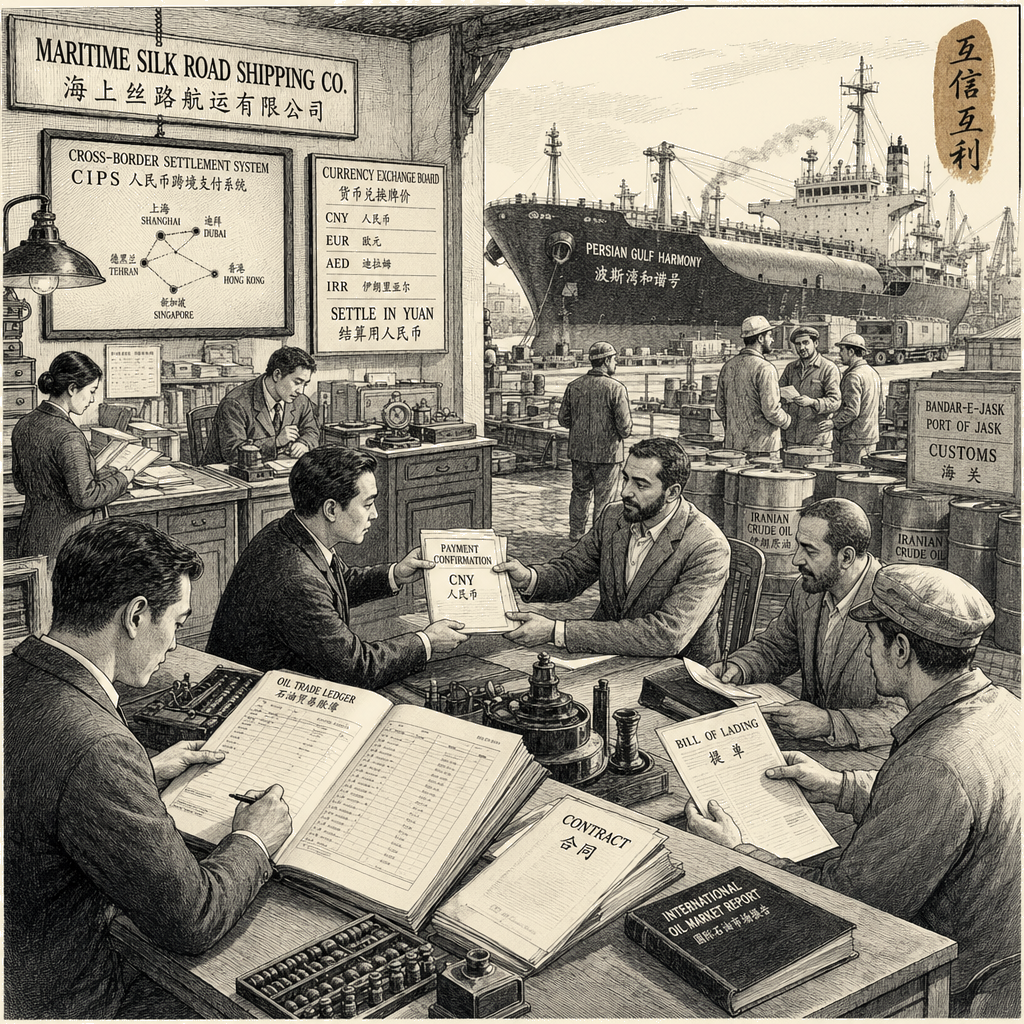
Talks between the White House and Tehran over a new nuclear deal depend in part on a traditional source of U.S. leverage: the promise of sanctions relief and access to roughly $100 billion in frozen Iranian assets. But that leverage is eroding, according to U.S. officials and analysts, as Iran has used China’s yuan-based financial infrastructure — systems that Washington cannot monitor or cut off — to sustain oil exports worth tens of billions of dollars annually.
Iran earned up to $43 billion in oil revenue in 2024, before accounting for discounts that in 2025 averaged about 13%, according to the U.S. Energy Information Administration and U.S. lawmakers. Most of those sales were paid for in yuan, according to the U.S. Treasury. The money flows through China’s Cross-Border Interbank Payment System, a yuan-denominated alternative to the Belgium-based Swift messaging network launched by Beijing in 2015, and mBridge, a digital-currency platform that settles transactions directly between central banks.
MSI previously reported that U.S. sanctions against Iran have failed to force compliance as the country found workarounds through China’s financial system. Read that article.
“They make it easier to work around U.S. sanctions,” said Josh Lipsky, a former International Monetary Fund staffer now at the Atlantic Council. “They cloud the U.S. intelligence community’s ability to see financial flows.”
The U.S. dollar is used in roughly 80% of international trade finance, according to The Wall Street Journal report. Since most dollar-denominated transactions must be settled by American banks, Washington can monitor them and cut off access to dollars if necessary. When transactions move in yuan outside the U.S.-led banking system, that enforcement power is neutralized.
Volume on CIPS averaged roughly 790 billion yuan, or about $115 billion, a day in the three months through May, compared with a daily average of 680 billion yuan, or about $100 billion, last year, according to the Atlantic Council. The Swift network facilitates an estimated more than $5 trillion a day. But the expansion of CIPS means it is becoming a more global cross-border payments system, the think tank said.
A similar pattern emerged after Russia’s war in Ukraine began in 2022. Total daily transactions on CIPS have doubled since then, and the number of financial institutions operating on the platform has more than doubled, according to Chinese central bank data and CIPS. Today, Russian officials say more than 90% of trade between Russia and China is settled in yuan and rubles. For comparison, the yuan was used in 2% of Russian trade in February 2022, according to the Centre for Eastern Studies, a Polish think tank.
The yuan’s share of global trade finance tripled over the past five years to 6% in April, according to Swift data. It has been the second most-used currency in such financing for most of this year, behind the dollar and ahead of the euro.
About half of China’s cross-border transactions are now denominated in its own currency, compared with almost nothing 15 years ago, according to Chinese central bank data.
China also is rapidly expanding mBridge, a platform launched in 2021 that uses digital versions of the yuan and other currencies. The system lets central banks settle cross-border payments directly without the money passing through U.S. financial institutions. The digital yuan constituted 95% of the 4,000 cross-border payments on mBridge as of November, according to Atlantic Council research published in March.
China has no intention of fully replacing the dollar with the yuan worldwide, analysts say. A more dramatic increase would require Beijing to give up capital controls and allow its currency to freely float, steps that could spark capital flight. Beijing’s goal instead is to build specific lanes of trade that work outside the U.S. dollar, driven in part by a desire to undermine U.S. authority and insulate China from the type of economic assault launched on Iran and Russia, former Treasury officials told The Wall Street Journal.
China’s Foreign Ministry said it was “unaware of the situation” regarding oil trade between China and Iran, adding that the two countries’ relations have always been conducted within the framework of international law.
The U.S. has escalated its “Economic Fury” campaign against Iran since the conflict began, sanctioning Chinese refineries and threatening penalties on Chinese banks. In late April, the U.S. sanctioned Hengli Petrochemical, a major Chinese refiner that U.S. officials said bought billions of dollars’ worth of Iranian oil. Hengli said its supplier had guaranteed the oil wasn’t Iranian. Future purchases, Hengli said, would be settled in yuan instead of dollars, making the flows harder to track.
The White House is negotiating a new nuclear deal with Iran. The talks have proved bumpy, and the outcome is uncertain, officials said. Iran “has the ability to play for time, to obfuscate, to make trouble,” said Steve Yates, a former White House national security official. But, he added, “it has been profoundly degraded militarily, it has been profoundly degraded economically.”