Summary
- The European Union’s member-state ratification of tariff reductions on U.S. imports completes the July 2025 Turnberry agreement while shifting the active trade dispute toward European regulatory frameworks that the Trump administration characterizes as non-tariff barriers.
- U.S. Ambassador to the EU Andrew Puzder and European Commission officials stake opposing public positions on the bloc’s regulatory perimeter, with the Commission asserting that its legislative framework remains outside negotiation.
- The sequential structure of the Turnberry agreement isolates tariff reductions as the initial deliverable, deferring substantive regulatory harmonization and foreclosing simultaneous comprehensive alignment of trans-Atlantic standards.
- The European Commission’s simultaneous designation of Amazon and Microsoft cloud services as Digital Markets Act gatekeepers signals an independent regulatory pipeline that tests the compatibility of the EU’s regulatory autonomy claims with the agreement’s commitment to provide additional flexibilities.
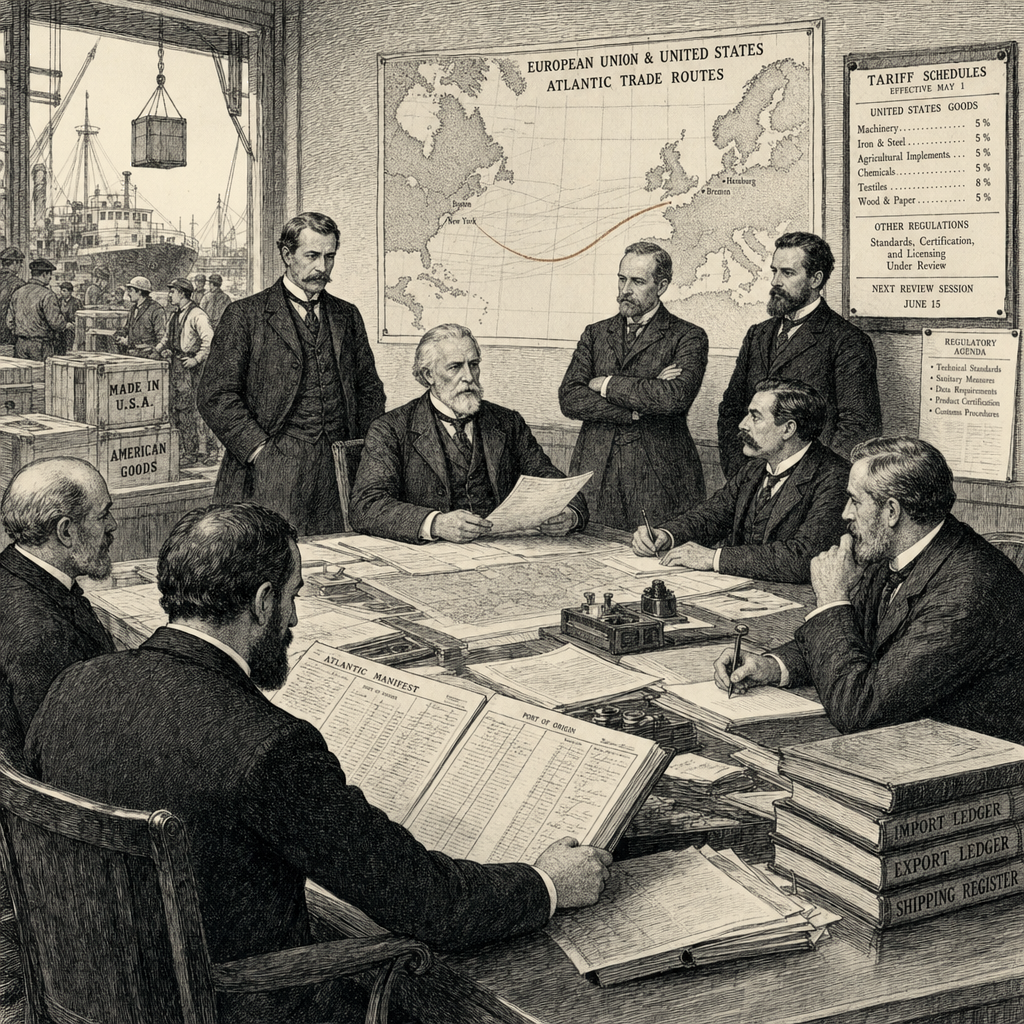
The European Union’s member-state approval of tariff cuts on U.S. imports on Thursday closed the final formal step in the multistep ratification process for the July 2025 trade agreement negotiated at President Donald Trump’s Turnberry golf course in Scotland. The vote clears the way for reduced duties on American goods and fulfills the EU’s commitment to lower tariffs in exchange for a U.S. pledge to cap most levies on the bloc at 15 percent. With the tariff phase resolved, the active dispute over trans-Atlantic trade shifts to European regulations that U.S. officials identify as non-tariff barriers, triggering a structural contest between Washington’s demands for market access and Brussels’ assertions of regulatory autonomy.
Position-setting on the next phase of the dispute
The shift from tariff reductions to regulatory alignment defines the next phase of U.S.-EU trade relations. U.S. Ambassador to the EU Andrew Puzder identified European rules on deforestation, methane emissions, and digital regulations as the Trump administration’s top concerns, stating, “The tough part is the non-tariff trade barriers.” The European Commission responded by asserting the limits of U.S. influence over European law. A Commission spokesman stated that the bloc “has been firm and consistent in explaining that our legislative framework and our regulatory autonomy are not up for negotiation.”
These two positions establish the boundaries of the upcoming dispute. The U.S. framing characterizes European regulations as barriers to trade, while the EU framing characterizes external pressure as an infringement on sovereign rulemaking. The two positions are not necessarily contradictory; the July 2025 deal text commits the bloc to provide “additional flexibilities” in the implementation of the Carbon Border Adjustment Mechanism (CBAM), a concession that can be read as procedural rather than substantive. However, the source materials do not specify the scope of these flexibilities, leaving the compatibility of the U.S. and EU positions to be tested against the deal’s implementation.
Stakeholder constraints and evidentiary asymmetries
The corporate and geopolitical bases of both sides constrain their respective negotiating positions. The U.S. position faces sectoral friction from its own corporate base: large technology firms face enforcement under the Digital Markets Act (DMA) and Digital Services Act (DSA); agricultural producers face compliance burdens under the deforestation regulation for rubber, wood, and cocoa; and energy producers face reporting requirements under new methane rules.
On the U.S. side, coordination relies on sectoral alliances. Energy ministers from the U.S., Qatar, Algeria, and Nigeria issued a joint letter to EU leaders regarding the methane-reporting law, stating, “As of now, there is no viable path to compliance.” The letter unites LNG exporters and pipeline-gas exporters, though the differing commercial interests among these supplier states remain unpacked in the source reporting.
The EU side demonstrates its regulatory posture through enforcement actions and legislative sequencing. Documented enforcement includes fines against major U.S. technology companies under the DMA and DSA, including a €140 million fine on Elon Musk’s X over transparency concerns and an allegation that its blue-check-mark system was deceptive. A separate DSA investigation into X’s handling of illegal content and information manipulation remains ongoing.
The source substrate carries more EU-side documentation, including Commission statements, fine amounts, and regulatory texts, than U.S.-side documentation, which relies primarily on Puzder’s quotes and the energy ministers’ letter. This evidentiary asymmetry constrains the ability to evaluate both sides’ claims with identical granular specificity, though the documented actions establish the operational reality of the EU’s regulatory perimeter.
Deal sequencing and foreclosed alternatives
The sequential structure of the Turnberry agreement dictated the current phase of the dispute. Tariff cuts represent a discrete action that a qualified-majority vote of EU member states can authorize. In contrast, regulatory change typically requires legislation or rulemaking with longer lead times and more diffuse political costs.
The sequencing implies that the EU treated tariff cuts as the lower-cost component of the agreement, deferring the harder regulatory components rather than resolving them. The alternative of simultaneous, comprehensive regulatory harmonization was foreclosed by this sequential structure. Other alternative mechanisms, such as World Trade Organization challenges or Section 301 retaliation, remain less probable given the binding 15 percent tariff ceiling and the political costs of broader escalation. The U.S. leverage for escalation is reduced by the cap; additional tools remain available, but straightforward tariff escalation requires testing the 15 percent ceiling against domestic economic costs. Consequently, the U.S. relies on sectoral friction and multilateral pressure, as demonstrated by the energy ministers’ letter.
Parallel regulatory action and strategic signaling
On the same day as the member-state tariff vote, the EU announced that Amazon.com’s and Microsoft’s cloud services should be added to the DMA’s list of digital platforms subject to stricter oversight. The timing of this designation indicates that the Commission’s regulatory pipeline operates on a timeline independent of the U.S. trade agenda.
This parallel action provides U.S. officials with a concrete basis to argue that the EU’s regulatory pipeline operates independently of the July 2025 deal’s spirit, regardless of compatibility with the agreement’s letter. The source phrasing—stating that “the EU said Thursday that Amazon.com’s and Microsoft’s cloud services should be added”—employs a construction that presents the regulatory pipeline as a procedural fact. Evaluating whether this reflects regulatory protectionism requires testing the hypothesis by assessing whether the compliance costs imposed by the DMA are proportionate to the stated objectives of fostering competition for smaller firms.
Frame audit of the dispute
The source material frames the shift toward non-tariff disputes through specific lexical choices, casting the upcoming negotiations as a routine procedural hurdle. The reporting positions the next phase as primarily the EU’s problem, a structural framing choice that obscures the fact that the U.S. has demands to make and that the deal’s “additional flexibilities” language on the CBAM commits the EU to at least procedural change.
The reliance on official sources from the U.S. Ambassador and the European Commission, accepting both sides’ competing premises without independent analytical stress, aligns with the structural parameters of the source-filter model set out by Edward S. Herman and Noam Chomsky in Manufacturing Consent (1988), in which debate boundaries are set by state and executive actors.
U.S. officials characterize the DSA as a tool to censor speech, an allegation the EU denies. The source reports both claims without adjudicating the dispute. This framing gap functions as a domestic political position each side can hold without committing to action on the regulatory substance. For the U.S. side, the censorship framing resonates with audiences predisposed to view European content rules as overreach. For the EU side, the autonomy framing resonates with audiences predisposed to view external pressure on European law as a sovereignty question. The prior belief required for this gap to remain invisible on each side is that the other side’s framing is sincere rather than instrumental; the source materials do not resolve which reading is correct.
If U.S. trade policymakers adopt the “non-tariff barriers” framing uncritically, it provides a rationale for unilateral tariff escalations that could violate the Turnberry agreement’s 15 percent levy cap. If EU officials treat the “regulatory autonomy” framing as absolute, it shields regulations calibrated to disadvantage non-EU incumbents.
Managed friction and the path forward
The interaction between Washington and Brussels has shifted from a negotiation over the removal of tariff barriers to a dynamic of managed friction. Former EU trade official Ignacio García Bercero observed, “None of these issues are easy,” adding, “If they were, they would’ve been solved a long time ago.”
This dynamic is consistent with García Bercero’s assessment: the core jurisdictional boundaries were settled, not dismantled, by the Turnberry accord. The EU enforces its regulatory perimeter; U.S. firms absorb the transition costs; and disputes settle into narrow technical negotiations over standards recognition and enforcement flexibilities. The next phase of the U.S.-EU trade relationship is a slower-moving contest over regulatory substance in which neither side has yet committed to specific changes, and the July 2025 deal provides a framework for discussion rather than a resolution.
Analytical techniques used in this piece
This analysis applies the methods below. Each links to a short, plain-English explainer you can read and reuse.
- Propaganda Audit
- Reads a message for propaganda technique — loaded framing, manufactured consensus, and demonization.
- Red-Team Assessment
- Models a capable adversary probing a plan for the seams they would exploit.
- Strategic Interaction (Game Theory)
- Models a situation as a game — players, moves, payoffs, and likely equilibria.
- Tragedy of the Commons
- A shared resource is depleted because each user’s incentive is to take more.