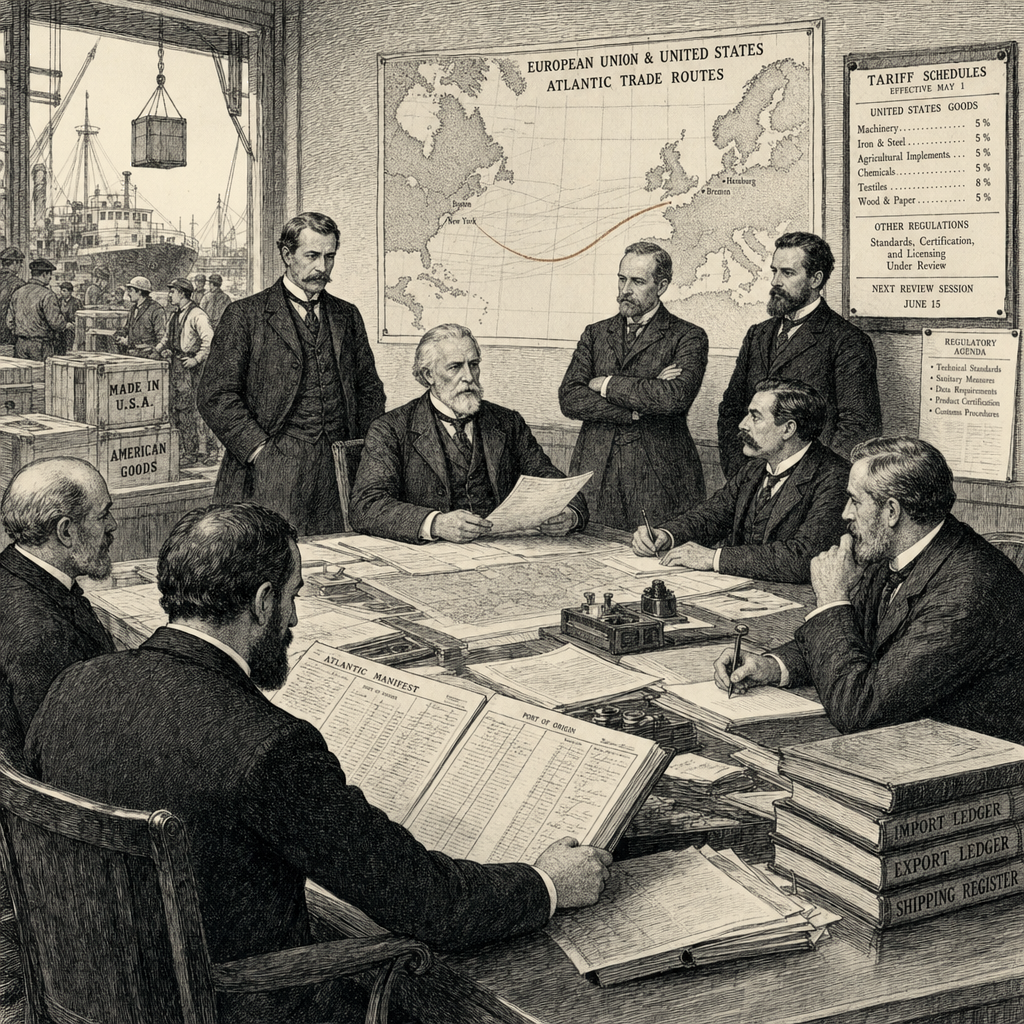
BRUSSELS — The European Union on Thursday followed through on a central plank of its trade deal with President Donald Trump after months of internal wrangling, as EU member countries approved sweeping tariff cuts for many U.S. imports.
MSI previously reported that the European Parliament voted 440–151–50 on June 16 to approve the agreement. Thursday’s vote by EU member states marked the last formal step in a multistep ratification process whose pace had frustrated American officials, clearing the way for the tariff reductions to take effect.
The tariff cuts were among several commitments the EU made last year in exchange for a U.S. pledge to cap most levies on the bloc at 15%. The deal, reached at Trump’s Turnberry golf course in Scotland in July 2025, came after a volatile year that saw the launch of broad “Liberation Day” tariffs and protracted negotiations.
Now the EU must tackle an even thornier challenge: addressing U.S. complaints that its regulations are hurting American companies’ access to its 27-country market.
U.S. Ambassador to the EU Andrew Puzder identified European rules on deforestation, methane emissions, and digital regulations as among the Trump administration’s top concerns. He said the bloc’s tariff cuts were relatively easy to deal with by comparison.
“The tough part is the non-tariff trade barriers,” Puzder said.
EU officials said they are committed to tackling non-tariff barriers but do not plan to change their laws to appease the United States. A spokesman from the European Commission, the bloc’s executive body, said the EU “has been firm and consistent in explaining that our legislative framework and our regulatory autonomy are not up for negotiation.”
The Trump administration has focused criticism on several specific European regulations.
The EU’s Digital Markets Act, which aims to make it easier for smaller companies to compete with global tech giants, is a frequent target. The commission last year fined Apple and Meta Platforms for breaching the law. In a move that could add to tensions with Washington, the EU said Thursday that Amazon.com’s and Microsoft’s cloud services should be added to a list of digital platforms subject to tougher DMA scrutiny.
The bloc’s Digital Services Act requires large social-media and search platforms to address risks including the spread of illegal content and the use of disinformation to manipulate election results. U.S. officials have accused the bloc of using the law to censor speech, an allegation the EU denies. The DSA was used last year to fine Elon Musk’s X about $140 million over transparency concerns and an allegation that its blue-check-mark system was deceptive. A separate investigation into X’s handling of illegal content and information manipulation is ongoing.
The EU’s deforestation regulation, designed to ensure that products such as rubber, wood, and cocoa imported into the bloc are not contributing to global deforestation, is due to take effect at the end of this year after its enforcement was delayed twice and some of its requirements were eased. The U.S. says the regulation still imposes a large burden on producers who are managing natural resources responsibly.
Energy companies and importers in the bloc will also have to report their emissions of methane under a new law. Eventually, the law will require importers to meet new emissions intensity standards or risk fines. Energy ministers from the U.S., Qatar, Algeria, and Nigeria said in a joint letter to EU leaders this week that the rules could disrupt Europe’s oil-and-gas supply. “As of now, there is no viable path to compliance,” they said.
The bloc’s carbon border adjustment mechanism, which adds a charge for certain imports based on greenhouse gases emitted in their production, is another point of tension. The trade deal the U.S. and EU reached last summer said the bloc would work to provide “additional flexibilities” in the law’s implementation.
The U.S. and EU agreed in last year’s trade deal to make it easier for companies to prove their compliance with trans-Atlantic standards. Businesses on both sides of the Atlantic have long advocated such harmonization, but progress has been slow.
Ignacio García Bercero, a former EU trade official, said the two sides should focus their efforts on issues identified in the text of last year’s agreement, including the push to recognize each other’s standards.
“None of these issues are easy,” he said. “If they were, they would’ve been solved a long time ago.”