Summary
- Vice President JD Vance assumes public advocacy for the U.S.-Iran ceasefire agreement while President Donald Trump allocates political blame for potential negotiation failures.
- Trump’s explicit credit-and-blame framing mirrors prior risk-delegation patterns directed at Secretary of State Marco Rubio during active diplomatic engagements.
- Vance’s documented accommodation of presidential threats during active talks absorbs principal risk while generating elevated 2028 primary visibility.
- The structural concentration of negotiation risk imperils Vance’s Republican primary standing by exposing his foreign policy record to intra-party neoconservative criticism.
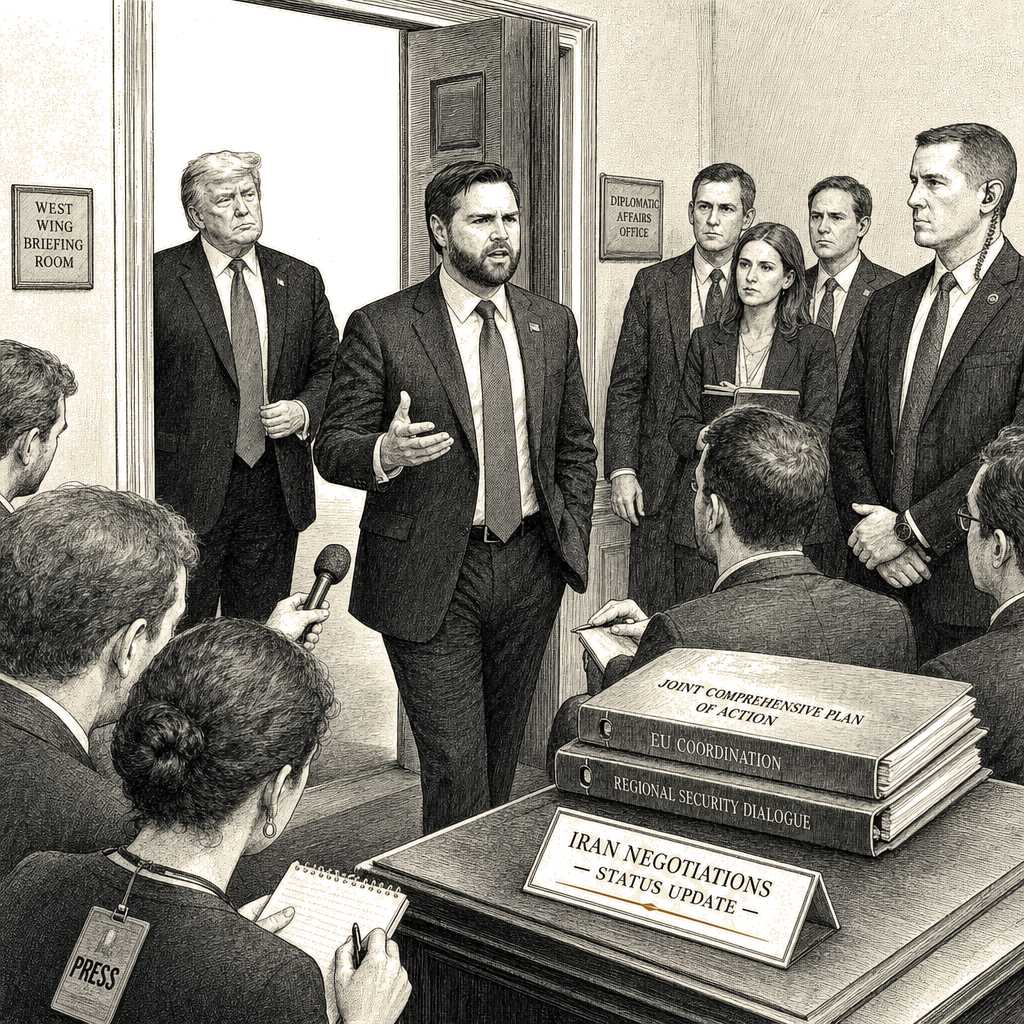
Vice President JD Vance has positioned himself as the lead public advocate for the U.S.-Iran ceasefire deal, absorbing the political risk of an agreement that President Donald Trump has explicitly framed as a potential vehicle for vice-presidential blame. The arrangement, documented by The Guardian on June 25, 2026, places Vance at the center of the highest-level U.S.-Iran engagement since the 1979 revolution while Trump retains the option to claim success or disavow failure. This risk-delegation structure transforms the diplomatic channel into a dual-negotiation environment where Vance must secure terms with a foreign adversary while simultaneously navigating an executive branch dynamic that permits the president to publicly undercut the talks and redirect blame.
Structural Risk Allocation and Documented Conduct
The Guardian’s June 25, 2026 reporting documents a public credit-and-blame framing by President Trump regarding the Iran ceasefire deal and Vice President JD Vance’s parallel media campaign to sell it. Trump stated, “If it works out, I’m going to take the credit. If it doesn’t work out, I’m blaming JD.” The Guardian characterized the framing as “nearly identical to a joke Trump had made about Secretary of State Marco Rubio more than a year earlier.” The pattern, the precedent, and the documented public undercutting during active talks constitute the reported facts informing this structural assessment.
Three readings of the documented conduct compete to explain Vance’s lead-advocate role. The first reading interprets the arrangement as risk delegation to the vice president. This reading is supported by Trump’s explicit statements, the prior Rubio precedent, and Trump’s documented threats during active talks—as The Guardian reported—to resume strikes on Iran and to assassinate Iranian negotiators. Vance’s documented public defense of those threats—“What we told the Iranians yesterday is that when you guys engage in what us millennials might call trash talk, you can’t expect the president of the United States not to respond and not to correct the record”—is conduct consistent with the absorption of the principal’s political risk.
The second reading interprets Vance’s 2028 repositioning as a calculated cost. Andrew Day of The American Conservative, a publication whose founding in 2002 by Pat Buchanan, Scott McConnell, and Taki Theodoracopulos to advance an anti-neoconservative perspective is documented by Wikipedia, AllSides, and the publication’s own self-description, noted, “Vance, to come out on top, will first need to define himself.” Vance’s documented conduct under this reading includes the multi-media campaign to sell the deal, the coincident promotion of his new memoir, and the strategic timing of his emergence from the Mar-a-Lago periphery, where he had been sidelined from Iran war planning and where journalists were privately briefed on his opposition to the war. A former Senate colleague told The Guardian: “We could see that he was deeply uncomfortable with the war. This is not what he joined the administration to do. But he chose to play along with Trump himself.”
The third reading interprets the dynamic as a division of diplomatic labor, wherein Trump’s public threats to resume strikes and assassinate negotiators function as positional pressure while Vance maintains the negotiating channel. However, the available public record does not supply evidence that Iranian negotiator walkbacks or concessions were directly traceable to the president’s threat windows, leaving the instrumental diplomatic value of this friction unverifiable from the substrate. The substrate’s silence reflects the inherent opacity of back-channel diplomacy—closed-door talks rarely surface traceable concessions in public reporting—and treating that silence as evidence-of-absence would over-reach on the documented record.
Evaluating the documented conduct against these readings yields distinct likelihoods. The observed conduct aligns most directly with risk delegation, as this reading predicts the public defense of the principal’s threats required by the role. The 2028 repositioning reading aligns moderately, as an ownership-of-cost posture would predict tolerance of such threats for future upside. The division-of-diplomatic-labor reading aligns moderately, though the absence of traceable Iranian concessions weakens its explanatory power. The memoir-promotion timing separates the 2028 repositioning reading from a baseline independent-conviction posture, since independent conviction does not predict promotional timing tied to a personal book, but it does not cleanly separate repositioning from risk allocation, as both can be co-extensive in the same conduct. The Guardian’s anonymous-source confirmation that Vance “chose to play along with Trump himself” is direct evidence on accommodation but does not discriminate between risk delegation and repositioning, both of which predict accommodation.
Vance’s heterodox posture—described by The Guardian as a former combat correspondent in Iraq and a vocal opponent of the “forever wars”—together with his documented private discomfort, supports an independent-conviction baseline that the documented public accommodation is in tension with. The heterodox critique of Israeli policy Vance delivered in an interview with New York Times columnist Ross Douthat, directed at Israeli ministers Ben-Gvir and Smotrich—“You’re a country of 9 million people. You can’t just kill your way out of solving every single national security problem that you have”—is the documented departure from prior administration posture that The Guardian characterized as “unusually critical.”
Diplomatic Architecture and Adversarial Dynamics
The negotiation elements outlined by Roger Fisher and William Ury—interests, alternatives to agreement, objective criteria, and interpersonal friction—frame the structural environment of the ceasefire talks. The U.S. interest centers on the cessation of hostilities, regional stabilization, and non-proliferation, without conceding perceived strategic weakness. Iran’s interests center on regime security, sanctions relief, and guarantees against further military intervention.
For the U.S., the alternative to a negotiated agreement is the continuation of the large-scale military intervention launched in February—a campaign characterized as the largest U.S. military intervention in the Middle East in a generation. Iran’s alternative is sustaining asymmetric and kinetic resistance under continued strikes. The high cost of both alternatives creates a structural incentive for a ceasefire by establishing a zone of possible agreement on cessation-of-hostilities terms, with verification mechanisms, sanctions-relief sequencing, and regional-stabilization commitments as the integrative currency.
The interpersonal friction generates a perception gap on the Iranian side that Vance’s mediation must absorb. Integrative negotiation assumes a counterparty willing to engage on the merits; when Trump publicly threatens to assassinate negotiators while talks are ongoing, this constitutes a positional pressure tactic that operates outside the integrative framework. Vance’s reframing of these threats as a response to Iranian “trash talk” represents an effort to maintain the diplomatic channel and manage the adversary’s perception, but it does not resolve the underlying structural contradiction between the president’s adversarial posture and the vice president’s facilitative engagement.
Within the implicit negotiation between Vance and Trump, the objective criterion Trump appears to be using is whether the deal can be made to work without costing him political capital. Vance’s alternative to agreement—public disagreement, resignation, or quiet non-cooperation—is weak. The former Senate colleague’s confirmation of accommodation, and the absence in the reporting of any documented Vance pushback on the credit-and-blame structure, updates the assessment that the price of accommodation is below the cost of the alternative. Trump’s documented conduct—the credit-and-blame framing, the public threats during talks, the Rubio precedent—is consistent with self-credit and plausible deniability. The same conduct is consistent with an interest in preserving optionality over the 2028 field, though that interest-imputation is an inference consistent with, but not uniquely established by, the documented conduct.
The integrative move available to Vance is to convert the credit-and-blame framing from a zero-sum allocation into a shared-outcome structure with explicit objective criteria for what counts as success. The discriminator of whether such a move is feasible is whether the president will accept any criterion-bound definition of a successful outcome that is not tied exclusively to presidential approval metrics. The available evidence—the public threats during talks, the Rubio precedent, the absence of any documented Vance counter-frame—updates the assessment against presidential acceptance. Irrevocable commitments are unavailable on either side, and the objective criteria for the ceasefire must satisfy not only the bilateral interests of the U.S. and Iran but also the domestic political constraints of the U.S. executive branch. This dual-negotiation requirement constrains the U.S. option space, requiring Vance to secure terms with a foreign adversary while navigating an executive branch dynamic that allows the president to publicly disavow the outcome. The single forward test for this architecture is whether the president permits the deal to be described as successful on any objective criterion Vance can claim.
Projected Political Cascades
The structural concentration of risk generates distinct political cascades depending on the outcome of the negotiations. Under a cascade of collapse, the first-order effect is that Vance absorbs the blame Trump has publicly pre-assigned. The second-order effect, as The Guardian reported, is the imperiling of Vance’s “likely run for the presidency in 2028” and his loss of ground to Rubio, whom The Guardian described as “a foreign policy hawk who has proved a competent top diplomat and security official.” The third-order effect is a rebalancing of Republican foreign-policy identity away from post-Iraq skepticism and toward neoconservative restoration. Andrew Day observed: “For many voters, Vance now represents a deeply and increasingly unpopular administration that presides over a spluttering economy, geopolitical decline, and a catastrophic war with Iran.”
Under a cascade of ambiguous outcomes, Vance acquires partial credit, the credit-and-blame asymmetry is reduced, the 2028 race remains open, and the Republican coalition’s foreign-policy debate continues without resolution. In this scenario, Vance’s heterodox Israel critique possibly produces a split between pro-Israel hawks and post-Iraq skeptics. Under a cascade of success, Vance becomes the Republican face of a major diplomatic achievement, his 2028 positioning strengthens, and the precedent may shift Republican foreign-policy orthodoxy toward deal-making.
The reversibility of these branches varies significantly. The collapse branch is largely irreversible for Vance’s 2028 positioning absent a dramatic external intervention, as the blame attribution, once cemented, is not undone by subsequent political moves alone. The success branch is reversible in a specific sense: the president can redirect credit at any time, leaving Vance with the conduct record but not the framing record. The ambiguous branch is the preserve-of-options state, where neither attribution is locked in and the 2028 race remains contestable. The single discriminator between branches is whether Trump publicly credits the vice president on any specific deliverable. Conditional on a first public Trump credit on a specific deliverable, the assessment shifts toward the success branch. Conditional on no credit and a deal setback, the collapse branch becomes the dominant projection.
An immediate-term feedback loop is already active. The Guardian reported that the agreement has drawn sharp criticism from hawkish Republicans. As Vance becomes the public target for intra-party opposition, his political capital is depleted, which in turn makes it harder for him to defend the agreement domestically. An unintended cross-domain consequence of his elevated profile is that his foreign policy positions are now subjected to the same scrutiny as the president’s, limiting his ability to maintain the distinct foreign policy posture he previously occupied, a posture characterized by his documented distancing from Mar-a-Lago war planning and his vocal opposition to the “forever wars.” His Israel critique creates a secondary friction point with pro-Israel hawks already critical of his approach to the Iran portfolio.
Source Framing and Evidentiary Boundaries
The primary substrate for this analysis is The Guardian’s June 25, 2026 report, “JD Vance is the face of the beleaguered Iran deal – is he its fall guy?”, a national daily Tier 2 originating publication. Secondary substrates include Andrew Day of The American Conservative, Ross Douthat of The New York Times as the interview venue for Vance’s Israel critique, and, according to the June 25, 2026 Guardian report, Pakistani mediators as the channel for the highest-level U.S.-Iran engagement since the 1979 revolution. Substrate language is preserved throughout, including The Guardian’s characterization of Vance’s Israel critique as “unusually critical,” the characterization of the deal as “appearing to unravel,” and the framing of the credit-and-blame asymmetry as a “joke,” which reflects Trump’s own self-characterization reported without endorsement.
Symmetric application of the evidentiary standard requires noting that the substrate does not establish that Trump’s conduct is uniquely attributable to self-credit rather than to a genuine adversarial posture toward Iran; nor does it establish that Vance’s accommodation is uniquely attributable to 2028 positioning rather than to policy conviction. Both are flagged as inferences consistent with, but not uniquely established by, the documented conduct. Furthermore, the substrate is heavily weighted toward U.S. domestic politics and executive branch dynamics; Iran’s internal negotiation dynamics and domestic constraints are inferred rather than explicitly detailed in the source text.
The primary surfaced tension in the reporting is the discrimination between risk delegation and 2028 repositioning. The load-bearing remaining uncertainty is whether the arrangement was Vance’s choice or the principal’s structuring. The Guardian’s reporting does not uniquely resolve this distinction, which would require domain expertise on vice-presidential staff dynamics in first-term administrations or a former White House official’s account of the role-allocation decision. A secondary surfaced tension involves the adversarial-dynamics perspective, which notes that integrative negotiation assumes a willing counterparty and that positional pressure operates outside the integrative framework. A tertiary tension involves the granularity of reversibility assessments across the different outcome branches, complemented by the immediate-term feedback loop in which Vance’s political capital depletes as he becomes the public target for intra-party opposition. An anonymous-source coverage gap exists regarding the former Senate colleague’s “chose to play along” quote, which rests on a single Guardian source and could not be independently grounded beyond the substrate.
The underlying substrate facts are heavily corroborated. The Trump credit-and-blame quote is corroborated by Fox News, multiple New York Times reports, MSNBC, Deadline, The Hill, and a Guardian opinion column. The Vance “country of 9 million people” quote is corroborated by DropSite News, RealClearPolitics, RT, Times of Israel, Hindustan Times, and Siasat, attributed to Vance’s Douthat interview and directed at Israeli ministers Ben-Gvir and Smotrich. The Guardian’s reporting places the war’s launch in February and characterizes the intervention as the largest U.S. military operation in the Middle East in a generation. The American Conservative’s anti-neoconservative editorial stance is corroborated by Wikipedia, AllSides, and the publication’s own self-description.
Analytical techniques used in this piece
This analysis applies the methods below. Each links to a short, plain-English explainer you can read and reuse.
- Bayesian Hypothesis Network
- Updates the probabilities of competing hypotheses as evidence accumulates.
- Consequences & Sequels
- Plays a decision forward to its first- and second-order consequences.
- Principled Negotiation
- Works a negotiation from interests, options, and objective criteria rather than positions.
- Bayesian Reasoning
- Starting from base rates and updating beliefs proportionally as evidence arrives.
- Confirmation Bias
- Seeking and overweighting the evidence that confirms what one already believes.