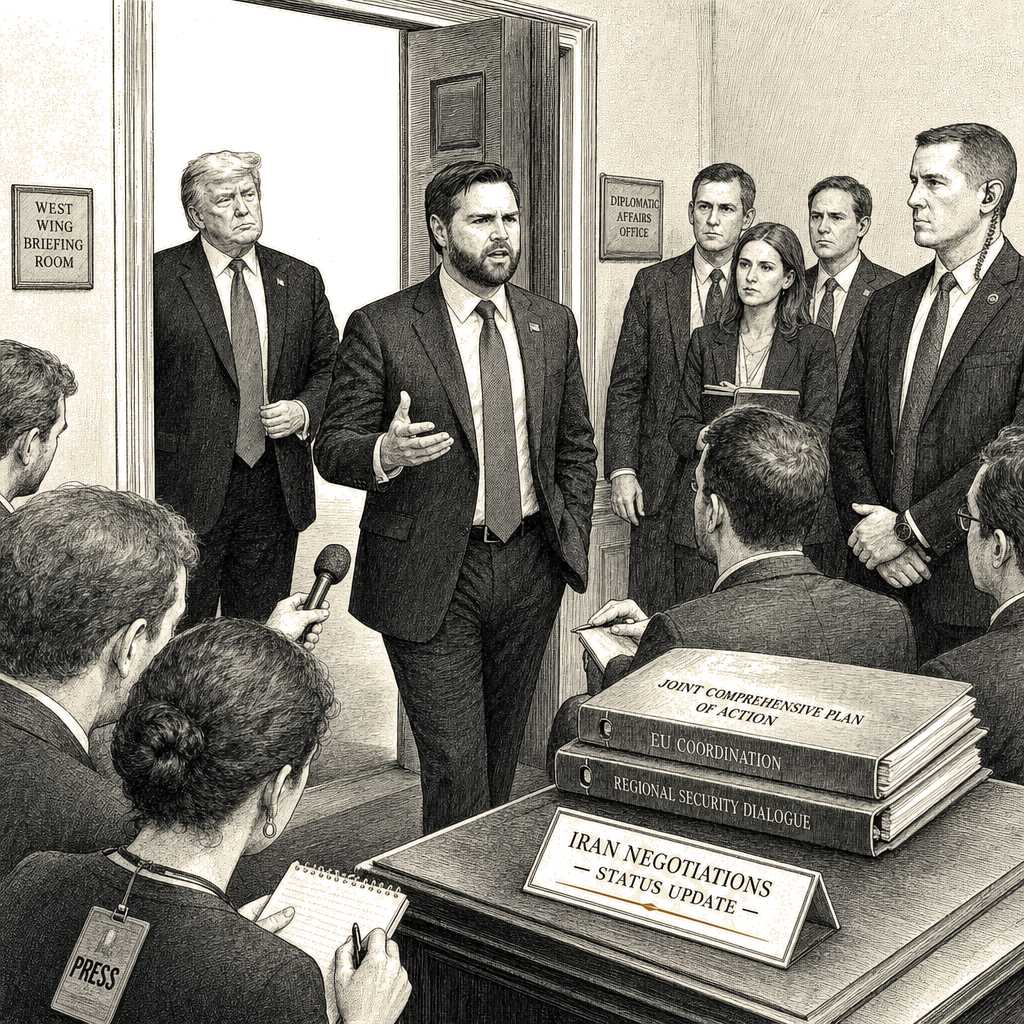
Vice President JD Vance has taken the greatest gamble of his vice-presidency by making himself the face of the Iran ceasefire deal, according to a report from The Guardian. The agreement, which has drawn sharp criticism from hawkish Republicans and appears to be unraveling, represents a high-stakes political maneuver for a figure who was initially sidelined from the administration’s war planning.
President Trump has publicly positioned Vance as the point person for the deal but has also set him up as a potential fall guy should the talks collapse. “If it works out, I’m going to take the credit,” Trump said, according to The Guardian. “If it doesn’t work out, I’m blaming JD.” The comment was nearly identical to a joke Trump had made about Secretary of State Marco Rubio more than a year earlier.
Vance has been leading the highest-level engagement between U.S. and Iranian officials since the 1979 revolution, negotiating through Pakistani mediators. He has conducted a multi-media campaign to sell the deal, including appearances on “The View” and in interviews, while also promoting his new memoir.
The vice president has faced regular public undercutting from the White House. Trump has threatened to resume strikes on Iran and even to assassinate Iranian negotiators while talks were ongoing. Vance sought to explain the dynamic in an interview, saying: “What we told the Iranians yesterday is that when you guys engage in what us millennials might call trash talk, you can’t expect the president of the United States not to respond and not to correct the record.”
Vance’s role represents a sharp reversal from his early months in the administration. According to The Guardian, Vance had been sidelined from the Iran war planning at Mar-a-Lago and appeared distanced from the conflict. In private, journalists were briefed on his opposition to the war. A former Senate colleague told The Guardian: “We could see that he was deeply uncomfortable with the war. This is not what he joined the administration to do. But he chose to play along with Trump himself.”
Vance served as a combat correspondent in Iraq and had been a vocal opponent of what he called the “forever wars” of previous administrations. The Iran war, launched in February, represented the largest U.S. military intervention in the Middle East in a generation.
The political stakes are high. The Guardian reported that some insiders said Vance’s handling of the deal had imperiled his likely run for the presidency in 2028, where he remains the presumptive Republican favorite but has lost ground to Rubio, a foreign policy hawk who has proved a competent top diplomat and security official. Andrew Day of the American Conservative, a publication critical of neoconservatism, was quoted saying: “For many voters, Vance now represents a deeply and increasingly unpopular administration that presides over a spluttering economy, geopolitical decline, and a catastrophic war with Iran.”
Vance has also drawn criticism from pro-Israel hawks over his approach. In an interview with New York Times columnist Ross Douthat, he offered an unusually critical appraisal of Israeli foreign policy. “What is your exact proposal?” Vance asked rhetorically when questioned about criticism from hardline Israeli politicians. “You’re a country of 9 million people. You can’t just kill your way out of solving every single national security problem that you have.”
The vice president has attempted to use his new prominence to define himself ahead of a potential 2028 campaign. “Vance, to come out on top, will first need to define himself,” Day said.