WASHINGTON — Vice President JD Vance on Thursday cast the U.S.-Iran memorandum of understanding as an accomplished victory for the United States regardless of what happens in the next 60 days of negotiations, as he prepared to lead the administration’s diplomatic sprint toward a final nuclear deal.
“We have all of the cards,” Vance said at a White House press briefing. “If the Iranians want the benefit of the bargain, they have to give us the things that are necessary to get those benefits.”
The MOU was signed Wednesday evening by President Trump at the Palace of Versailles in France, capping a three-month military conflict that began in April. Under the initial agreement, the U.S. lifted sanctions on Iranian oil sales and began allowing ships through its blockade of Iranian ports. In exchange, Iran reopened the Strait of Hormuz and committed not to seek a nuclear weapon — a pledge it has made repeatedly in the past — with the details to be negotiated over 60 days.
Vance said Tehran had not fired on commercial vessels for two consecutive days and had allowed ships carrying 12.5 million barrels of oil to pass through the Strait of Hormuz over the previous 24 hours. He described a system of calibrated economic pressure: “As they dial up their good behavior, we can dial up the economic relief. If they dial down their good behavior, we can turn it off.”
The vice president acknowledged that not all agreements with Iran are in writing. The disposal of Iran’s enriched uranium stockpile, which Vance said Iran agreed to do, is not covered in the 14-point document. “There’s a lot of discussion, the MOU, the gentlemen’s agreements, the final deal — words don’t matter, ladies and gentlemen, we’re about verification,” Vance said.
The deal has drawn skepticism from prominent Republicans. Sen. Roger Wicker (R., Miss.), chairman of the Senate Armed Services Committee, said in a statement that he is “concerned that the memorandum of understanding negotiates away the victories of Operation Epic Fury in ways that are completely out of step with the President’s goals.”
Vance urged critics to trust Trump. “He believes in the deal, he is going to see it to completion and if the Iranians don’t comply, we still have every single tool and point of leverage that we have,” the vice president said.
Trump sounded a more ambiguous note about his own negotiator’s position. “If it works out, I’m going to take the credit,” Trump said Wednesday. “If it doesn’t work out, I’m blaming JD. You better be careful, JD!” Vance laughed off the remark at the briefing, saying “the president was joking as he often does,” adding that his appearance this week on ABC’s “The View” had prepared him for hostile situations. “Joy Behar is way tougher than the Iranians,” he said, referring to one of the program’s co-hosts.
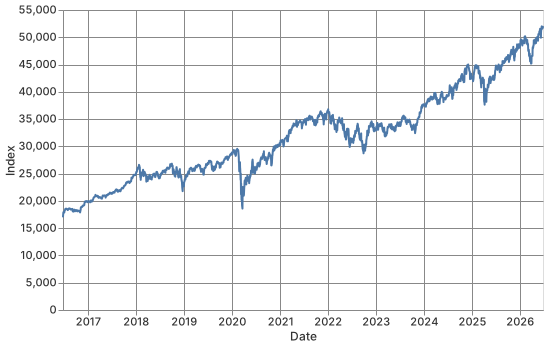
Trump said Wednesday he pushed to end the conflict because he was worried about the economic consequences of a prolonged closure of the Strait of Hormuz. He has pointed to the stock market’s rebound and declining oil prices as evidence the deal is working. The Dow Jones Industrial Average closed at 51,492.55 on June 18, the same day Vance addressed reporters. The average cost of a gallon of gasoline dipped below $4 for the first time in more than two months, according to the AAA.
Vance struck a cautious note on how much further relief consumers could expect. “I think you’re going to see a substantial reduction in gas prices,” he said, but added, “we don’t think you’re going to see significant relief at the pump on top of what you’ve already seen.”
Vance said negotiators would meet soon but did not offer a specific date for the start of the 60-day talks. Trump has said he would be open to negotiations continuing beyond the two-month window. The ultimate challenge for Vance as lead negotiator is that any final agreement must be approved by the president, who has frequently shifted his stated positions — originally seeking to dismantle Iran’s ballistic missile program before saying Wednesday that he thought Iran needed some missiles.