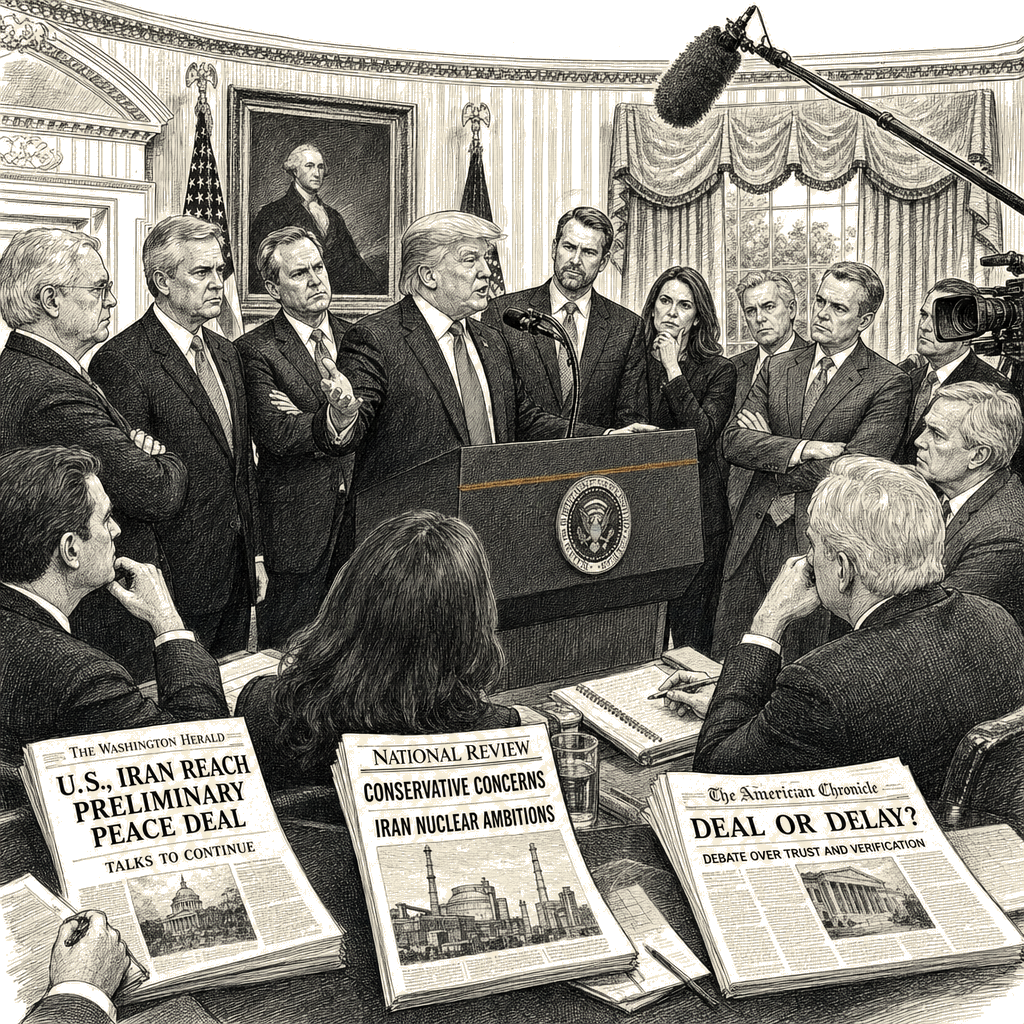
WASHINGTON — Hawkish conservatives who once defended President Trump’s war with Iran are expressing alarm over the preliminary peace deal he announced Sunday, fearing it will embolden Tehran and fail to curb Iran’s nuclear ambitions. Critics are demanding the full text of the agreement as details emerge about potential sanctions relief and billions in frozen funds being unlocked.
The emerging rift threatens to fracture a key part of Trump’s political coalition as the administration prepares to formalize the agreement. Conservative commentators and some Republican lawmakers are pressing for the deal’s text, while Vice President JD Vance defends the terms as a victory that denies Iran any funds unless it changes its behavior.
Senior Trump administration officials said the U.S. and Iran have discussed sanctions relief, restoring Tehran’s access to some of its estimated $100 billion in frozen funds and a $300 billion fund to facilitate reconstruction and repair of war damage. Officials have said Iran will not receive taxpayer money. A U.S. official said Iran will only get access to frozen funds if it can demonstrate that it will abide by the agreement’s terms, including neutralizing its highly enriched uranium and reopening the Strait of Hormuz. The memorandum of understanding includes an extended pause in fighting, lifts the U.S. and Iranian blockades in the Strait of Hormuz, and sets the stage for extended talks on Iran’s nuclear program. The Wall Street Journal reported Tuesday that the deal allows Iran to immediately begin selling oil and fuel.
Two influential voices who privately advised Trump throughout the war — retired Army Gen. Jack Keane, a Fox News contributor, and Marc Thiessen, a former chief speechwriter for President George W. Bush — have raised pointed concerns. “I can’t square some of the things that are coming out of the administration from reliable sources. That’s what I find so disturbing,” Keane told Fox News on Monday night. Thiessen called early reports about the agreement “utterly disastrous.” Sen. Lindsey Graham, a hawkish adviser to Trump, said he is eager to see the text. “I want to see it myself,” Graham said. “The way Iran describes it is awful. The way we describe it makes sense to me. Let’s look at it and see what it actually is.”
Vance did a round of television interviews this week to sell the agreement and push back on the criticism. “Iranians don’t get a dime unless they behave and change their behavior,” Vance said Monday during a Fox News interview, stressing that the reconstruction fund would come from Gulf states, not the U.S. He dismissed early critics and wrote on social media that “people who (rightly) said Donald Trump was a historic president a month ago” were subsequently “criticizing a deal based on unconfirmed media reports.”
The deal has also stirred conflict within conservative media. When Mark Levin, a Trump ally, called on the administration to release the text, former Trump campaign aide Alex Bruesewitz chastised Levin on social media. Levin replied that Bruesewitz was “a fool.” Ben Shapiro, a prominent pro-Israel commentator, said, “If the president signed a bad deal, many of us who cheered and stood by him and thought that his action in Iran was heroic, will be extraordinarily disappointed.” Shapiro added, “It is not enough to win the first half of the basketball game. You have to close it out.” Conservative talk-radio host Erick Erickson opened his program Monday by condemning the deal as “an American surrender.”
The unpopular war has already dragged down Trump’s approval ratings and fractured part of the coalition that catapulted him to a second term. Both Tucker Carlson and Megyn Kelly, influential conservative podcasters who campaigned on his behalf, earned a Trump rebuke after they blasted the Iran war as a betrayal of an America-first foreign policy inspired by Israel. Now the path to peace threatens to alienate the more hawkish conservatives who stuck with the president during the conflict. “If the only people who end up liking this deal are the people who have spent months screaming at Trump for taking on a 47-year enemy of the U.S.… then it will be, definitionally, a bad deal,” Shapiro said.
Vance, one of the administration’s most prominent skeptics of foreign wars, helped negotiate the deal. It could be both a crowning achievement and a potential political liability as Vance mulls his own White House ambitions. “The American people don’t like war, they like even less losing wars,” cautioned Shapiro. “If this deal is perceived as an American loss, and the vice president brokered that deal then the political consequences will be significant.”