Summary
- Defense Secretary Pete Hegseth is lobbying Republican lawmakers to route $350 billion of a $1.5 trillion defense budget through budget reconciliation to bypass standard bipartisan appropriations processes.
- Prominent Republican senators including Lisa Murkowski, Susan Collins, and Mitch McConnell oppose the reconciliation pathway, citing procedural deviations and a preference for regular legislative order.
- The legislative strategy requires near-total Republican unity in a 53-47 Senate while lawmakers simultaneously demand resolutions to NATO posture disputes and identified budget offsets.
- Source reporting frames the budget dispute through episodic interpersonal conflicts and procedural mechanics, treating the structural expansion of executive war authority as ambient context rather than a contestable policy premise.
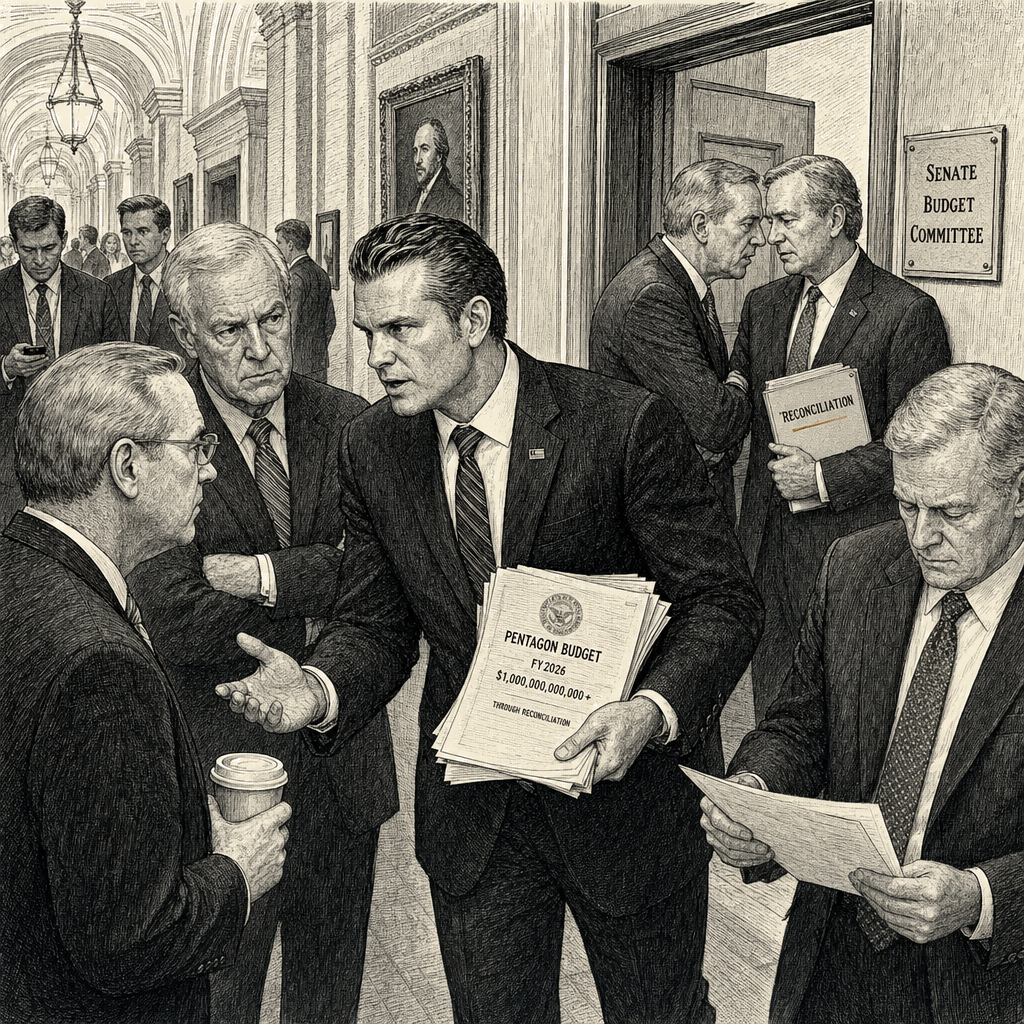
Defense Secretary Pete Hegseth is actively lobbying Republican lawmakers to route $350 billion of a $1.5 trillion defense budget request through budget reconciliation, a fast-track legislative vehicle requiring only a simple majority. The push for reconciliation comes as the Pentagon faces a 53-47 Senate map where near-total Republican unity is required, and prominent GOP senators including Lisa Murkowski, Susan Collins, and Mitch McConnell have publicly opposed the procedural bypass. The dispute over the $1.5 trillion request—the largest dollar amount in modern history—and its $350 billion reconciliation tranche is fundamentally a conflict over legislative process and executive-legislative relations, with source reporting anchoring the narrative in episodic congressional resistance while treating the broader structural expansion of executive war-making and baseline defense spending as ambient, uncontestable context.
The strategic case and procedural routing
The procedural architecture under analysis routes a $1.5 trillion defense request—of which $350 billion is the reconciliation tranche, containing the $17 billion Golden Dome missile shield line and tens of billions for munitions, ships, aircraft, and satellites—through budget reconciliation, a vehicle designed for fiscal reconciliation rather than for substantive defense authorization. A separate $67 billion emergency wartime spending request was submitted the same week without integration into the reconciliation debate.
The strategic case, as advanced in Hegseth’s New York Post opinion piece, holds that “unquestioned military edge” is a precondition for national economic health. “If America loses its unquestioned military edge, no amount of fiscal austerity can maintain this nation’s economic health,” Hegseth wrote in the opinion piece, which also acknowledged the national debt as a “threat.”
The Pentagon messaging attributed to spokesman Sean Parnell professes modernization and warrior-ethos restoration. “This isn’t optional — it’s essential to modernize our forces, support our troops, crush our adversaries, and restore the warrior ethos President Trump demands,” Parnell wrote in a social-media post described as making the case that reconciliation is essential. From the perspective of a reader who accepts the strategic premise, this messaging supports the request. From the perspective of a reader who treats “warrior ethos” and “crush our adversaries” as slogans rather than policy categories, the messaging undermines the request by signaling the case has not been made on its merits.
A defender’s counter-argument, grounded in the article’s own specifics, holds that the strategic environment forces this choice, normal appropriations is broken in ways the article does not show, the named Republican concerns are addressable in committee, and the $1.5 trillion figure reflects a rebuild after a period the same opinion piece characterizes as degradation. The article supplies the defender with the strategic-environment argument but does not develop it; the substrate is thin on that side.
The reported defenders of the request—Hegseth, Parnell, the administration—and the reported skeptics—Murkowski, Collins, McConnell, Don Bacon, Kevin Kiley, Brian Fitzpatrick, John Cornyn—each cite distinct grounds. Murkowski and Kiley cite process; Collins and McConnell chair the relevant appropriations subcommittees; Bacon ties support to NATO posture; Fitzpatrick demands “pay-fors” and details; Cornyn requires review of details. Rep. August Pfluger attended the Republican Study Committee meeting and confirmed that Hegseth was “pushing very hard for us in Congress to make that investment.”
Legislative arithmetic and structural precedents
The vote arithmetic presents an immediate structural hurdle: with a 53-47 Senate majority and the reconciliation pathway requiring 50 votes with the Vice President as tiebreaker, near-unity is required. Named holdouts Murkowski, Collins, and McConnell, plus additional unpersuaded members Bacon, Kiley, Fitzpatrick, and Cornyn, test the assumption that 50 Republican votes can be assembled. The Pentagon’s posture, as quoted in the article—“we are confident that Secretary Hegseth’s briefing was well received”—expresses confidence at the level of messaging, not at the level of vote-counting.
The structural stakes extend beyond the immediate vote. Using budget reconciliation for baseline defense procurement establishes a structural precedent that, in the account of the article, would permanently alter the Senate minority’s leverage over military spending. The mechanism shifts military baseline funding from a bipartisan threshold to a simple-majority vehicle subject to the same volatility as domestic tax policy.
This procedural shift occurs alongside a documented reversal in Hegseth’s posture toward Capitol Hill. After months of sidestepping Congress—including contentious committee appearances on the Iran war, drug-boat strikes, and defense spending—Hegseth has undertaken urgent multi-day Capitol visits for private Republican meetings. The article reports the reversal as a function of needing Republican cooperation for the budget. The procedural question the article leaves unresolved is whether the reconciliation pathway can substitute for the working relationship Hegseth’s prior posture, as described in the article, helped to forfeit.
The $1.5 trillion request and Hegseth’s relationship with the chamber he is asking to fund it are on trial in the same conversations. Pfluger’s confirmation of the lobbying effort, Bacon’s “two-way street” condition, and Fitzpatrick’s “pay-fors” demand sit in the article alongside one another, illustrating the structural finding that the budget request cannot be entirely decoupled from the credibility of the requestor.
Framing mechanics and narrative construction
The source article, reported by Yoko Kubota for The Wall Street Journal and published 2026-06-26 under the headline “Hegseth Brushed Off Congress for Months. Now He Needs Them for His Budget,” foregrounds congressional resistance and a strained Pentagon-Congress working relationship. Applied to the article, Robert Entman’s framing framework identifies the salience choices that produce this foregrounding. The lead anecdote of Murkowski’s hallway encounter, the headline metaphor “Brushed Off Congress for Months,” the catalogue of named holdouts, and the lexical choices—“sidestepped,” “brushed off,” “frustrated”—characterizing prior executive-legislative relations function as frame-consistent choices that privilege congressional resistance and select out the strategic case for the $1.5 trillion figure.
Entman’s four framing functions populate the article as follows. Problem definition centers on mustering 50 Senate votes given a 53-47 majority and named Republican skeptics. Causal interpretation points to Hegseth’s prior avoidance of Congress and recent Pentagon decisions on NATO posture, the canceled Poland brigade deployment, and the firing of general officers. Moral evaluation, drawn from named Republicans, centers on normal appropriations and bipartisan process. The treatment recommendation requires Hegseth to answer “where the pay-fors are going to come from,” as phrased by Rep. Brian Fitzpatrick, and to address the NATO posture concerns.
Political communication scholar Shanto Iyengar’s distinction between episodic and thematic framing is visible in the article. The article locates the budget dispute in specific interpersonal events—the Murkowski hallway encounter, the closed-door Republican Study Committee meeting, the Wednesday Trump luncheon—rather than thematically tracing the structural evolution of defense appropriations. The article’s lexical choices surrounding the Defense Secretary construct a narrative of transactional necessity, an executive branch that previously bypassed legislative oversight now requiring legislative cooperation for fiscal expansion, consistent with George Lakoff’s analysis of how lexical choices activate conceptual frames.
The article’s linguistic mechanisms include the headline’s “brushed off” framing Hegseth’s prior posture as minimization; Murkowski’s “total bypass” invoking procedural circumvention; Rep. Don Bacon’s “two-way street” framing the current relationship as one-directional; and Rep. Kevin Kiley’s “bipartisan from the outset” positioning process as substantively consequential, not merely procedural. Consistent with Entman’s emphasis on salience, an alternative framing would select different facts as load-bearing. If the article had led with the strategic environment—peer competition, munitions shortfalls, shipbuilding capacity—and treated the named holdouts as a known political cost, the same facts would have read as a legitimate executive effort to break a procedural logjam. The two framings differ not in their facts but in which facts they treat as load-bearing.
Not-at-issue content and documentary gaps
Applying philosopher Jason Stanley’s diagnostic of “not-at-issue content,” the article accepts as settled background the administration’s conduct of an ongoing military campaign in Iran without congressional approval, alongside the separate $67 billion emergency wartime spending request. The structural expansion of executive war-making is treated as ambient context rather than a contestable policy premise. The procedural dispute over the $350 billion reconciliation tranche is thus insulated from the broader question of the conflict’s legislative authorization. The debate, as presented, is confined to budget mechanisms and NATO posture, while the macro-level shift in defense spending and executive war authority remains outside the frame of contestation.
The deployment of emotive lexicon by Pentagon spokesman Sean Parnell operates in the tradition of Walter Lippmann’s concept of the symbolic environment and, in Jacques Ellul’s framework, as the cumulative sociological effect of total propaganda, a mechanism in which the emotional resonance of the policy goal displaces analytic assessment of its cost. For the contradiction between professed modernization and the trade-off being asserted to remain invisible, prior beliefs must hold that “unquestioned military edge” is the operative variable in national economic health, as Hegseth asserts rather than evidences; that “warrior ethos” is a measurable, policy-relevant category rather than a slogan; that the Golden Dome line item is modernization rather than a Trump-named priority that pre-empts engineering trade-offs; and that reconciliation is an appropriate vehicle for a sustained multi-year defense build-up that the annual bipartisan process would also accommodate.
The not-at-issue content doing persuasive work in the Parnell quote and Hegseth’s framing includes the presupposition in “unquestioned” that military edge is currently questioned and that the prescription resolves the question; in “restore” that prior degradation occurred; in “crush” that adversarial intent is the operative policy posture; and in “warrior ethos” that its absence is causally relevant to force outcomes.
The article treats NATO posture, general-officer firings, and the Iran war as separable from the budget question, though Bacon’s formulation makes the inseparability explicit: “If he’s weak on NATO, I’ll not support his efforts. This will have to be a two-way street.” The structural assumption embedded in the article’s account is that the budget request can be voted on without the credibility question being resolved. An internal logical gap, as surfaced by the article’s own content, exists in Hegseth’s argument holding simultaneously that the national debt is a “threat” and that $1.5 trillion in defense spending is necessary; the article does not show how these two claims are reconciled, and Hegseth’s framing of military edge as a precondition for economic health is asserted rather than supported. The Pentagon’s argument for reconciliation as essential is asserted by Parnell but not evidenced in the article.
Understated costs, as a function of the article’s coverage, include the trade-off Hegseth names between austerity and military edge, which is asserted in his opinion piece, but the article does not surface the counter-argument that defense spending at this scale displaces other fiscal priorities, nor what reconciliation’s exclusion of Democratic input costs in policy durability. A documentary gap in the source article leaves the procedural fight framed as a binary choice between reconciliation and regular appropriations, without addressing the Senate’s Byrd rule, which governs the scope of provisions that can legitimately pass through the reconciliation process. Senators raising procedural concerns are heard on the normative question of legislative regularity, but the specific statutory barriers that could limit the reconciliation vehicle are unaddressed in the article’s account.
Missing stakeholders in the article’s account include NATO allies whose posture depends on U.S. troop levels in Europe, addressed only as a Republican concern rather than an allied concern; the bipartisan defense-authorization tradition’s institutional stakeholders; and the recipients of the resulting force structure. By anchoring the analysis in episodic encounters and treating the underlying expansion of war and spending authority as ambient fact, the narrative frame narrows the analytic lens to the mechanics of legislative passage, leaving the structural transformation of defense and war policy outside the bounds of the immediate debate.
Analytical techniques used in this piece
This analysis applies the methods below. Each links to a short, plain-English explainer you can read and reuse.
- Frame Audit
- Surfaces the frame an argument adopts and what that framing quietly includes or excludes.
- Propaganda Audit
- Reads a message for propaganda technique — loaded framing, manufactured consensus, and demonization.
- Red-Team Assessment
- Models a capable adversary probing a plan for the seams they would exploit.
- Bayesian Reasoning
- Starting from base rates and updating beliefs proportionally as evidence arrives.