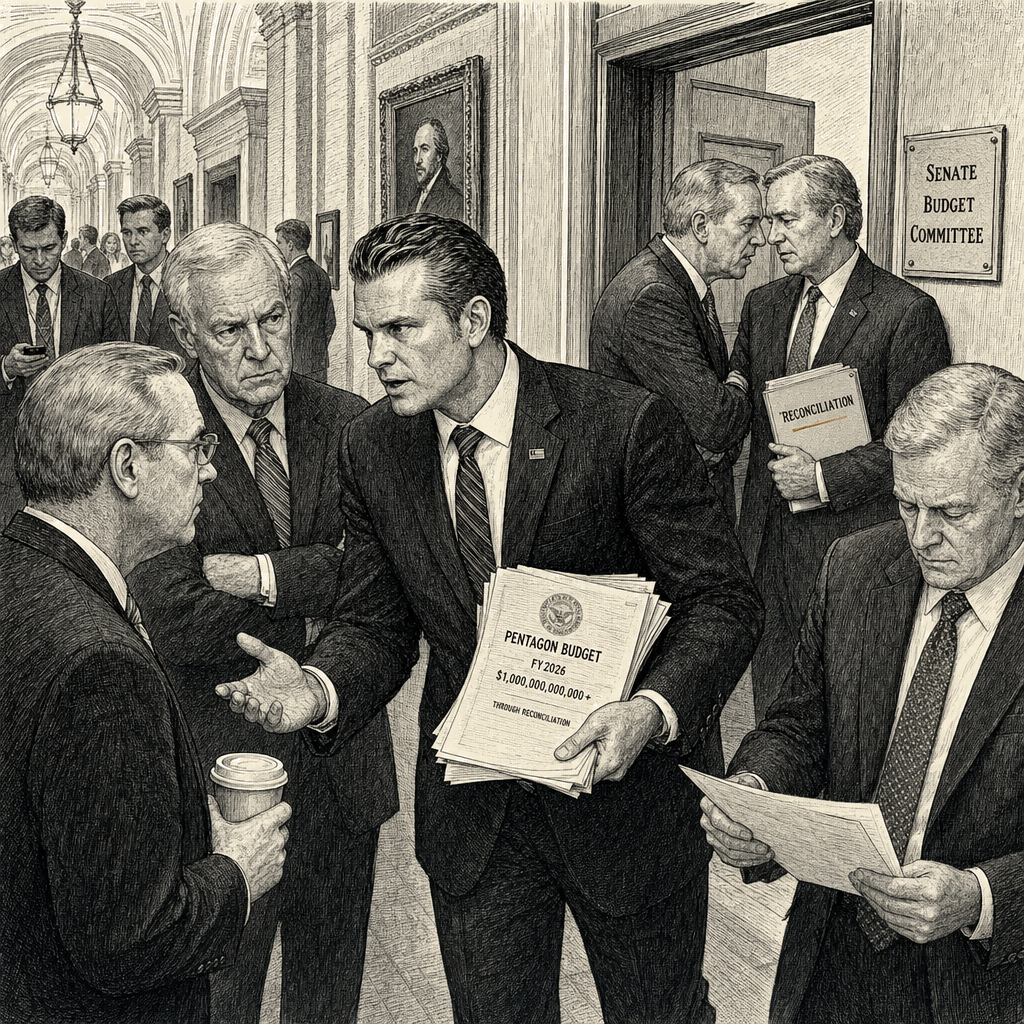
Defense Secretary Pete Hegseth, who has largely sidestepped Congress for months, is now urgently working to win Republican support for President Donald Trump’s $1.5 trillion Pentagon budget — the largest in modern history — by pushing lawmakers to use budget reconciliation, a partisan fast-track process that would allow passage with a simple majority, according to The Wall Street Journal.
Hegseth’s lobbying campaign marks a sharp shift from his earlier posture toward Capitol Hill, where his committee appearances often turned contentious and he frustrated lawmakers in both parties who wanted more information on the Iran war, drug-boat strikes, and defense spending. Now in need of their cooperation, Hegseth has made multiple visits to the Capitol in recent days for private meetings with Republican lawmakers.
Sen. Lisa Murkowski (R., Alaska), who voted against Hegseth’s confirmation last year, encountered the defense secretary in a hallway as he passed with his entourage. After doubling back to speak with her, Murkowski emerged from the brief conversation opposed to the reconciliation strategy.
“I do not see reconciliation as our tool,” Murkowski told The Wall Street Journal. “We need to be legislating. We need to be appropriating. Reconciliation is not that. Reconciliation is a total bypass.”
Murkowski also said she had turned down a request for a 20-minute meeting with Hegseth on Wednesday because it conflicted with a lunch Trump was holding with Senate Republicans at the same time. She said she expected to speak with a Pentagon official on Thursday.
Other GOP senators who have said they oppose reconciliation include Sen. Susan Collins (R., Maine), chair of the Senate Appropriations Committee, and Sen. Mitch McConnell (R., Ky.), who chairs the Senate Defense Appropriations subcommittee.
The $1.5 trillion budget request for fiscal year 2027 includes $350 billion that would be funded through reconciliation legislation rather than through the annual bipartisan appropriations process. That portion contains Trump priorities such as $17 billion for the proposed Golden Dome missile shield and tens of billions of dollars for munitions, ships, aircraft and satellites. The Pentagon this week also submitted a separate $67 billion emergency wartime spending request.
Under budget reconciliation, Senate Republicans would need only 50 votes with Vice President JD Vance as a tiebreaker. With a 53-47 majority, the party would need near-unity to pass the legislation.
On Wednesday, Hegseth met for about an hour with members of the Republican Study Committee, the largest conservative caucus in the House. In an opinion article in the New York Post this week, Hegseth acknowledged the national debt was a “threat” but argued that “if America loses its unquestioned military edge, no amount of fiscal austerity can maintain this nation’s economic health.”
Rep. August Pfluger (R., Texas), who attended the closed-door meeting, confirmed that Hegseth was “pushing very hard for us in Congress to make that investment.” But other Republicans at the meeting expressed frustration over Pentagon decisions beyond the budget. Rep. Don Bacon (R., Neb.) said Hegseth made a “strong case” but needed to address concerns such as the Pentagon’s cancellation of an armored brigade deployment to Poland. “If he’s weak on NATO, I’ll not support his efforts,” Bacon told the Journal. “This will have to be a two-way street.”
Rep. Kevin Kiley (R., Calif.), an independent who heard Hegseth’s presentation on Wednesday, said he opposed the reconciliation pathway because it would establish a partisan approach from the start. “Especially on an issue like national defense, I think we’ll get a better result, better policy, better buy-in, better implementation if it’s bipartisan from the outset,” Kiley said.
Rep. Brian Fitzpatrick (R., Penn.) said Hegseth had asked to meet with him but that he needed more details. “They haven’t described what their goal is, where the pay-fors are going to come from,” Fitzpatrick said. “Those are important questions to answer.”
Pentagon spokesman Sean Parnell called on lawmakers to use reconciliation in a social-media post, writing: “This isn’t optional — it’s essential to modernize our forces, support our troops, crush our adversaries, and restore the warrior ethos President Trump demands.”
On Wednesday, the same day Hegseth was meeting with members, Trump spoke at a contentious luncheon with Republican senators, where he clashed over the Iran war with one of his top Republican critics.
The administration’s challenge is compounded by the fact that Trump has largely ignored Congress on the Iran war, which began without congressional approval two months ago, and has targeted veteran Republican lawmakers for primary defeat over insufficient loyalty. Sen. John Cornyn (R., Texas), who lost a Trump-backed primary challenger in May, said he would need to review details before supporting any reconciliation bill.
A Pentagon official told the Journal that “we are confident that Secretary Hegseth’s briefing was well received.”