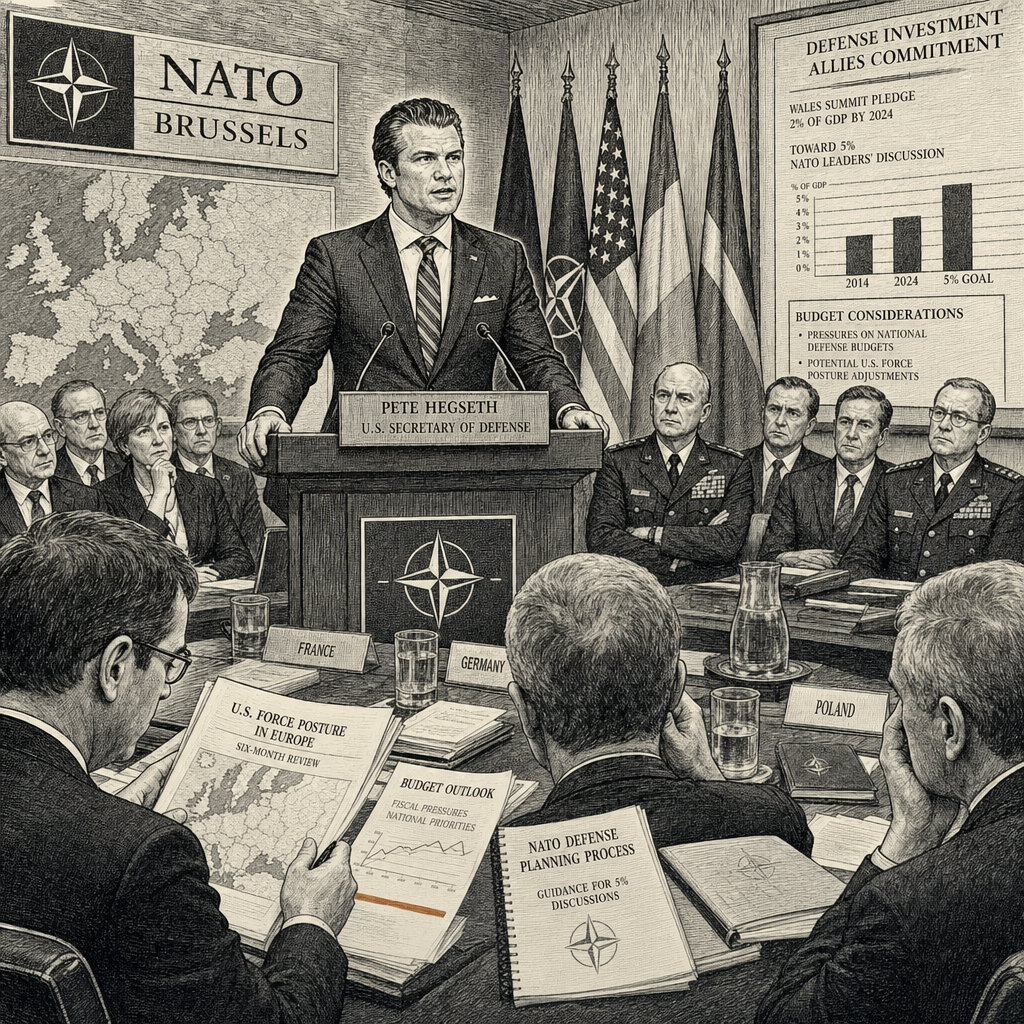
Defense Secretary Pete Hegseth delivered a confrontational address Thursday at NATO headquarters, warning that the U.S. is launching a six-month assessment—“to examine America’s force posture and basing in Europe”—and that future U.S. contributions to NATO’s budget would hinge on allies’ progress toward a new defense-spending target of 5% of gross domestic product.
“Make no mistake about it—this will be a real review,” Hegseth said at the opening of a twice-yearly gathering of NATO defense chiefs. “It will be designed to ensure that NATO is moving fast and irreversibly toward Europe, stepping up to take primary responsibility for the defense of Europe.”
The U.S. currently contributes 14.9% of NATO’s annual budget of roughly $5.75 billion, a proportion that has already been reduced from 22% a decade ago under prior U.S. pressure, according to NATO data.
“Going forward, our annual NATO dues will be contingent on other countries meeting their defense-spending targets,” Hegseth said. “Where other allies do not spend with urgency, our dues contributions will go down. NATO will be a two-way street.”
Hegseth also said the administration would press allies to ensure U.S. forces maintain access to bases throughout the alliance and can cross NATO territory when carrying out military operations in other parts of the world. He cited the U.S. war with Iran as an example: the United Kingdom made an airfield available for U.S. bombers, but Spain banned the use of its installations for the American campaign against Tehran. The Trump administration did not consult European nations before striking Iran.
Trump “gave our allies a test: to support America when we asked for their help,” Hegseth said. “And too many failed it.”
The speech escalates a push that began when President Trump returned to the White House. The administration has repeatedly called on Europe to shoulder more responsibility for its own nonnuclear defense, while the U.S. maintains its nuclear umbrella over the 32-country alliance. Allied military spending is set to be a central focus of NATO’s annual summit in Ankara, Turkey, next month.
The Pentagon has already taken steps to reduce its European footprint. In May, it canceled the deployment of an armored brigade to Poland and reduced commitments to alliance battle plans in the event of a war. It also significantly cut back the U.S. air and naval forces that would be earmarked for Europe in a crisis. The cuts took many allies and lawmakers by surprise.
Those moves have drawn sharp criticism from both parties. Sen. Thom Tillis (R., N.C.) said Wednesday that European allies have made significant progress in boosting military spending and cautioned against further cuts. “I believe the United States has led by example, by virtue of what we’ve invested as a percentage of our GDP,” Tillis said at the Atlantic Council in Washington. “What we don’t want to have in Ankara is some discussion of us reducing our commitment to NATO.”
Republican and Democratic lawmakers have inserted provisions in military spending legislation for 2027 that would make it harder to further reduce troops or remove stocks of U.S. weapons and munitions from Europe.
Sen. Jeanne Shaheen (D., N.H.) warned that Russia’s partnership with China and North Korea underscored the risks for the U.S. and its allies. “Clearly there’s still a threat,” she said Wednesday at the Atlantic Council.
Many military experts have long argued that the U.S. should shift more of its military effort to the Pacific while European nations pick up the slack in Europe. But the Pentagon cutbacks are taking effect immediately and do not provide time for a transition, raising concerns about a gap in capability.
“The question yesterday came up: Is this immediate or not? It is immediate,” NATO Secretary-General Mark Rutte said Thursday, confirming that the reductions to U.S.-dedicated forces are already underway.