Summary
- U.S. Central Command and the Islamic Revolutionary Guard Corps execute cross-domain military strikes across the Gulf while public statements defend a sixty-day diplomatic memorandum.
- Iranian Foreign Minister Abbas Araghchi and Revolutionary Guard commanders issue divergent public conditions regarding the continuation of bilateral negotiations.
- Iranian munitions strike Bahraini and Kuwaiti sovereign territory, targeting U.S. treaty partners rather than direct U.S. military assets.
- Qatar navigates simultaneous roles as diplomatic mediator and economic stakeholder following an Iranian maritime strike on a Qatari-contracted tanker.
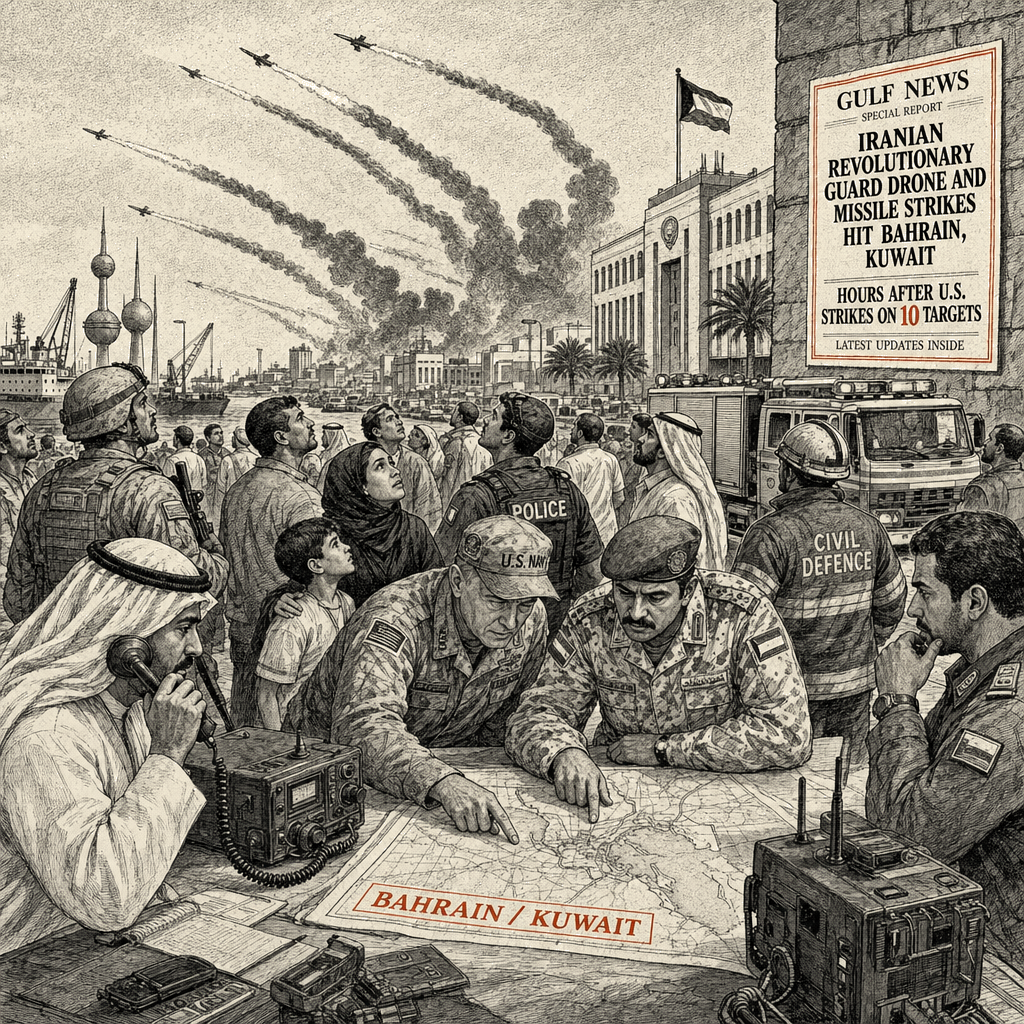
U.S. Central Command struck 10 Iranian military targets late Saturday, and the Islamic Revolutionary Guard Corps launched drone and missile attacks on Bahrain and Kuwait on Sunday, escalating a regional confrontation while a 60-day diplomatic memorandum remains in effect. The U.S. operation, which targeted surveillance infrastructure, communication systems, air defense sites, drone storage facilities and minelayer capabilities, responded to an Iranian Saturday strike on the Panamanian-flagged tanker Kiku in the Strait of Hormuz. The geographic choice to strike U.S. treaty partners rather than U.S. assets, combined with divergent public messaging from Tehran’s diplomatic and military institutions, indicates a cross-domain synchronization designed to test regional red lines without formally collapsing the June memorandum of understanding.
Signal Architecture and Target Selection
The regional security architecture operates as a hub-and-spoke network, with the Revolutionary Guard and U.S. Central Command functioning as competing central hubs. Iran is signaling across at least three documented channels: direct U.S. targets, Gulf partner states, and the Israel-Hezbollah front, even though the Israel-Hezbollah ceasefire signed earlier this month is structurally outside the memorandum framework. The Lebanon front and Hezbollah’s Iranian backing introduce a parallel escalation vector outside the bilateral track.
The utilization of third-party flags and sovereign territories is documented conduct. The Panamanian flag of the Kiku and Bahraini and Kuwaiti sovereign airspace for the retaliatory strikes route the maritime action-reaction chain through non-U.S. flags and non-U.S. territory rather than U.S.-flagged vessels or U.S. sovereign territory. Qatar occupies a dual role as a key mediator between Iran and the U.S. regarding the June memorandum, and the Kiku was carrying crude oil on behalf of Qatar’s state-run energy company, compressing diplomatic and economic domains into a single target set.
Bahrain’s Interior Ministry reported munitions struck a residential building near the international airport, destroying its top floor and blowing out windows, with no fatalities. Kuwait reported its air defenses intercepted two Iranian ballistic missiles with no injuries or damage. Bahrain’s baseline diplomatic posture has shifted following these events. Separately, violence between Israel and Hezbollah continued in southern Lebanon. Hezbollah killed an Israeli soldier in Deir Siryan village, and Israel’s military responded by killing the man responsible. Hezbollah’s leader stated the group would fight on until Israel withdraws from southern Lebanon. Israel’s military chief of staff, Lt. Gen. Eyal Zamir, warned that Israeli forces are “prepared to rapidly resume offensive operations in both Lebanon and Iran if required,” establishing an explicit cross-domain conceptual link that transforms isolated bilateral disputes into an integrated regional threat matrix.
Explanatory Frameworks for Escalation
Deterrence theory frames concurrent diplomatic and military escalations as either action-reaction spirals, where localized probes trigger proportional responses that escape diplomatic control, or as deliberate cross-domain synchronization, where military probes test red lines across multiple theaters.
The proposition that the Revolutionary Guard struck Bahrain and Kuwait to match the U.S. strike as direct retaliation is inconsistent with the geographic record. Bahrain and Kuwait are not parties to the U.S.-Iran exchange, and the strikes exceed what symmetric retaliation against the U.S. would predict.
Conversely, the proposition that maritime and land-front pressures are coordinated to stretch adversary responses is consistent with documented conduct. The June memorandum framework remains in place. Iranian Foreign Minister Abbas Araghchi stated Sunday that any attempt to establish new arrangements for the Strait would “only lead to further complications, delay the reopening of the Strait of Hormuz and increase the level of tension,” defending Tehran’s stated position while strikes targeted U.S.-allied territory.
The proposition that hardline elements are attempting to collapse the negotiating track is consistent with the rhetorical gap between institutions. The Revolutionary Guard warned it “could halt negotiations entirely if U.S. military action continued,” diverging in tone from Araghchi’s measured statement. These statements are from different institutional sources on the same day and remain unreconciled.
A tension exists between analyzing the strikes as a miscalculation and assessing the memorandum as having reached its functional limits. The centralized command and control required for coordinated strikes on two distinct partner states weigh against an impulsive miscalculation. Alternatively, the June memorandum may have already reached its functional limits, rendering these strikes a managed transition back to baseline deterrence rather than an accidental war. This divergence remains a surfaced tension.
The rogue-action hypothesis, positing the tanker attack was an unauthorized local-commander action, is rejected because immediate, coordinated retaliatory strikes indicate centralized command. The third-party false-flag hypothesis lacks evidentiary indicators. The signaling-not-warfighting calibration hypothesis, which posits strict casualty-avoidance to demonstrate resolve, is undermined by the strike on a residential building in Bahrain, demonstrating a willingness to accept severe diplomatic collateral damage. The available evidence is consistent with cross-domain synchronization and institutional divergence in combination, with the 60-day window’s expiration operating as a cross-cutting structural pressure point.
Public Framing and Institutional Postures
Bahrain’s Foreign Ministry characterized the strikes as “a dangerous escalation” and “a deliberate approach and a systematic pattern of repeated aggression,” an advocacy framing of prior events utilized to justify its posture.
Iranian Foreign Minister Abbas Araghchi spoke of complications, not collapse, with the Sunday statement on the Strait of Hormuz recording the documented governmental position. The Revolutionary Guard, according to a paraphrase carried by state-run media on social media, warned of a conditional halt, stating it “could halt negotiations entirely if U.S. military action continued.”
President Trump accused Iran of violating the ceasefire. In a social media post, he stated, “There may come a point when we are no longer able to be reasonable, and will be forced to militarily complete the job that we very successfully started,” adding, “If that happens, the Islamic Republic of Iran will no longer exist!”
Lt. Gen. Eyal Zamir stated Israeli forces are “prepared to rapidly resume offensive operations in both Lebanon and Iran if required,” documenting an explicit military posture. Iran’s stated position is that it “insists it alone must govern the waterway,” foreclosing any settlement naming a multilateral or U.S. role in the Strait. The conditional and maximalist statements from both the Revolutionary Guard and the U.S. presidency narrow the diplomatic room.
Scenario Trajectories and Strategic Postures
The predetermined elements shaping the environment include the running 60-day clock with most of the window remaining; Iran’s stated governance position on the Strait; the Lebanon front sitting structurally outside the memorandum framework alongside Zamir’s warning; the shifted baseline posture of the Gulf states; and the expiration functioning as an exogenous calendar deadline forcing resolution or lapse regardless of battlefield events.
Critical uncertainties dictate the trajectory: whether the U.S. responds to the Sunday strikes with further military action or accepts them as a contained signal; whether Iran’s negotiating track halts given the unreconciled institutional statements; and whether the Hezbollah front expands beyond the established pattern of the Sunday soldier-killing.
Under a framework analyzing the memorandum versus regional front stability, four trajectories emerge:
- The memorandum holds and the regional front is contained. Both sides treat Sunday as a signal that did not cross a red line. Leading indicators include no further U.S. strike within 72 hours and Iranian messaging continuing to reference the 60-day window.
- The memorandum collapses and the regional front is contained. The U.S. responds militarily, Iran halts negotiations, and the Hezbollah front stays in its current pattern. Leading indicators include a new Central Command strike or a formal suspension of talks.
- The memorandum holds and the regional front expands. The diplomatic track survives while a Hezbollah, Houthi, or Iraqi militia action opens a second channel. Leading indicators include a multi-casualty Hezbollah attack, a Houthi shipping strike, or Iraqi militia action against U.S. assets.
- The memorandum collapses and the regional front expands. Both axes break, combining the indicators of the second and third trajectories. The conditional and maximalist statements on both sides narrow the path to the first trajectory; the second and third are plausible based on substrate-visible postures.
Under an analytically independent framework analyzing internal Iranian control versus U.S. military posture, axis shifts occur if Revolutionary Guard directives supersede the Foreign Ministry, or if U.S. strikes target command nodes, civilian infrastructure, or regime symbols. Four trajectories emerge:
- Restrained U.S. and Diplomatic Tehran. Strikes remain limited to military infrastructure, and the memorandum is renegotiated prior to expiration. Leading indicators include resumed Qatari mediation and purely military target sets.
- Restrained U.S. and Revolutionary Guard Dominance. The Guard utilizes proxy strikes to exhaust defenses while the U.S. limits responses to military targets. The memorandum is functionally dead, but no regime-threatening action materializes. Leading indicators include the Guard maintaining public negotiation-halt threats and U.S. strike packages excluding command nodes.
- Regime-Targeting U.S. and Diplomatic Tehran. The U.S. escalates to regime-threatening levels, and Tehran’s diplomatic faction attempts to absorb strikes, generating internal fractures. Leading indicators include the execution of the presidential warning and observable friction between Iranian civilian and military leadership.
- Regime-Targeting U.S. and Revolutionary Guard Dominance. Full-scale U.S. strikes target regime infrastructure, and the Guard unleashes its full arsenal on Gulf states and Israel. Leading indicators include Hezbollah opening a sustained northern front and Gulf states integrating militaries into the conflict.
A wild-card scenario involves a catastrophic maritime environmental or infrastructure disaster in the Strait—such as a minelayer strike on a massive LNG carrier or an errant strike hitting critical Gulf desalination infrastructure—instantly closing the waterway. Compounded by the formal lapse of the memorandum, this event would force immediate macroeconomic intervention by global energy consumers, potentially overriding strategic calculations by imposing an external economic ceasefire.
Robust strategies holding value across all trajectories include Gulf states hardening critical civilian infrastructure, prompted by the Bahrain airport residential strike, and the U.S. securing alternative diplomatic backchannels that bypass formal foreign ministry tracks to engage Revolutionary Guard pragmatists directly. A full-scale U.S. military campaign yields decisive outcomes only in the third and fourth trajectories of the second framework. Qatar leveraging its dual status is viable in the first two but fails in the latter two. Contingent actions include transitioning to regime-targeting postures if Qatari mediation signals withdrawal as the window closes, or escalating air defense integration and target-sharing if Gulf intercept rates drop. Social, Technological, Economic, Environmental, and Political driving forces scan across the post-memorandum environment, encompassing domestic political directives in Washington, factional signaling in Tehran, the economic imperative of Strait transit, and the environmental vulnerability of Gulf coastal infrastructure.
The Sixty-Day Window
The Sunday strikes do not, on the published record, constitute an Iranian withdrawal from the memorandum. Araghchi spoke of complications, not collapse, and the Revolutionary Guard spoke of a conditional halt, not termination. The room for continued negotiation has narrowed. The strikes on Bahrain and Kuwait targeted U.S. partners while Iranian public statements defended Tehran’s stated position on the framework, leaving the question of whether those partners, and the U.S., accept that price as the binding variable for the remainder of the 60-day window.
Analytical techniques used in this piece
This analysis applies the methods below. Each links to a short, plain-English explainer you can read and reuse.
- Differential Diagnosis
- Lists the candidate explanations for a symptom and rules them out one by one.
- Relationship Mapping
- Extracts the network of ties among people, institutions, and entities.
- Scenario Planning
- Builds a small set of distinct, plausible futures to plan against.