Summary
- Marine insurance thresholds and depleted strategic reserves create concave exposure in Gulf oil transit, complicating market assumptions of a linear return to baseline flows following resumed U.S.-Iran talks.
- Strait vessel traffic operates at reduced levels under precarious routing conditions, creating a logistical bottleneck where insurer capital withdrawal can halt transit independently of physical vessel availability.
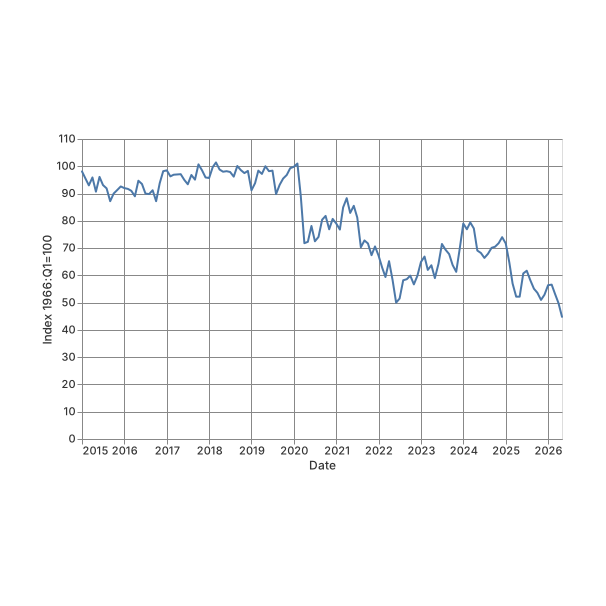
- The U.S.-Iran strategic interaction functions as a canonical repeated game of brinkmanship where domestic consumer sentiment at 44.8 constrains U.S. political runway for sustained energy price shocks.
- Utility-scale battery storage expansion by Tenaga Nasional demonstrates a physical decoupling mechanism that structurally buffers grid stability against the volatile input costs of strait-dependent energy corridors.
Oil futures rebounded Monday on resumed U.S.-Iran diplomacy, but market pricing overlooks the concave fragility of Gulf transit logistics, where depleted strategic reserves and discontinuous marine insurance thresholds threaten to halt flows independently of physical vessel availability. Front-month WTI settled up 2.2% at $70.75 a barrel and Brent rose 1.6% to $73.15, reversing a sharp decline to prewar levels, yet analysts note the physical and financial plumbing governing the Strait of Hormuz exhibits non-linear response functions that complicate assumptions of a smooth return to baseline supply chains.
Fragility topology and convex-concave exposure
Front-month WTI settled up 2.2% at $70.75 a barrel; front-month Brent rose 1.6% to $73.15 ahead of its Tuesday expiry. The gains followed a sharp decline the prior week that pushed oil to prewar levels as flows through the Gulf resumed. Rob Thummel, senior portfolio manager at Tortoise Capital, stated the risk premium has come down “quite a bit,” noting that while conditions remain subject to change, the market currently perceives flows through the Strait of Hormuz will continue for an extended period.
Nassim Nicholas Taleb’s framework (Antifragile, 2012) classifies the physical and financial plumbing governing Gulf transit as exhibiting concave response functions, specifically in marine insurance capacity and strategic reserve buffers, complicating the assumption of a linear return to baseline flows. Under this topology, holders of long oil-futures positions and underwriters of war risk insurance hold convex exposure, with payoffs gaining non-linearly from tail-event probability shifts. Conversely, oil-importing consumer-discretionary sectors hold concave exposure. Baird analysts Jonathan Komp and Alexander Conway noted that apparel and footwear companies’ forecasts have not yet absorbed the price decline from $95–$110 a barrel in late April and early May to current levels.
A hidden concave exposure exists in the substitution of supply sources. Neil Crosby of Sparta Commodities observed the market is clearing crude trapped behind the Strait of Hormuz by “hitting the global market just as we had covered crude needs with other sources (e.g. SPR).” This substitution masks the underlying imbalance rather than resolving it. Insurance capacity operates on a threshold: as risk crosses an underwriter’s tolerance, coverage withdraws discontinuously rather than linearly, creating a logistical bottleneck independent of the physical availability of vessels. Robert Yawger of Mizuho stated “the main concern is that shipping will lose momentum as insurers pull back from green-lighting the accelerated transit of crude through the strait.” The system consequently classifies as fragile, exhibiting an equilibrium built on the smoothest-credible diplomatic outcome, with tail risks originating in insurer capital retreat.
Pre-mortem failure pathways and interface constraints
The element whose removal would do the most damage to the current equilibrium is shipping-insurance capital availability. The element currently doing the most damage by being present is the market assumption that diplomacy alone sustains flows. Yawger noted that “Traffic in the strait was already operating at reduced levels because of the precarious nature of the routes available to shipping.” Under that load condition, the inventory-rebuild narrative supporting $70–$73 prices would, with transit costs unfunded, push differentials toward the April–May peaks of $95–$110. Leading indicators visible at present include vessel AIS coverage gaps in the strait, war risk premium trajectories at Lloyd’s, and the entry-versus-exit velocity Crosby identifies as the normalization condition, stating that “it is still fairly obvious to us that until more vessels sustainably head into the Strait than come out of it, we won’t get anywhere near a normal Arabian Gulf supply chain.”
Applying a five-class fragility taxonomy derived from Hollnagel’s resilience quadrivium and Perrow’s normal accident theory reveals specific structural vulnerabilities:
- Load fragility: the volume of accelerated transit requests could overwhelm the finite capital reserves of marine war-risk syndicates, causing a coverage freeze.
- Dependency fragility: shipping operators depend entirely on insurer green-lighting, while insurers depend on real-time threat intelligence reflecting a precarious routing environment.
- Interface fragility: the Strait of Hormuz is a narrow geographic joint where a single disabled vessel or mining event physically blocks the interface, halting all traffic regardless of insurance status.
- State fragility: the cumulative depletion of the SPR and commercial inventories means the system lacks the state variables required to absorb transit delays. If — as Crosby’s framing implies — SPR releases have been the marginal source covering the gap, the system has effectively lost that shock absorber.
- Emergent fragility: a phantom blockade emerges where the physical channel is open, but the coordinated behavioral response of captains, insurers, and charterers halts transit without a single kinetic event.
The most plausible breakage pathways center on interface and state fragility. The physical interface of the strait is highly constrained, and Crosby’s observation that entry must sustainably exceed exit indicates that any minor kinetic event at the interface will trigger a cascading behavioral withdrawal. With the state buffer removed, the system cannot absorb the resulting supply shock, forcing prices to re-test the $95–$110 range observed in late April. Secondary stressors that could exploit this concavity include simultaneous degradation of the Bab el-Mandeb strait or a cyber-attack on Gulf port loading infrastructure. If the Red Sea corridor remains contested while Hormuz requires accelerated transit, the global fleet faces a dual-chokepoint constraint. The insurance market would face compounding, correlated exposures, likely triggering a total withdrawal of coverage rather than a priced adjustment, transforming a geopolitical risk premium into a physical supply halt.
Strategic interaction and attrition constraints
The strategic interaction between the United States and Iran operates as a canonical repeated game of brinkmanship, alternatively modeled as a war of attrition in formal bargaining literature (Fearon, 1995; Powell, 2004), in which Iran’s commitment to resumed talks is one move in a continuing sequence of escalation-and-conciliation rounds. The current equilibrium of limited strikes combined with renewed negotiation is consistent with the limited-strike pattern the parties have demonstrated, with the alternative of sustained conflict imposing costs on infrastructure, capital deployment, and shipping flows. Iran-side credibility remains unanchored; Iran’s stated commitment to resumption of talks lacks an observable enforcement mechanism, since neither side’s diplomatic commitment has been ratified by institutions capable of imposing sanctions for breach. U.S. credibility is backed by sunk costs already deployed during the weekend strikes, giving that escalation move tangible rather than rhetorical weight.
The shipping insurance market operates as a contingent strategy detached from the bilateral game. Underwriters price observable transit conditions, not diplomatic intent, which is why the insurance-and-traffic framing carries more mechanical weight in price discovery than talk-related optimism. The strategic equilibrium of a war of attrition shifts depending on which side faces a binding constraint first. The U.S. cost of waiting is partially transmitted through domestic consumer sentiment, with the University of Michigan Consumer Sentiment Index standing at 44.8. U.S. political and economic stability is sensitive to fuel-cost-driven sentiment shocks. If the phantom blockade re-emerges and drives prices back toward $110, the marginal cost to U.S. consumer confidence rises steeply. The Iranian cost of waiting is measured in foregone oil revenue and fiscal stability. The market’s current discounting of the risk premium implies an assumption that Iran’s fiscal constraints are binding; the U.S. consumer-sentiment reading of 44.8 implies the U.S. constraint may be equally acute.
Consumer sentiment and secondary market transmissions
The recent decline in oil prices from levels of about $95 to $110 a barrel in late April and early May is likely to provide a boost to consumer confidence that has not yet been accounted for in apparel and footwear companies’ forecasts, according to Komp and Conway. They noted such sizable declines typically lift consumer confidence and support upside for stocks in the sector, pointing to particularly good setups for Dick’s Sporting Goods, Crocs, and Adidas. The counterfactual symmetric to the Baird thesis is that if concavity-driven withdrawal scenarios materialize and precipitate a renewed price spike, the same apparel and footwear names would face inverse margin compression, demonstrating the transmission of geopolitical fragility through the energy complex directly into consumer discretionary equities.
The 44.8 University of Michigan Consumer Sentiment reading functions as a fragility signal rather than a standard market input. Household-level risk perception has not converged with the financial-market repricing of oil and shipping insurance. The divergence between Thummel’s inventory-rebuild narrative — “We’ll need to have an oversupply in the oil market just to build back inventories, for a while” — and the consumer-discretionary cost base Komp and Conway describe is the space in which the next dislocation forms. This divergence is visible in the persistent gap between headline oil prices and the sentiment curve still descending toward a multi-year floor.
Via-positiva adaptation in grid infrastructure
The via-negativa subtraction in the current market is the removal of the assumption that diplomatic continuity alone can sustain a flow-heavy oil market, in favor of pricing transit risk through war risk premia rather than relying on continued peace. The via-positiva counterpart requires physical capacity that absorbs grid volatility structurally rather than logistics chains that price it on the flow side. RHB IB analyst Max Koh stated Tenaga Nasional could build more battery energy storage projects to strengthen grid stability and support regulated capital spending growth. Koh estimated that expanding battery storage capacity to 3 gigawatts could lift his 2028 net profit forecast by 14%. The utility’s 595-megawatt hybrid hydro-floating solar project in Terengganu could generate a 12% internal rate of return and contribute 178 million ringgit, or about 3% of forecast 2028 net profit, based on current grid prices and its 70% stake.
In the context of fossil-fuel transit fragility, utility-scale battery storage acts as a concave-decoupling mechanism. It buffers grid stability against the volatile input costs and supply shocks inherent in strait-dependent energy corridors, allowing the utility to absorb systemic energy fragility and convert it into regulated capital spending growth. The asymmetry between the oil market’s via-negativa diplomacy-pricing and the grid side’s via-positiva physical-capacity absorption represents the most actionable structural observation in the current energy complex. The 98.10 starting value of the University of Michigan Consumer Sentiment time series in January 2015 provides the baseline for the current 44.80 reading, confirming the persistent gap between macroeconomic headlines and household confidence.
Analytical techniques used in this piece
This analysis applies the methods below. Each links to a short, plain-English explainer you can read and reuse.
- Fragility / Antifragility Audit
- Asks whether a system gains or loses from volatility, shocks, and disorder (Taleb).
- Pre-Mortem (Fragility)
- Imagines a system has already broken and traces the structural fragilities that let it.
- Strategic Interaction (Game Theory)
- Models a situation as a game — players, moves, payoffs, and likely equilibria.
- Supply & Demand
- Price and quantity settle where what buyers want meets what sellers will offer.
- Antifragility (Taleb)
- Whether shocks break a system, leave it unharmed, or actually make it stronger.