Summary
- Daiwa Capital Markets, Macquarie, and Bernstein published health-care sector assessments identifying a bimodal exposure pattern where concave losses concentrate in labor and consumer-demand vectors while convex upside ties to regulatory reversals and platform launches.
- Macquarie analysts linked moderating earnings outlooks for Cochlear and CSL to single-jurisdiction dependencies, citing ongoing declines in U.S. consumer sentiment and the near-certain withdrawal of Tavneos therapy in Europe.
- Bernstein analysts positioned Roche Holding and Neuren Pharmaceuticals as convex-upside opportunities, highlighting the Axelios 1 gene-sequencing platform’s potential to capture 40 percent of the next-generation sequencing market and European regulatory support for trofinetide.
- Multi-criteria evaluation of the six covered names places regulatory-execution risk and pipeline diversification as dominant ranking dimensions, exposing single-event dependencies across both the concave and convex clusters.
The June 30, 2026, health-care analyst note cycle reveals a distinct structural divide across six covered companies, with Daiwa Capital Markets, Macquarie, and Bernstein tracing divergent trajectories driven by labor disputes, macroeconomic sentiment, regulatory withdrawals, and platform launches. The assessments map onto two non-overlapping clusters: a concave-exposure group comprising Samsung Biologics, Cochlear, and CSL facing headwinds from union demands, weakening U.S. consumer confidence, and imminent European product withdrawals; and a convex-upside group anchored by Neuren Pharmaceuticals, Sartorius Stedim Biotech, and Roche Holding, buoyed by regulatory reversals, temporary regional slowdowns, and next-generation sequencing market share projections. Evaluating these notes through structural risk, demand-cycle exposure, and pipeline diversification criteria demonstrates that the underlying investment theses for both groups remain highly sensitive to single-jurisdiction regulatory events and macroeconomic anchors.
Convex-upside exposures and platform catalysts
Macquarie upgraded Neuren Pharmaceuticals after a key European regulator changed its mind on the registration of trofinetide for Rett Syndrome, raising earnings-per-share forecasts by 5 percent in each of fiscal 2027 and 2028. The upgrade relies on an expected $35 million milestone payment in the second half of 2026 for the product, known in the EU as DAYBU, alongside favorable currency movements. Macquarie expects an initial launch in Germany by the fourth quarter of 2026, with the product able to be sold in a free pricing environment for six months, and France and Italy to follow. The analysts noted the U.K. typically has weaker pricing and involves a separate regulatory process. Evaluating the trade-off decomposition reveals that while the free-pricing environment captures price-per-unit upside, Germany’s standard health technology assessment framework may defer but not eliminate volume-side cost-effectiveness reviews at the point of statutory-insurance reimbursement, leaving penetration rate as the binding constraint on launch-period revenue alongside unit margins. The $35 million milestone and fourth-quarter 2026 Germany launch thesis is highly sensitive to whether the U.K. weaker pricing pathway materially compresses pan-European revenue.
Bernstein analysts characterized the diagnostics launch of the Axelios 1 platform as Roche Holding’s most important inflection point in 25 years. They project the next-generation sequencing market to grow at an 11 percent annual rate over the next decade to reach about $15.5 billion in 2035, asserting that Roche can capture a 40 percent share. The diagnostics division’s launch of Axelios 1, which Bernstein said has a cost and speed advantage over Illumina’s NovaSeq X Plus, challenges an incumbent that previously held a quasi-monopoly but has faced competition from new entrants including U.S. rivals Element Biosciences and Ultima Genomics and China’s MGI Tech in recent years. Bernstein concluded the sequencing platform, alongside new mass-spectrometry and glucose-monitoring products, means Roche’s diagnostics business is at its most important inflection point in 25 years and should significantly increase Roche’s presence in the profitable U.S. market and help it deliver annual sales growth of 9 percent over the 2025-2035 period. Analyzing the structural dimensions of this claim identifies a critical under-named variable in switching costs and reagent lock-in, where proprietary bioinformatics pipelines, established technician training regimens, and integrated data architectures create a durability effect that resists disruption by superior but newer hardware. The 40 percent share assumption remains highly sensitive to Illumina’s competitive response, the named cohort of new entrants, and the implicit dependence on the 9 percent annual sales growth rate over the 2025–2035 period, while evolving regulatory environments surrounding genomic data privacy and bioinformatics sovereignty can materially alter the switching-cost calculus independent of hardware speed.
Bernstein analysts Delphine Le Louet and Susannah Ludwig projected that Sartorius Stedim Biotech will likely narrow its sales guidance to the high end of its range, moving from 6-10 percent to 8-10 percent. The analysts attributed the optimism to a U.S. first-quarter slowdown they characterized as likely temporary, alongside demand for disposable supplies from large pharma customers in Europe and Asia, and equipment demand showing signs of catching up after recent product launches, a thesis reflected in a 1.8 percent share-price increase. The assessment demonstrates structural alignment by decomposing the revenue stream into distinct geographic and equipment-versus-consumable vectors, avoiding the criterion redundancy observed in other notes. However, the ranking is fragile to weight perturbation regarding Sartorius Stedim, where the U.S. slowdown that Bernstein characterizes as likely temporary carries a duration tail the note does not quantify.
Concave-exposure clusters and structural headwinds
Daiwa Capital Markets analyst Yoonki Bae identified a labor-cost and production-disruption tail at Samsung Biologics, citing a union demand for an average 14 percent increase in base salary and a performance-based bonus equal to 20 percent of operating profit. Bae stated this could undermine the rationale for the company’s valuation premium, which has been supported by historically higher profitability and revenue growth than its global peers, and expects the impact of a partial strike and production disruptions in May to be recognized in the third quarter. Daiwa trimmed its target price for the company by 3 percent to 1,600,000 won and kept a buy rating, with shares 0.5 percent lower at 1,441,000 won. Evaluating the structural framing reveals a scope shift where contract-manufacturing valuation premiums typically anchor to forward capacity-utilization and revenue-growth metrics, while union profit-sharing demands index to historical operating profit, a presumption of interchangeability the source note does not explicitly state. The labor-bargaining exposure functions as a hidden margin concavity, where contract manufacturing organizations operating on high fixed-cost bases face a concave financial response if a variable profit-sharing mechanism accelerates margin compression when top-line revenue softens. This structural absence of robustness is distinct from regulatory and demand-cycle exposures because the absence of a decentralized production footprint means a single-site labor dispute maps directly into valuation premium erosion.
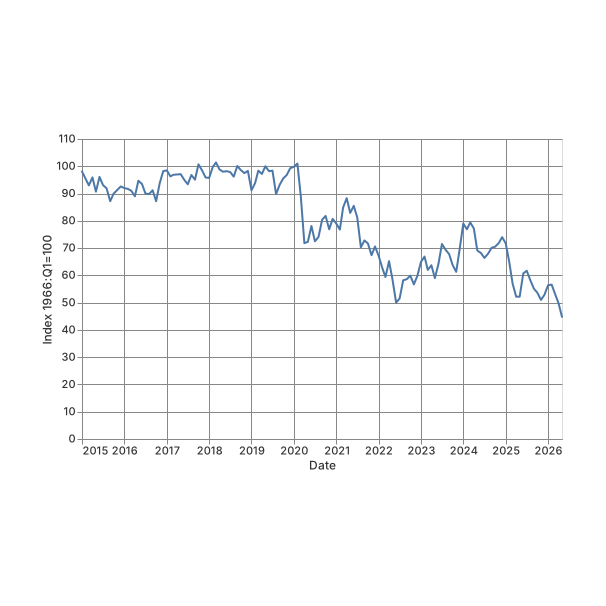
Macquarie analysts linked Cochlear’s moderating earnings outlook to an ongoing decline in U.S. consumer sentiment, which has worsened since the company downgraded its fiscal 2026 guidance in April. The firm reduced its fiscal 2026 underlying net profit forecast by about 3 percent to A$306 million, with similar cuts over the next two fiscal years, while keeping a neutral rating and raising its target price 3.5 percent to A$119.00 on an updated weighted risk-free rate; shares were down 0.9 percent at A$120.04. According to the University of Michigan Surveys of Consumers, the consumer sentiment index printed 44.8 in May 2026, later revised higher to 49.5 in the final June 2026 reading, reflecting continued consumer pessimism well below historical norms. Evaluating the causal attribution identifies a questionable structural linkage, as a parent cause of consumer sentiment may not generate the observed sub-cause of implant-demand decline through a non-trivial causal chain if hearing implants are evaluated as medical necessities rather than discretionary consumer goods. The analysis also flags criterion redundancy in the analyst’s citation of both ongoing declines in U.S. consumer sentiment and cost-of-living pressures, which proxy the same underlying macroeconomic constraint rather than distinct demand variables.
Macquarie cited the near-certain withdrawal of the CSL-marketed Tavneos therapy in Europe, describing it as a formality pending a European Commission ruling. The firm trimmed earnings-per-share forecasts by 3 percent for fiscal 2027 and by 4 percent for fiscal 2028, reiterating a neutral rating and noting significant near-term earnings uncertainty across CSL’s core business segments plus ongoing medium-term competitive risks. The target price rose 2.7 percent to A$114.00, reflecting currency moves. The Tavneos withdrawal functions as a non-linear revenue cliff, concentrating the firm’s vulnerability to single-regime policy shifts and exposing the structural fragility of single-product dependencies.
Multi-criteria ranking and cross-cluster sensitivities
The structural evaluation operates across regulatory-execution risk, demand-cycle exposure, geographic concentration, and pipeline diversification, weighting regulatory-execution risk and pipeline diversification most heavily on the reasoning that the convex cluster’s tail-up and the concave cluster’s tail-down are both event-driven. Neuren and Roche place at the top of the convexity-adjusted ordering, with Sartorius Stedim as a third non-overlapping tail-up position. Sartorius Stedim outranks the concave cluster but trails the top pair because its tail-up thesis, a guidance narrowing to the high end of a stated range, is narrower in magnitude than a regulatory reversal or a $15.5 billion market projection. Cochlear and CSL screen lowest on the same criteria, with concave demand and regulatory-withdrawal exposure dominating, while Samsung Biologics occupies an intermediate position where the labor dispute resolution is the binding variable. The ranking is robust to reasonable weight perturbation on the convex pair but fragile regarding Sartorius Stedim.
A second-order cross-cluster sensitivity operates through the consumer-sentiment vector, where a deterioration in the macro anchor would compress biotech and medical-device multiples broadly, weighing on Neuren’s valuation independent of its regulatory thesis because the trofinetide launch’s commercial uptake is exposed to the same consumer-confidence backdrop Cochlear faces. Single-jurisdiction regulatory and demand dependencies, including Cochlear’s reliance on U.S. consumer sentiment, CSL’s exposure to the Tavneos withdrawal, and Neuren’s dependence on the EU regulatory reversal holding through national reimbursement and pricing, share the structural feature that each thesis turns on a single external event with no diversified counterweight in the underlying business.
A via-negativa reading of the cycle would prune Cochlear and CSL on demand-cycle and single-product-withdrawal concentration grounds and reduce Samsung Biologics exposure pending resolution of the labor dispute. The addition-of-robustness complement would weight Roche and Neuren as the cycle’s two non-overlapping tail-up positions, with Sartorius Stedim as a third conditional on the U.S. slowdown remaining transient. The single most damage-relevant element by presence in the set is consumer-sentiment sensitivity, which appears in the Cochlear thesis and as a macro anchor across the roundup, while the single most damage-relevant element by absence is the platform-diversification structure Roche carries, which only one name in the six holds, with the labor-bargaining decentralization observed at other large-cap pharma manufacturers representing a secondary structural absence that Samsung Biologics does not carry.
Frame audit and evaluative discipline
The cycle’s assessments operate within a deliberation dialogue type, translating complex operational realities into financial models, with structural friction emerging when the evaluative criteria used by analysts misalign with the underlying operational mechanics of the firms in question. The evaluative discipline holds that analytical outputs are sound when the evaluative criteria align with the structural realities of the firms, a standard that varies across the six notes. The structural scope shift in the Samsung Biologics note, the questionable causal linkage in the Cochlear note, and the criterion redundancy in the CSL note demonstrate instances where the framing metrics diverge from the operational mechanics, whereas the Neuren, Roche, and Sartorius Stedim notes demonstrate stronger alignment between their evaluative criteria and the structural realities of regulatory milestones, platform inflection points, and geographic revenue decomposition.
Analytical techniques used in this piece
This analysis applies the methods below. Each links to a short, plain-English explainer you can read and reuse.
- Coherence Audit
- Tests whether an argument hangs together — spotting contradictions, gaps, and circular reasoning.
- Fragility / Antifragility Audit
- Asks whether a system gains or loses from volatility, shocks, and disorder (Taleb).
- Multi-Criteria Decision Analysis
- Scores competing options against several weighted criteria at once.