Summary
- President Donald Trump has declined to authorize a return to full-scale military operations against Iran while extending the reportedly August 18 nuclear deadline, preserving a diplomatic equilibrium neither side wishes to break.
- The administration maintains targeted strikes for memorandum of understanding violations alongside indirect negotiations in Doha, relying on economic leverage and predictable reprisals rather than broad escalation.
- Iran sustains credible leverage through active operational disruption of the Strait of Hormuz while refusing severe restrictions on its nuclear program.
- The United States retains asymmetric military advantages from Operation Epic Fury but faces structural constraints from global energy markets and the political costs of a failed diplomatic initiative.
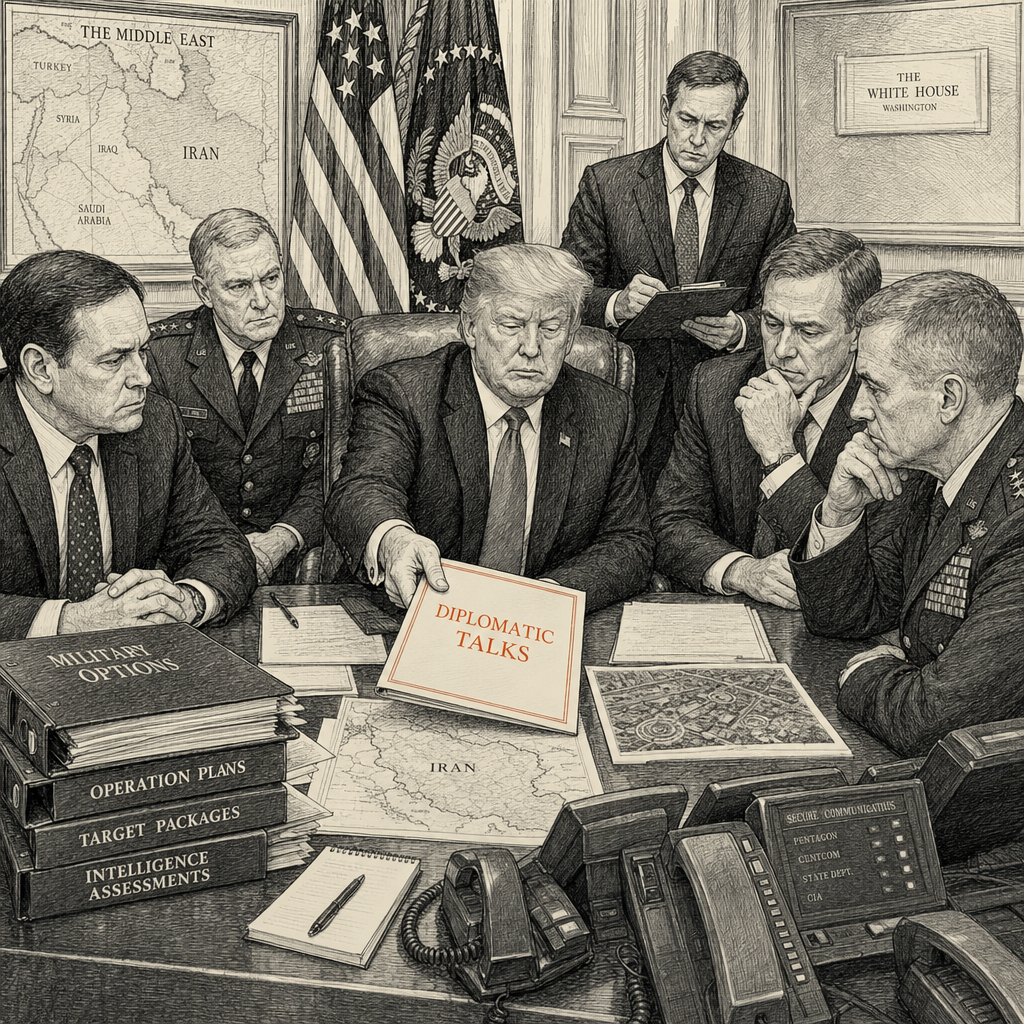
President Donald Trump has rejected options presented by Defense Secretary Pete Hegseth and Chairman of the Joint Chiefs of Staff Gen. Dan Caine for resuming full-scale airstrikes against Iran, opting instead to extend the reportedly August 18 nuclear deadline and preserve a fragile diplomatic equilibrium. According to U.S. officials familiar with the discussions, the administration is maintaining indirect negotiations mediated by Qatar and conducted by envoys Steve Witkoff and Jared Kushner while reserving one-off strikes for violations of the current memorandum of understanding. The decision reflects a calculated assessment by both Washington and Tehran that the alternative — a return to broad conflict — carries unacceptable economic and political costs, leaving the two sides bound within a middle-ground strategy that relies on targeted enforcement and conditional economic incentives rather than comprehensive resolution.
The equilibrium configuration and bargaining geometry
The U.S.–Iran track operates as an interaction under conditions of incomplete information in which both sides retain reasons to keep talking rather than fight, but neither can credibly commit to the terms the other is demanding. The United States holds an advantage on the nuclear file rooted in the damage inflicted during Operation Epic Fury, which U.S. military leaders report destroyed much of Tehran’s arsenal of conventional missiles and drones and its ability to build new weapons after striking more than 13,000 targets prior to an April 7 ceasefire. Conversely, the Iranian advantage on the strait is rooted in operational disruption capacity that is currently being exercised. Energy Secretary Chris Wright stated on Fox News that “the U.S. military effort to escort ships is the sole reason why global oil supplies are rebounding,” indicating the United States is paying for that asymmetry through escort operations.
The administration’s stated objectives include dismantling Iran’s nuclear program, restoring unconstrained maritime transit, avoiding the economic disruption of a closed strait, and avoiding the political cost of a failed diplomatic initiative. Iranian leadership is seeking compensation for strait transit and the preservation of nuclear capabilities. A binding constraint complicates this mapping: per the reporting, Tehran will not accept severe restrictions on its nuclear work despite Trump insisting that Iran already has made that commitment, an unresolved factual contradiction indicating the gap on nuclear restrictions may remain narrow if fundamental red lines prove immovable. The diplomatic track persists not because either side believes a comprehensive deal is imminent, but because the alternative — resumption of full-scale conflict — has been priced at a level neither can accept. Resuming the conflict, some officials acknowledged, “would be a tacit admission that the much-touted Iran deal failed.” Global energy markets and the domestic political coalition invested in stable supply function as constraining stakeholders, with Wright noting that resuming all-out war would disrupt the U.S. escort operation and close the strait.
Credibility asymmetry and interaction mechanics
The credibility of the commitments in play is asymmetric, rooted in the divergence between rhetorical maximums and operational follow-through. The Wall Street Journal reported that Trump has twice threatened extreme action — to wipe out Iranian civilization and to seize the oil-export hub of Kharg Island — and pulled back from both threats, returning to talks. Trump’s stated position, expressed in June and reported by officials, is that he would resume full-scale war only if U.S. troops were killed; that threshold has reportedly guided his approach since early June and functions as a commitment device that constrains the U.S. escalation path in a way the rhetorical maximums do not. Each time a maximalist threat is followed by a return to negotiations, the threat’s credibility as a future bargaining lever depreciates, making future maximalist threats — in the language bargaining analysts use — cheap talk: rhetorical commitments unbacked by follow-through.
Iran’s strait-disruption capacity is credible because it is currently being exercised, and its defense of the nuclear program is credible because it is anchored in a stated refusal to accept severe restrictions. The pattern indicates the side with the more operationally exercised commitment device — Iran on the strait, the United States on one-off reprisals — holds the more credible leverage. The public framing quoted in the article — “They’re agreeing to everything that I want, and they have to. Otherwise, we just go back and do what we have to do” — signals resolve that the bargaining record does not fully back.
Mechanically, the United States has not stated a final decision on resuming all-out war, leaving the threshold for escalation ambiguous, while Iran’s stated red lines have unknown firmness under pressure. The establishment of a deconfliction channel between the Islamic Revolutionary Guard Corps and U.S. Central Command functions to reduce operational-level information asymmetry and prevent accidental escalation; a White House official confirmed the channel is open and in use, though others cautioned it is in its early stages. The August 18 deadline, now flexible, has lost its forcing power. The memorandum of understanding instead creates a coordination device for one-off strikes that both sides have used, producing weekend back-and-forth fighting that undermined a fragile two-week-old ceasefire. The establishment of the deconfliction line and the extension of the deadline signal a mutual alignment on preventing the interaction from collapsing back into full-scale conflict.
Strategic alternatives and breakpoints
The administration’s review of options has encompassed a spectrum from resumption of full-scale military operations to extension of diplomatic deadlines. The status quo alternative involves indirect negotiations in Doha coupled with targeted military responses to Iranian violations. The reversal alternative, previously probed by the president, includes the seizure of Kharg Island or the resumption of the broad targeting campaign that characterized Operation Epic Fury — a move some officials described as “finishing the job.” A third alternative involves leveraging economic tools to alter Tehran’s decision calculus. Suzanne Maloney, vice president for foreign policy studies at the Brookings Institution, characterized the current U.S. approach as a “middle ground strategy” and noted that the United States could “slow-roll access to billions of Iranian frozen funds” or “continue to drive up the price of Iran’s efforts to control the Strait of Hormuz.”
The levers that retain credibility inside this envelope are the ones that have already been exercised: targeted strikes for memorandum violations, conditional access to Iranian frozen funds, and the deconfliction channel. Maloney cautioned that “this middle ground strategy has real limitations,” though she added that “the combination of predictable U.S. reprisals and conditioning economic incentives on compliance could persuade Tehran not to overplay its hand.”
The pre-mortem for the war option is sourced in Trump’s own June remarks: “If we go and bomb, which we can do very easily if we want, and we spend another two or three weeks bombing, they’ll have nothing left whatsoever, but you won’t have the strait opened for months. If we do the bombing, a lot of people are going to be killed. Who wants to do that? I don’t,” adding that a deal would be “stronger than doing the bombing.” The decision to extend diplomacy reflects an implicit economic rationale for restraint alongside the primary security constraint of avoiding a closed strait. The pre-mortem for the talks option is sourced in the officials’ own framing: resuming the conflict “would be a tacit admission that the much-touted Iran deal failed.”
The track remains bounded within this middle-ground equilibrium, constrained by three potential breakpoints: a U.S. troop casualty that would trigger Trump’s stated threshold; a sufficiently provocative Iranian action on the strait that would raise the political cost of restraint above the political cost of war; or a negotiated settlement on terms the public record does not yet disclose. None of those breakpoints is currently visible in the reporting.
Analytical techniques used in this piece
This analysis applies the methods below. Each links to a short, plain-English explainer you can read and reuse.
- Decision Architecture
- Designs the structure of a high-stakes decision — sequencing, gates, and what to settle first.
- Decision Clarity
- Articulates the real stakes, stakeholders, and interests behind a decision facing a third party.
- Strategic Interaction (Game Theory)
- Models a situation as a game — players, moves, payoffs, and likely equilibria.
- Brinkmanship
- Manufacturing shared risk at the edge of catastrophe to force the other side to blink.
- Mutually Assured Destruction
- Deterrence by guaranteeing that any attack is suicidal for the attacker.