Summary
- Analysts attribute President Donald Trump’s abrupt rhetorical shift at the Ankara NATO summit to a strategic environment where interpersonal rapport and transactional validation operate as primary alliance management mechanisms.
- NATO Secretary General Mark Rutte’s documented strategy of calibrating praise to European defense spending increases functions as the material substrate enabling institutional flattery channels.
- The structural deployment of 80,000 United States troops in Europe and documented European fiscal compliance constitute a stable alliance floor beneath volatile presidential rhetoric.
- European allies pursue partial insulation strategies including accelerated strategic autonomy and binding fiscal commitments to reduce dependence on the interpersonal disposition of the U.S. president.
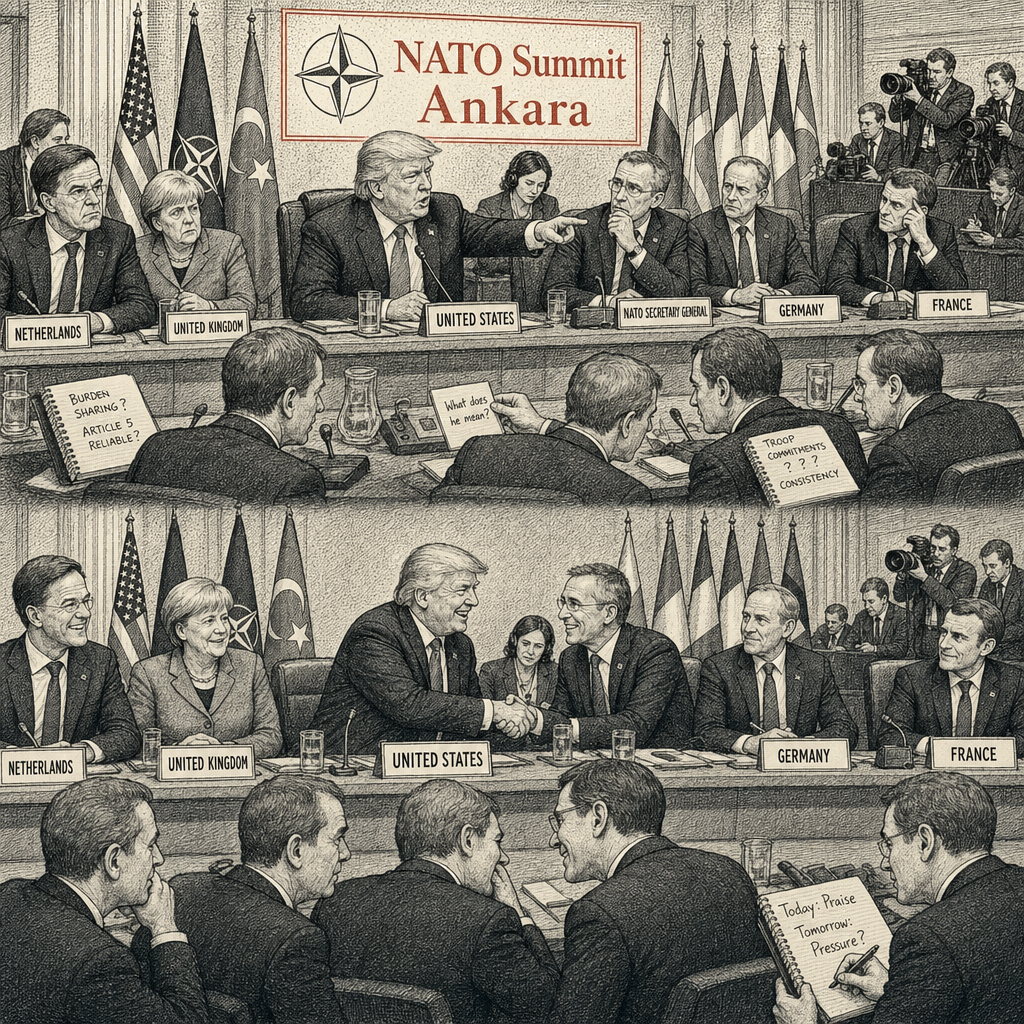
Analysts observing the Ankara NATO summit have characterized the abrupt oscillation in the U.S. presidential posture—from public hostility regarding a failed Iran ceasefire to declarations of alliance unity—as reflecting a strategic environment in which interpersonal rapport and transactional validation operate as the primary mechanisms for alliance management. The summit compressed into roughly twenty-four hours the bargaining architecture that has come to characterize U.S. engagement with the North Atlantic Treaty Organization, swinging from what the Guardian described as a “spectacular funk” to a conclusion producing “a lot of love in that room.” This shift, according to analysts cited in summit reporting, rests on three documented enabling conditions: the president’s personal rapport with Turkish President Recep Tayyip Erdoğan, the flattery strategy pursued by NATO Secretary General Mark Rutte, and the material concessions extracted from European allies.
Documented rhetorical arc
The summit timeline records a sequence of abrupt positional shifts by the U.S. president:
- President Trump arrived in Ankara on Tuesday visibly angry that the temporary Iran ceasefire had failed to hold.
- The president characterized Iran’s leaders as “scum” and “sick people,” reversing a description from two weeks prior in which he called them “very reasonable.”
- Trump declared himself “not happy with Nato” and cited the failure of alliance members, including Britain, to assist in the Iran war.
- The president rehashed sovereignty claims regarding Greenland despite it being sovereign Danish territory.
- Trump demanded the U.S. sever trade ties with Spain following the refusal of the Spanish socialist government, whom he denounced as “bad people,” to comply with new defense spending targets.
- Following a closed meeting with allied leaders, Trump described the summit as “very positive” and stated “there was a lot of love in that room.”
- The president praised Ukrainian President Volodymyr Zelenskyy as “ingenious” for maintaining Ukraine’s cohesion in the war against Russia.
Analyst attributions and diagnostic assessment
Analysts have advanced competing hypotheses to explain the abrupt tonal reversal, primarily centering on interpersonal dynamics, institutional validation, and substantive policy feedback.
Ian Lesser, a fellow at the German Marshall Fund who attended the summit, attributed the meeting’s “bipolar quality” to the president’s chemistry with Turkish President Recep Tayyip Erdoğan. Lesser stated, “The fact that President Trump has this apparently very close relationship with President Erdoğan probably played a role in stabilizing things,” and noted that the president tends to prioritize individual relationships over multilateral institutions, holding a skeptical view of such frameworks.
Charles Kupchan, a professor of international affairs at Georgetown University and a former senior White House adviser on Europe, identified the institutional validation channel. Kupchan observed that Secretary General Mark Rutte is “doing a good job of trying to say to Trump, ‘Hey, it’s working. We’re becoming more capable allies. We hear you,’” through the art of praising the president for European defense spending increases. Kupchan further suggested the president’s sudden praise for President Zelenskyy may have been driven by disappointment in Russian President Vladimir Putin for offering no concessions to end the Ukraine war, alongside awareness of U.S. congressional opinion approaching midterm elections.
Diagnostic assessment of these hypotheses indicates that the interpersonal rapport hypothesis passes a basic threshold test, supported by the president’s visible warmth toward the host and on-site observations, though it remains insufficient alone to account for the broader tonal shift toward previously rebuked allies. The institutional validation hypothesis passes a similar threshold and is reinforced by documented European defense spending increases, which function as the material substrate making the flattery channel operative. The flattery and fiscal channels are interdependent; the credibility of the flattery collapses if European spending does not continue to rise. Kupchan’s hypotheses regarding Russian disappointment and midterm domestic politics remain unconfirmed by direct documentary evidence on the public timeline. Definitive selection between these explanations requires the transcript or detailed readout of the closed meeting, which remains absent from the public record.
Structural topology and strategic interaction
The strategic interaction at the summit reveals a structural mismatch between the U.S. approach, operating as a series of one-shot transactional negotiations, and the alliance’s reliance on a repeated-game institutional framework. The structural topology functioned as a hub-and-spoke network centered on bilateral relationships rather than a cohesive multilateral framework.
The relationship between the U.S. president and President Erdoğan operated as an influential but non-structural link, with durability dependent on personal disposition. The relationship between the president and Secretary General Rutte functioned as an asymmetric-influence arrangement in which Rutte supplied calibrated praise and the president supplied rhetorical cover for the alliance, with durability contingent on continued European fiscal compliance.
The broader alliance interaction ran through parallel channels of coercive threats, including trade-severance demands directed at Spain and military-consequences language directed at the broader membership, and reassurance, including the post-meeting “very positive” assessment. The credibility of the institutional flattery relies on the president’s receptivity and can be retracted, whereas the credibility of the underlying commitment the president values—European defense spending increases—is structural. The initial hostility directed at NATO allies followed the public collapse of the Iran ceasefire, linking a Middle Eastern security failure to European alliance grievances, while the abrupt reversal on Ukraine linked internal congressional dynamics to external alliance signaling.
Structural floor and volatile superstructure
Despite the rhetorical volatility, analysts note that the structural U.S.-NATO commitment remains anchored in physical and fiscal deployments. The structural floor is reflected in the presence of approximately 80,000 U.S. troops in Europe—a figure broadly consistent with current estimates of U.S. service members in the EUCOM area including rotational deployments as of mid-2026. This deployment acts as a costly signal and a structural anchor for the U.S. security guarantee, independent of the verbal posture.
As Kupchan argued, “Stepping back from all the heated rhetoric, and Trump’s demeaning language toward Nato, in some ways, the picture that emerges is a positive one,” adding, “Nato is still Nato. There are still 80,000 US troops in Europe.” The documented troop presence and the documented defense spending increases constitute the structural floor, while the presidential rhetorical swings constitute the volatile superstructure.
Distribution of benefits and costs
The summit’s transactional architecture distributed specific benefits and costs across the participating principals. The U.S. president secured rhetorical cover for the alliance, a transactional validation channel, and preserved bargaining leverage through coercive threats. Secretary General Rutte secured influence through the validation channel and preserved his institutional role. President Erdoğan secured stability through personal rapport and hosting credibility.
European allies in aggregate secured preservation of the alliance through fiscal compliance, though they bear the risk of permanent reputational damage from continued public criticism. Spain bore the targeted cost of the trade-severance demand after being singled out for non-compliance with defense spending targets. Denmark bore the cost of renewed sovereignty claims regarding Greenland. Iran bore the documented rhetorical escalation as the presidential characterization shifted within two weeks.
Consequences and strategic sequel
The volatility of the rhetorical superstructure has deepened allied apprehension regarding the durability of U.S. security guarantees, even as analysts maintain the structural anchors remain intact. Kupchan warned that the collapse of the U.S. political center means the country “doesn’t really have a foreign policy any more,” prescribing that European allies must “plan for the worst” because they cannot know whether they can count on the U.S. security guarantee.
In response, European allies possess an adjacent opportunity space to pursue partial insulation strategies that reduce dependence on the interpersonal disposition of a single U.S. principal. These strategies include accelerated strategic autonomy initiatives, formal multilateral mechanisms that lock in defense spending commitments as binding treaty obligations to insulate the fiscal channel from the rhetorical superstructure, and bilateral or minilateral European defense arrangements to provide a structural floor independent of NATO’s political volatility. None of these strategies eliminate the U.S. guarantee, but each reduces the share of European security dependent on presidential whim.
Outstanding evidentiary gap
The closed-door session transcript or detailed readout remains the load-bearing piece of evidence the public inventory does not contain. Hypothesis selection between the interpersonal-rapport, institutional-validation, and substantive-feedback explanations depends entirely on the specific interactions and concessions that occurred during that session.
Analytical techniques used in this piece
This analysis applies the methods below. Each links to a short, plain-English explainer you can read and reuse.
- Process Tracing
- Reconstructs the step-by-step causal pathway of a specific historical event.
- Relationship Mapping
- Extracts the network of ties among people, institutions, and entities.
- Strategic Interaction (Game Theory)
- Models a situation as a game — players, moves, payoffs, and likely equilibria.