Summary
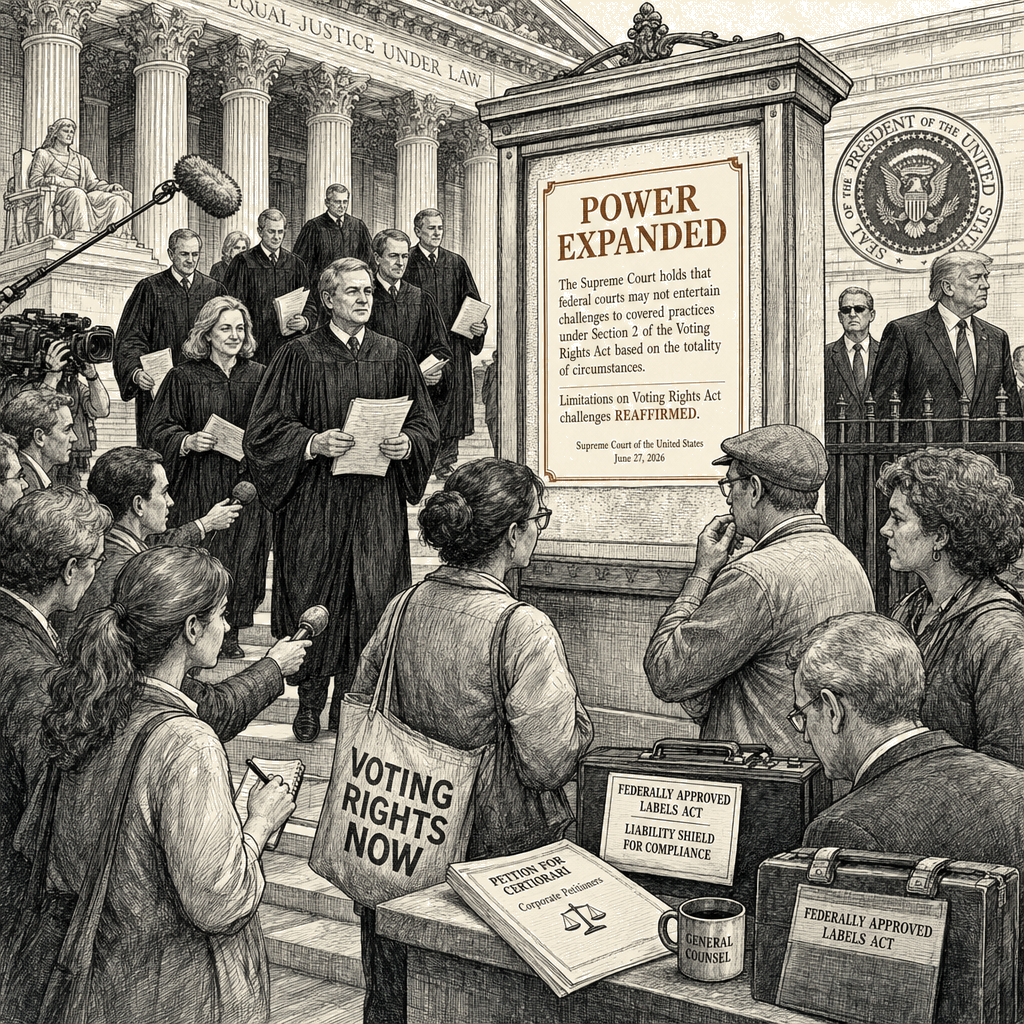
- The Supreme Court’s June 2026 term produced five 6-3 rulings whose combined effect, as characterized by constitutional scholars working within the unitary executive tradition, constitutes a structural redefinition of the relationship between the executive branch, Congress, and the federal judiciary.
- The four rulings on removal authority, immigration, voting rights, and corporate preemption operate along a parallel logic in which each narrows the scope of a previously available institutional check until that check is no longer meaningfully available.
- The birthright citizenship ruling departs from the term’s pattern, with Chief Justice Roberts, Justice Kavanaugh, and Justice Barrett joining the three liberal justices to protect an individual constitutional right while the other four rulings redefine structural separation of powers in favor of executive authority.
- The same 6-3 voting pattern across all five rulings—with the same ideological division—suggests a coherent institutional posture rather than case-specific convergence, though the alternative reading of discrete constitutional corrections remains articulable.
The Supreme Court’s June 2026 term has produced five 6-3 rulings whose combined effect, as characterized by constitutional scholars working within the unitary executive tradition, is a structural redefinition of the relationship between the executive branch, Congress, and the federal judiciary. The Cornell Legal Information Institute characterizes the unitary executive theory as “a constitutional law theory holding that the President of the United States possesses sole authority over the executive branch”; the theory has roots in the Reagan administration Justice Department and has been developed by scholars including Steven Calabresi, who has described himself as the theory’s foremost proponent. The rulings do not share a single legal theory but converge on a common structural outcome: expanded executive discretion and contracted institutional checks on that discretion.
The Rulings
In Trump v. Slaughter, the court ruled 6-3 to overturn the 1935 precedent Humphrey’s Executor v. United States, which had allowed Congress to provide cause-based protections for Federal Trade Commission members. Chief Justice Roberts wrote the majority opinion: “what text, history, and structure settle, our precedent confirms — the president may remove his subordinates at will.” The decision removes cause-based protections for commissioners such as Rebecca Slaughter and eliminates what had been the framework governing independent-agency member removal for 90 years. Justice Sotomayor, writing for the dissent, characterized the ruling as granting the president “far greater power than ever before,” writing that “neither the People, no Congress, nor the Constitution bestowed upon him. In granting the President this unbridled authority, the Court upends its precedent, misconstrues our history, and sheds any pretense of judicial modesty.”
On birthright citizenship, the court ruled 6-3 against Trump’s 2025 executive order that sought to end the automatic citizenship granted to anyone born on U.S. soil. The majority included Roberts, Justice Kavanaugh, and Justice Barrett alongside the three liberal justices. Roberts wrote that the 14th Amendment’s Citizenship Clause guarantees that “All persons born or naturalized in the United States, and subject to the jurisdiction thereof, are citizens.” He added: “Citizenship then and now, was the right to have rights — to freely participate in our political community.” Trump reacted on social media, writing that the ruling was “too bad for our Country” but that he would pursue ending birthright citizenship through legislation: “No long, unwieldy Constitutional Amendment is necessary! Congress should start TODAY to work on ending expensive and unfair to our Country, Birthright Citizenship. They have my Complete and Total Support!”
In Mullin v. Doe, the court ruled 6-3 that the Trump administration can end Temporary Protected Status for more than 350,000 Haitian and 6,000 Syrian refugees. Justice Alito wrote the majority opinion, which held that lower courts lack authority to block the executive branch from terminating TPS unless the challenge rests on constitutional grounds, requiring discrimination to be the “main or sole factor” before a court can find racial animus. Alito wrote that Trump’s comments about Haiti were not “overtly racial” and were “insufficient to show that the termination of Haiti’s TPS designation was based on the race of the Haitian people.”
In Louisiana v. Callais, the court ruled 6-3 along ideological lines to strike down Louisiana’s congressional map, which had created a second majority-Black district in compliance with Section 2 of the Voting Rights Act. Alito wrote in the majority opinion that “because the Voting Rights Act did not require Louisiana to create an additional majority-minority district, no compelling interest justified the State’s use of race in creating SB8, and that map is an unconstitutional gerrymander.” The decision requires a showing that race was the “predominant factor” in map drawing. Justice Kagan, in dissent, wrote that the ruling encourages states to “announce a partisan gerrymander” to avoid racial discrimination claims: “Assuming the State has left behind non-smoking-gun evidence of a race-based motive [an almost fanciful prospect], Section 2 will play no role. Whatever — results from the State’s asserted justification is all its minority citizens are entitled to.”
In Monsanto v. Durnell, the court ruled 6-3 that state law tort claims cannot force Monsanto to add a cancer warning to Roundup labels because the Environmental Protection Agency has approved the label without such a warning. Justice Kavanaugh wrote the majority opinion: “federal law requires Monsanto to sell Roundup with the label that EPA approved at the initial registration and that EPA has subsequently re-approved on multiple occasions — that is, the label without a cancer warning.” The decision blocks lawsuits alleging that glyphosate, Roundup’s active ingredient, causes non-Hodgkin’s lymphoma. The World Health Organization’s International Agency for Research on Cancer classified glyphosate as a probable human carcinogen in 2015.
The Institutional Logic: Narrowing Available Checks
The four rulings on removal authority, immigration, voting rights, and corporate preemption operate along a parallel logic: each narrows the scope of operation of a previously available institutional check until the check is no longer meaningfully available.
The removal check — the Humphrey’s Executor framework that governed independent-agency member protections from 1935 to 2026 — is eliminated. Congress cannot provide cause-based protections for independent-agency members. The judicial-review check on TPS termination is limited to constitutional challenges requiring proof that racial discrimination was the “main or sole factor.” The state tort check on federally approved products is eliminated — regulatory inaction preempts state law even when the manufacturer possesses information about carcinogenic risk. The Section 2 Voting Rights Act check on racial vote dilution is limited to cases where race was the “predominant factor” in redistricting.
The conceptual revision in Monsanto treats the EPA’s failure to require a cancer warning as the equivalent of an affirmative determination that no warning is needed — a transformation that moves from what analysts describe as “regulatory inaction” (a passive state carrying no substantive finding) to “regulatory determination” (an active judgment that preempts contrary state law). The conceptual shift in Slaughter treats independent agencies as extensions of the presidential office; the function of the independent agency — a body designed to exercise quasi-legislative and quasi-judicial power free from political pressure — is reengineered to depend entirely on presidential discretion.
Two-Decade Trajectory
The Slaughter removal-authority ruling and the Mullin TPS judicial-review limitation should be read against earlier doctrinal components that scholars have characterized as a set of at least eight doctrinal components producing functionally unreviewable executive authority in four operational settings — foreign-head-of-state killings, extraterritorial strikes, domestic federal-officer use-of-force, and immigration enforcement — built incrementally over two decades without any single ruling announcing the full architecture.
The prior components identified in case law include: the contraction of implied damages remedies for constitutional violations by federal officers, through Bivens contractions in Ziglar v. Abbasi (2017), Hernandez v. Mesa (2020), and Egbert v. Boule (2022); standing-doctrine narrowings in Lujan v. Defenders of Wildlife (1992) and Clapper v. Amnesty International (2013), which raised the bar for establishing injury-in-fact; the political-question doctrine’s uniform application to dismiss extraterritorial executive lethal-force challenges in the Al-Aulaqi line of cases; the state-secrets privilege’s tolerance of dismissals without merits adjudication; and qualified immunity’s consistent refusal to narrow in Pearson v. Callahan (2009) and Mullenix v. Luna (2015).
The five June 2026 rulings extend the same framework to new domains: removal authority over regulatory officials, immigration-status termination, voting-rights enforcement, and corporate tort liability for federally regulated products. The “eight doctrinal components” and “two-decade trajectory” framing appears in the substrate materials, though the specific underlying scholarly attribution beyond the listed prior cases could not be independently verified. The framing is presented as a synthesis supported by the documented prior cases, each of which is a real Supreme Court decision.
The Birthright Exception
The birthright citizenship ruling departs from the term’s pattern. The 6-3 majority — Roberts, Kavanaugh, and Barrett alongside the three liberal justices — rejected Trump’s executive order seeking to end automatic citizenship. The split — conservatives joining liberals on birthright while aligning 6-3 on the other four decisions — suggests the term’s outcomes are not reducible to a simple ideological binary. The visible pattern across the rulings is a distinction between individual constitutional rights (which the court protected in this instance) and the structural separation of powers (which the court redefined in favor of executive authority in the other four). This distinction is not articulated explicitly in the court’s opinions but is visible in the pattern of outcomes.
Framing and Conceptual Engineering
The majority positions its rulings as faithful to text, history, and structure. Roberts’s sentence in Slaughter — “what text, history, and structure settle, our precedent confirms” — operates as an appeal to fixed textual authority: the word “settle” implies resolution, foreclosing alternative readings; the framing characterizes the elimination of removal protections as “confirming” what was already settled, rendering invisible the fact that the ruling overturns a 90-year-old precedent and displaces the reliance interests of every independent agency in the federal government. In Callais, the formulation that “because the Voting Rights Act did not require Louisiana to create an additional majority-minority district” embeds the conclusion as a premise — presupposing that Section 2 did not require the district, the very question the case was supposed to resolve, and then deriving the legal outcome from that presupposition. In Mullin, Alito’s phrasing “the termination of Haiti’s TPS designation” backgrounds the actor and the individual decisions affecting hundreds of thousands of people, rendering the process technical and administrative rather than political and consequential.
The dissents do not counter-frame as an alternative legal theory but as a failure of institutional self-restraint. Sotomayor’s “sheds any pretense of judicial modesty” operates as an appeal to institutional self-restraint: the charge is not that the majority’s legal reasoning is wrong but that the institution has overstepped its own norms. Kagan’s Callais dissent — encouraging states to “announce a partisan gerrymander” — frames the majority’s rulings as institutional overreach rather than legal error. The dissent positions contest the same constitutional text and history; what is at issue is which institutional ambition that text authorizes.
“Presidential power” has been characterized as an essentially contested concept in the Gallie sense since the founding: its meaning is permanently disputed because the dispute is internal to the concept’s normative point. Different constitutional traditions produce different accounts of what the concept properly includes. The majority’s treatment of the concept selects one tradition — the unitary executive theory — and treats it as the only constitutionally available account. The dissent, and the prior 90 years of precedent, offered an alternative treatment: presidential power includes removal authority, but Congress may condition that authority when it creates agencies the Constitution does not require to be under the president’s direct control. The selection of one constitutional tradition over another is itself an exercise of authority — a point the episodic frame, focused on individual cases, obscures. Whether the five rulings are read as the legitimate resolution of the contestation or as the imposition of one contested account over another depends on which constitutional tradition one adopts.
Consequences
Immediate term (weeks to months): TPS termination for approximately 350,000 Haitians and 6,000 Syrians will proceed absent a constitutional challenge meeting the “main or sole factor” standard. FTC commissioner Rebecca Slaughter will be subject to removal without cause. State tort claims against Roundup will be dismissed. Section 2 VRA litigation will face new evidentiary burdens.
Medium term (one to five years): The Slaughter removal-authority ruling may open the full federal independent-agency structure to reorganization. The Monsanto preemption ruling may, if the preemption logic is applied consistently, extend beyond product labeling to any domain where a federal agency has considered and declined to act — environmental regulation, workplace safety, consumer financial protection.
Long term (five years and beyond): The doctrinal infrastructure that prior rulings established across foreign-lethal-force, extraterritorial-strike, and domestic-officer-use-of-force settings may extend to new settings added by the June 2026 term: regulatory governance through presidential removal authority, immigration enforcement through TPS termination unreviewable absent constitutional challenge, and corporate tort liability through the principle that regulatory inaction preempts state law.
The Discrete-Corrections Counter-Reading
An alternative reading holds that these rulings are discrete constitutional corrections rather than layers in a unified project. The Slaughter ruling, on this view, resolves a long-standing tension between Humphrey’s Executor and Article II’s vesting of executive power. The Callais ruling enforces the principle that the Voting Rights Act does not mandate race-based districting. The Monsanto ruling applies standard federal preemption doctrine. The Mullin ruling defers to executive discretion in immigration enforcement, a domain where courts have traditionally granted wide latitude. Each ruling, on this account, has its own doctrinal justification and does not require a unifying theory.
The unified-project reading remains more explanatory for three reasons. First, the same 6-3 voting pattern across all five rulings — with the same ideological division — suggests a coherent institutional posture rather than case-specific convergence. Second, the common mechanism of narrowing access to judicial review appears in all five rulings, even though the doctrinal domains differ. Third, the two-decade trajectory of narrowing Bivens, standing, political-question, state-secrets, and qualified immunity creates a pattern that the discrete-corrections reading would have to treat as coincidence. The discrete-corrections reading does not account for the structural convergence of these rulings with the broader doctrinal pattern.
Whether the same 6-3 voting pattern across removal, immigration, voting rights, and preemption rulings reflects a unified doctrinal project or coincident case-specific convergence remains the live interpretive question the term’s rulings pose. The unified-project reading is more explanatory on the available evidence; the discrete-corrections reading remains available and articulable; the disagreement turns on how much weight one places on doctrinal-convergence patterns versus case-specific justifications.
Analytical techniques used in this piece
This analysis applies the methods below. Each links to a short, plain-English explainer you can read and reuse.
- Conceptual Engineering
- Asks not just what a concept means but what it should mean, and re-engineers it.
- Decision Clarity
- Articulates the real stakes, stakeholders, and interests behind a decision facing a third party.
- Frame Audit
- Surfaces the frame an argument adopts and what that framing quietly includes or excludes.