Justices reject Trump’s bid to end birthright citizenship
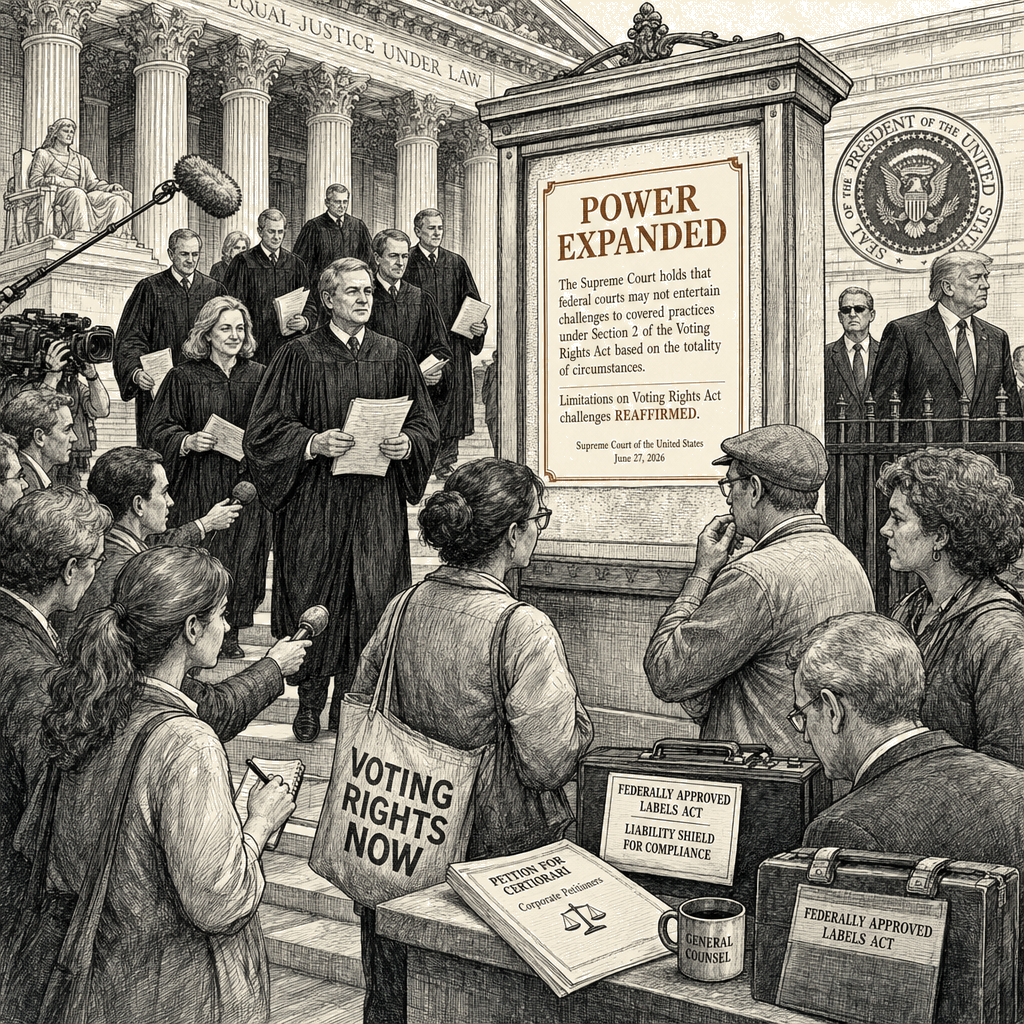
The Supreme Court’s final decisions last week concluded a consequential stretch of decisions. The court issued rulings on presidential removal authority, voting rights, immigration, and corporate liability.
On presidential authority, the court ruled 6-3 in Trump v. Slaughter that Congress cannot block the president from firing members of independent agencies without cause. Chief Justice John Roberts wrote the majority opinion, stating that “what text, history, and structure settle, our precedent confirms — the president may remove his subordinates at will.” The decision overturned the 1935 precedent Humphrey’s Executor v. United States, which had allowed Congress to provide “for cause” removal protections for Federal Trade Commission members.
Justice Sonia Sotomayor, writing for the dissent, said the ruling grants the president “far greater power than ever before.” She wrote: “It is a power, however, that neither the People, no Congress, nor the Constitution bestowed upon him. In granting the President this unbridled authority, the Court upends its precedent, misconstrues our history, and sheds any pretense of judicial modesty.”
On birthright citizenship, the court ruled 6-3 against Trump’s 2025 executive order that sought to end the automatic citizenship granted to anyone born on U.S. soil. The majority included Chief Justice Roberts, Justice Brett Kavanaugh, and Justice Amy Coney Barrett alongside the three liberal justices. Roberts wrote that the 14th Amendment’s Citizenship Clause guarantees that “All persons born or naturalized in the United States, and subject to the jurisdiction thereof, are citizens.” He added: “Citizenship then and now, was the right to have rights — to freely participate in our political community.”
Trump reacted on social media, writing that the ruling was “too bad for our Country” but that he would pursue ending birthright citizenship through legislation. “No long, unwieldy Constitutional Amendment is necessary!” Trump wrote. “Congress should start TODAY to work on ending expensive and unfair to our Country, Birthright Citizenship. They have my Complete and Total Support!”
In the immigration case Mullin v. Doe, the court ruled 6-3 that the Trump administration can end Temporary Protected Status for Haitian and Syrian refugees, putting the legal status of more than 350,000 Haitian refugees and 6,000 Syrian refugees in question. Justice Samuel Alito wrote the majority opinion, which also held that lower courts lack authority to block the executive branch from terminating TPS unless the challenge rests on constitutional grounds. The court required that discrimination be the main or sole factor behind a termination decision before a court can find racial animus. Alito wrote that Trump’s comments about Haiti were not “overtly racial” and were “insufficient to show that the termination of Haiti’s TPS designation was based on the race of the Haitian people.”
The court also issued a voting rights decision. In Louisiana v. Callais, a 6-3 ruling along ideological lines struck down Louisiana’s congressional map, which had created a second majority-Black district in compliance with Section 2 of the Voting Rights Act. Alito wrote in the majority opinion that “because the Voting Rights Act did not require Louisiana to create an additional majority-minority district, no compelling interest justified the State’s use of race in creating SB8, and that map is an unconstitutional gerrymander.” The decision requires a showing that race was the predominant factor in map drawing, making it more difficult for minorities to challenge redistricting maps on the basis of diluted electoral power.
Justice Elena Kagan, in dissent, wrote that the ruling encourages states to “announce a partisan gerrymander” to avoid racial discrimination claims. “Assuming the State has left behind non-smoking-gun evidence of a race-based motive [an almost fanciful prospect], Section 2 will play no role,” Kagan wrote. “Whatever — results from the State’s asserted justification is all its minority citizens are entitled to.”
In Monsanto v. Durnell, the court ruled 6-3 that state law tort claims cannot force Monsanto to add a cancer warning to Roundup labels because the Environmental Protection Agency has approved the label without such a warning. Justice Kavanaugh wrote the majority opinion, stating that “federal law requires Monsanto to sell Roundup with the label that EPA approved at the initial registration and that EPA has subsequently re-approved on multiple occasions — that is, the label without a cancer warning.” The decision blocks lawsuits alleging that glyphosate, Roundup’s active ingredient, causes non-Hodgkin’s lymphoma. John Durnell had brought a case in Missouri in 2019, alleging that his use of Roundup for about two decades caused the disease. The World Health Organization has classified glyphosate as a probable human carcinogen.