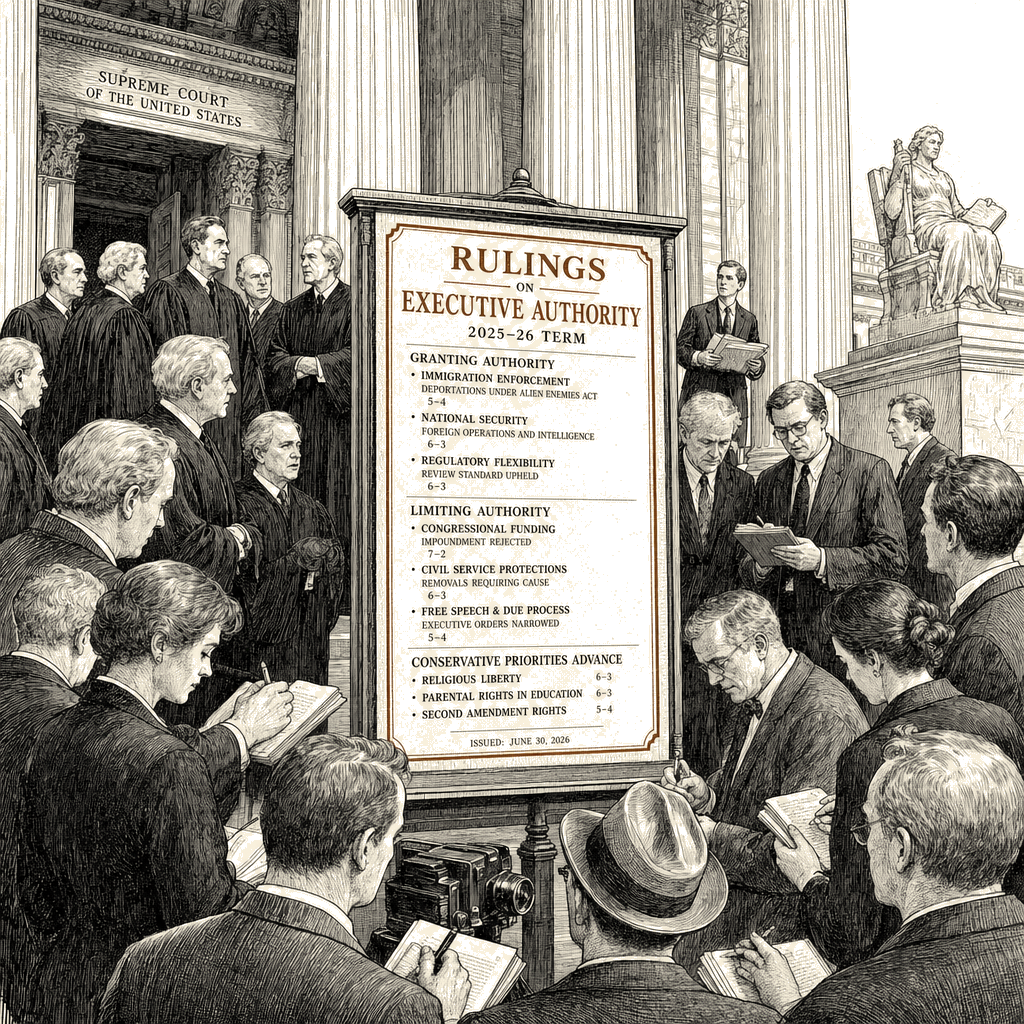
The Supreme Court concluded its 2025-26 term on Tuesday, issuing decisions that both granted and limited President Donald Trump’s executive authority while advancing conservative legal priorities, according to The Wall Street Journal.
The term, dominated by disputes over presidential power, produced landmark rulings on birthright citizenship, the president’s authority to fire federal officials, the Voting Rights Act, and Second Amendment rights, with Chief Justice John Roberts casting decisive votes in the most significant cases.
Among the term’s most consequential decisions, the court affirmed a broad understanding of birthright citizenship, rejecting Trump’s executive order that would have denied citizenship to children born in the U.S. to parents who are in the country illegally or temporarily. The court also struck down Trump’s global tariffs program and blocked his attempt to fire a sitting Federal Reserve governor, limiting presidential authority over the independent agency.
On immigration, the court upheld Trump’s authority to implement key aspects of his enforcement policies. The court also rebuffed a Republican-backed lawsuit supported by the Trump administration that would have disallowed some mail-in ballots during the 2026 midterm elections.
The justices expanded Second Amendment rights in two cases, one involving gun rights of drug users and another concerning the ability to carry weapons on private property. The court narrowed the Voting Rights Act, a decision the Journal said has already allowed red states to redraw congressional maps to create more Republican-leaning districts. On the term’s final day, the court ruled that states may prohibit transgender women and girls from participating on female sports teams.
Chief Justice Roberts was in the majority in every major Trump-related case this term, the Journal reported, and wrote the majority opinion in the four biggest ones. Justices Amy Coney Barrett and Brett Kavanaugh also served as pivotal votes in several high-profile disputes that divided the court’s conservative and liberal blocs.
The court’s relationship with Trump remained fraught throughout the term. After the tariff ruling in February, Trump called the justices “incompetent” and said he would stop capitalizing the term “Supreme Court.” Referring to Gorsuch and Barrett, who voted against him on tariffs, he said: “They sicken me, because they’re bad for our country.” Chief Justice Roberts responded at a public event in March, warning that personal hostility toward judges “has got to stop,” the Journal reported.
By the term’s end, tensions appeared to ease. Trump praised the court’s ruling on presidential authority over regulatory agencies and wrote that “the Republican Party was treated very fairly by the Supreme Court,” according to the Journal.
The court also remained favorable to business interests, the Journal reported, siding with Chevron in a venue dispute.
Constitutional litigator Elizabeth Price Foley told the Journal the mixed outcomes “take the steam out of the narrative that the court is just a bunch of politicians in robes.” But Pratik Shah, a lawyer who regularly argues before the court, said “the fact that the court rejected wholly unprecedented positions doesn’t signal that it is ready to push back on the president more broadly.”