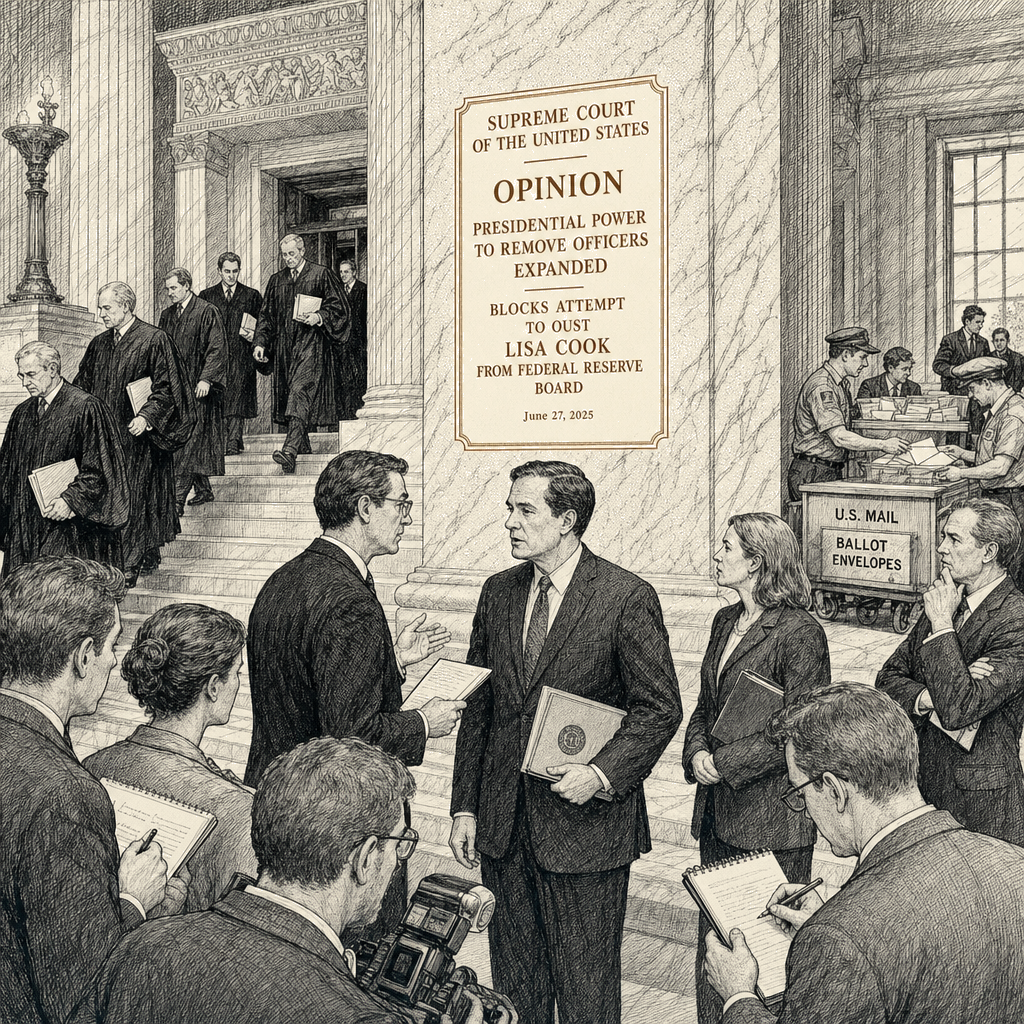
The Supreme Court on Monday ruled 6-3 in Trump’s favor on his authority to fire leaders of independent regulatory agencies, overturning a nearly century-old precedent from the Franklin D. Roosevelt era. Chief Justice John Roberts wrote for the majority that the old precedent was no longer valid. “Subordinates who exercise the president’s power are subject to removal by him,” Roberts wrote. “Then, and only then, can they remain accountable to the president, and the president to the people.”
All six conservative justices, including the three appointed by Trump, voted for the president. The three liberal justices dissented.
Trump reacted on Truth Social, writing: “Ninety years of precedent has been completely and unequivocally overruled, greatly increasing presidential power at a time when it is most needed!”
The decision applies broadly to dozens of regulatory bodies covering elections, communications, labor, finance and the environment. The Federal Trade Commission was directly at issue in the case.
A separate 5-4 ruling blocked Trump’s attempt to remove Federal Reserve Governor Lisa Cook. Chief Justice Roberts and Justice Brett Kavanaugh joined the three liberal justices in the majority. Trump had alleged that Cook committed mortgage fraud, but hanging over the dispute were his broader disagreements with the Fed’s recent decisions not to lower interest rates.
Writing for the majority, Roberts said Cook deserved a chance to challenge her removal and rebut the accusations, which he said would need to be further substantiated. He warned of the “calamities that could arise” if presidents could impose their will on the Federal Reserve.
In the third decision, the Supreme Court ruled 5-4 that states may count mail-in ballots postmarked by Election Day and received up to five days later. Justice Amy Coney Barrett wrote the majority opinion, joined by Roberts and the three liberal justices. Barrett quoted the Constitution’s provision that states have broad powers to set the “time, place and manner” of holding congressional elections. She dismissed Trump’s allegations that mail-in balloting is susceptible to fraud, indicating that the issue was best resolved through the “democratic process.”
Trump responded by urging Congress to pass his election-reform package that would significantly curtail mail-in voting. The Republican-controlled House has approved the legislation, but Democrats and a handful of Republicans have blocked a vote in the Senate.
In a fourth action, the court declined without explanation to review the $5 million civil judgment against Trump in the defamation case brought by writer E. Jean Carroll, who accused Trump of sexually assaulting her in the 1990s. A jury found Trump liable for defamation in 2023. Trump wrote on Truth Social: “I will continue the fight against this weaponization and lawfare case against me, including the ridiculous claim of defamation, with all my power and strength. This injustice cannot be allowed to stand!” A separate $83.3 million damages award won by Carroll in a second case remains on appeal.