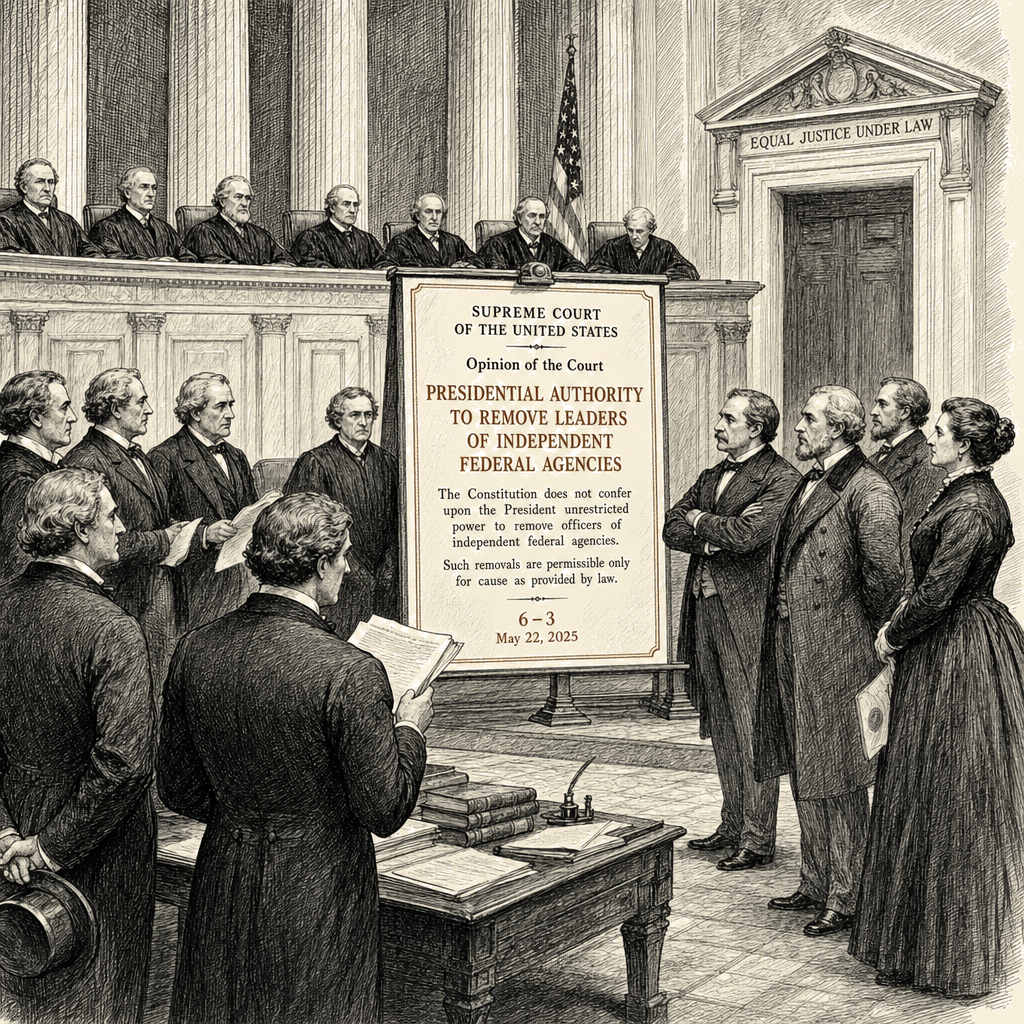
The Supreme Court on June 29 handed President Donald Trump a major expansion of executive power, ruling 6-3 that he may fire the leaders of independent federal agencies without cause and overturning a 91-year-old legal precedent that had limited presidential removal authority.
The case, Trump v. Slaughter, centered on Trump’s March 2025 termination of Rebecca Kelly Slaughter, a Democratic member of the Federal Trade Commission. Slaughter was appointed in 2018 and served on the five-member commission, which by law can have no more than three members from a single political party. Trump fired her via email, stating that her “continued service on the FTC is inconsistent with [the] administration’s priorities.” She was given no reason related to her performance.
Slaughter sued, and a lower court reinstated her, citing the 1935 Supreme Court decision Humphrey’s Executor v. United States. That precedent had held that Congress could insulate commissioners of independent agencies from at-will removal because the FTC performed “quasi-judicial and quasi-legislative” duties rather than purely executive ones.
Writing for the majority, Chief Justice John Roberts said that precedent no longer stands. “Although it is up to the Senate to decide whether to confirm those with whom the President would prefer to work, neither Congress nor the courts may saddle him with those with whom he cannot work,” Roberts wrote. “Subordinates who exercise the President’s power are subject to removal by him. Then, and only then, can they remain accountable to the President, and the President to the people.”
The court’s three liberal justices dissented. Justice Sonia Sotomayor, joined by Justices Elena Kagan and Ketanji Brown Jackson, wrote that “the text of the Constitution, along with its history, the longstanding practices of the political branches, and the precedents of this Court, make clear that Congress may limit the causes for which the heads of Commissions like the FTC can be removed by the President.”
The decision effectively eliminates the structural protections Congress wrote into the FTC’s founding statute. The 1914 law creating the FTC allowed removal only for “inefficiency, neglect of duty or malfeasance in office” and required bipartisan balance. Trump has already fired two Democratic FTC commissioners; only Republican commissioners remain on the panel.
The ruling also raises questions about other agencies with similar protections, including the Equal Employment Opportunity Commission, the Merit Systems Protection Board, and the Consumer Product Safety Commission. Trump has already removed Democratic members from those agencies as well.
James M. Burnham, an attorney who served in both Trump administrations, told NPR that Congress’ limits on removal powers “have been unconstitutional from the beginning” and that “there is no such thing as an independent agency.” Slaughter told NPR that “independence allows the decision-making that is done by these boards and commissions to be on the merits, about the facts, and about protecting the interests of the American people.”
In a separate 5-4 ruling the same day, the Supreme Court allowed Federal Reserve Board Governor Lisa Cook to remain in her position while litigation over the administration’s attempt to remove her continues in lower courts. The court had previously signaled during January oral arguments that it viewed the Federal Reserve differently from other agencies; Justice Brett Kavanaugh said at the time that allowing Trump to remove Cook would “weaken, if not shatter, the independence of the Federal Reserve.” MSI previously reported that the Supreme Court appeared to carve out a distinct exception for the Fed from the president’s expanded removal power in a January 23 article Supreme Court shields Federal Reserve while expanding Trump’s agency firing power.