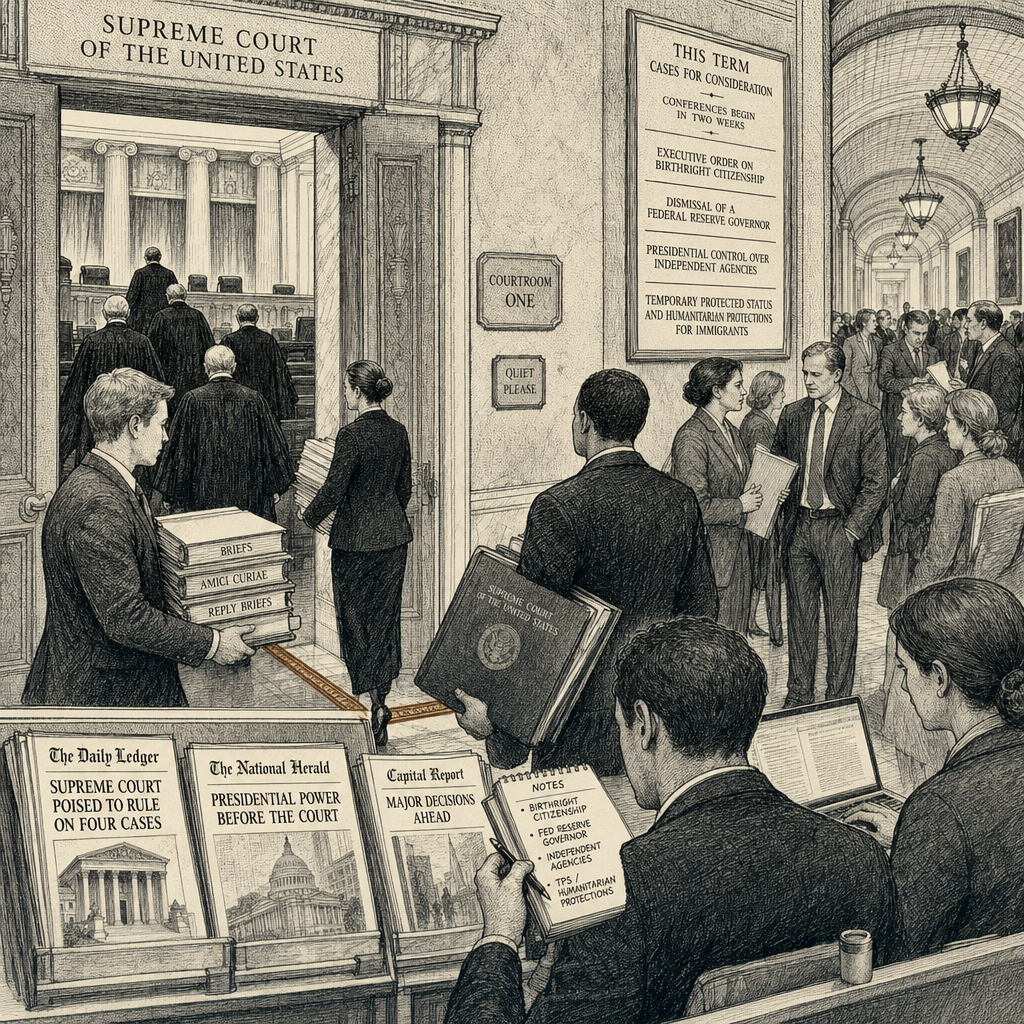
The Supreme Court will rule over the next two weeks on four cases testing the boundaries of presidential authority, deciding whether President Trump can unilaterally redefine birthright citizenship, fire a Federal Reserve governor, consolidate control over independent agencies and strip protections from hundreds of thousands of immigrants.
The birthright citizenship case is widely seen as the most consequential. The justices heard oral arguments in April on Trump’s executive order declaring that children born on U.S. soil would not be considered American citizens if their parents are undocumented immigrants or temporary visitors. Justices across the ideological spectrum expressed unease about the president’s bid to unilaterally reinterpret the Constitution’s 14th Amendment guarantee, the Wall Street Journal reported. Trump himself has said he expects to lose the case.
“It would be the moment to say that they’re still engaging in their own constitutional interpretation and not simply taking the president’s cue,” Stephen Wermiel, a law professor at American University, told the Journal, referring to a perception among some observers that the court has become a rubber stamp for the president.
The court will also consider Trump’s effort to fire Lisa Cook, a member of the Federal Reserve’s board of governors. Supreme Court watchers cited by the Journal said the justices are likely to rule against Trump, but disagreed about whether the court would issue a broad opinion with strong protections for Federal Reserve independence or a narrow one that allows Cook to keep her job while avoiding deeper questions about presidential authority over monetary policy and bank regulation.
Trump appears likely to prevail in a separate dispute over his power to dismiss the heads of agencies that Congress designed to operate at arm’s length from the White House, such as the Federal Trade Commission. The court’s conservative justices have repeatedly signaled that such structural independence conflicts with the president’s constitutional authority over the executive branch, the Journal reported.
The outcome is less clear in the fourth case, which tests Trump’s ability to rescind Temporary Protected Status — a program Congress established allowing immigrants already in the United States to remain legally if their home countries are experiencing war or humanitarian disaster. The Trump administration has argued that courts have virtually no role in supervising the president’s decisions about who qualifies.
Elizabeth Wydra, president of the left-leaning Constitutional Accountability Center, cautioned that a ruling against Trump on birthright citizenship would not by itself signal the court growing more hostile to the president. “Those arguments are so far out there that simply preserving the status quo is not a serious check on Trump’s power,” she told the Journal.
The four cases arrive at the end of a term in which the court has drawn both accommodating and adversarial lines with Trump. Over the past year and a half, the justices repeatedly used short-form emergency rulings to allow controversial Trump policies to take effect even after lower courts blocked them. But the court also blocked Trump from sending the National Guard into Chicago in an unsigned order in December, and in a February decision written by Chief Justice John Roberts, struck down Trump’s global tariffs.
Trump reacted to the tariffs ruling by publicly calling the justices unintelligent, shameful and disloyal, the Journal reported.
The court is also expected to rule before its July 4 break on whether states can ban transgender women and girls from competing on female sports teams, and on Republican challenges to a key campaign-finance law and extended deadlines for mail-in ballots.