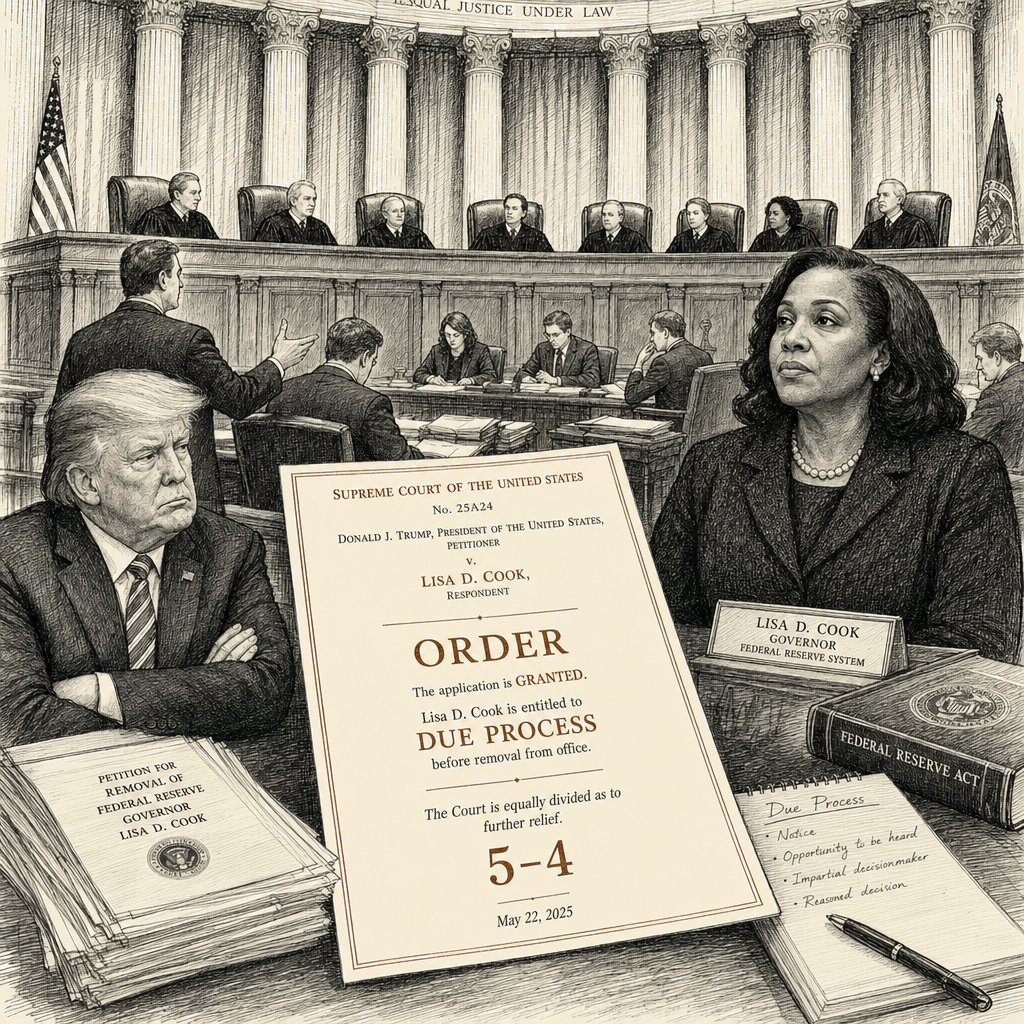
WASHINGTON — The Supreme Court on Monday rejected President Donald Trump’s attempt to fire Federal Reserve Governor Lisa Cook in a 5-4 decision that preserves the central bank’s legal protections from political interference, for now. Chief Justice John Roberts wrote the majority opinion, which holds that Trump’s effort to remove Cook without providing her notice or a chance to contest the allegations violated the for-cause removal protections Congress established for Fed board members.
The ruling means Cook, a Democratic appointee with 10 years remaining on her 14-year term, will retain her seat on the Board of Governors while her case returns to lower courts for further litigation. Trump announced his decision to fire Cook last August on his Truth Social platform, citing allegations that she falsified mortgage documents by listing two different properties as her primary residence. Cook has vehemently denied the charges. Her lawyers have called the administration’s case a “cherry picking” of routine mortgage paperwork, pointing to similar applications filed by Trump Cabinet members that did not trigger accusations of wrongdoing.
Roberts wrote that the Federal Reserve is a “uniquely structured” entity “that follows in the distinct historical tradition of the First and Second Banks of the United States,” according to the opinion. Congress created the Federal Reserve in 1913 after a series of financial panics, insulating board members with 14-year terms and limiting removal to cases of neglect of duty or malfeasance. No previous president had attempted to fire a sitting Fed governor in the institution’s 112-year history.
The White House had argued that Trump’s social media post announcing the firing provided sufficient notice, and that the courts should defer to the president’s judgment on whether cause existed. Solicitor General John Sauer told the court in January that the alleged conduct, even if inadvertent, amounted to “negligence” that could undermine confidence in the Fed. Cook’s attorney, Paul Clement, responded that accepting that argument would make the Fed’s legal protections “kind of a joke.”
Fed defenders have warned that allowing the president to remove Fed board members at will would undermine the central bank’s political independence, which economists and former policymakers have long said is essential for credible monetary policy.
In a separate ruling Monday, the court’s conservative majority voted 6-3 to give Trump free rein to fire leaders of other independent regulatory agencies — including the Federal Trade Commission, the National Labor Relations Board, and similar bodies — for any reason. The pair of decisions creates a legal framework in which the Federal Reserve enjoys unique insulation from presidential removal power while nearly all other congressionally created independent agencies do not.
Trump has not nominated a replacement for Cook’s seat. The lower courts will now examine the administration’s allegations of wrongdoing and Cook’s challenge to her firing, a process that could take months or years.