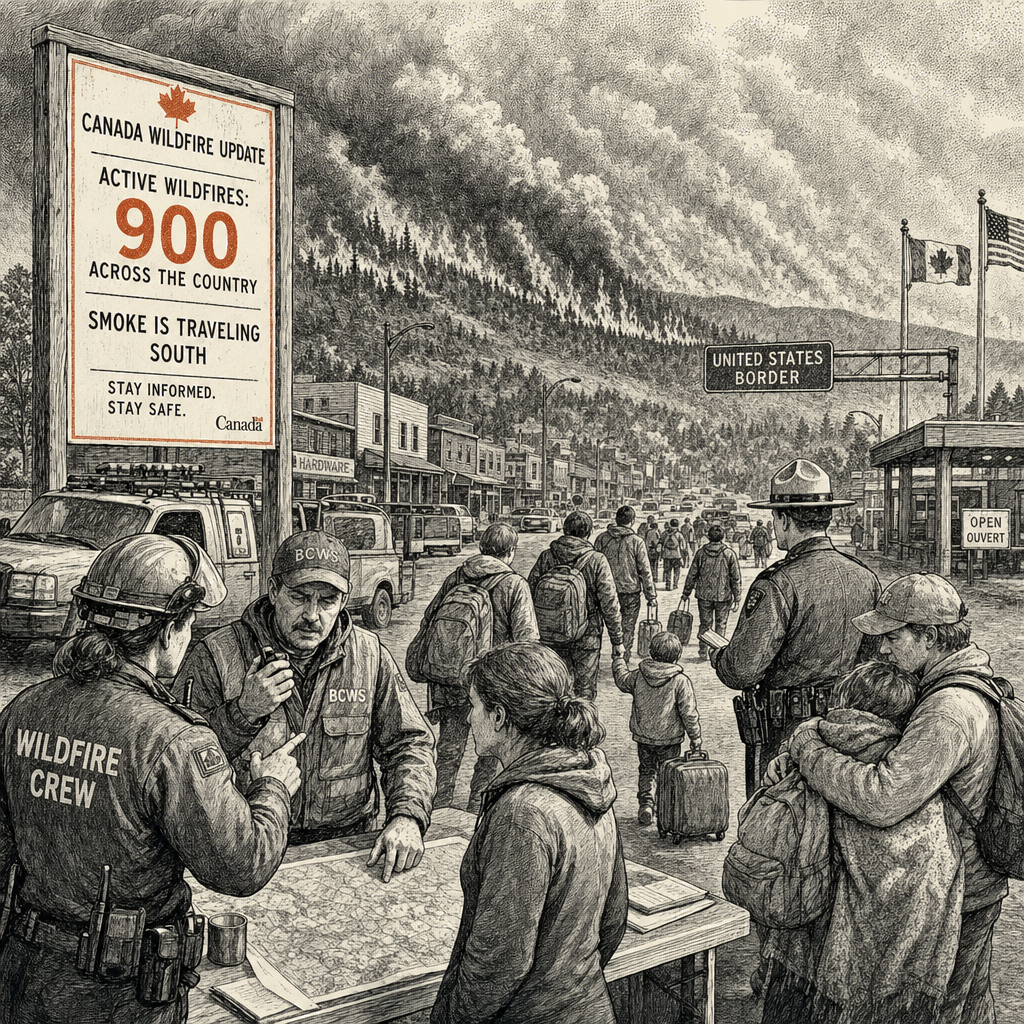
The fires blanketing the United States in smoke are not the ones Canada could have suppressed — they are the ones Canadian firefighting cannot reach. That inversion makes President Trump’s tariff threat not merely misguided but structurally absurd.
Lori Daniels, a forestry professor at the University of British Columbia, laid out the operational logic on the record: when 900 fires burn simultaneously, “the ones that get the greatest attention are those closest to communities, homes or critical infrastructure.” The fires producing the most transboundary smoke are burning in the northernmost reaches of Ontario, where there are no highways, roads, or permanent settlements. Canada’s boreal forest covers 1.3 billion acres — roughly seven times the combined area of all U.S. national forests. The triage system deprioritizes the remote fires; those fires produce the smoke drifting south. The more remote the fire, the less suppression it receives, and the more smoke it generates. The political response in Washington — a tariff threat aimed at Canada’s forest maintenance — is pointed at the wrong end of the causal chain. The fires, as of Friday, had scorched nearly seven million acres — an area larger than Vermont — and were active in all but one of Canada’s ten provinces and all three territories.
The intensity of those fires reflects decades of accumulated combustible material driven by three mechanisms. Decades of fire suppression prevented natural burn-off, allowing fuel loads to build. Warmer winters — Canada’s climate is warming at twice the global average rate — enabled insect populations that weakened and killed trees, adding deadfall. And historical bans on Indigenous cultural burning removed a proven fuel-reduction practice. Those bans were a colonial policy failure — a displacement of the people whose land-management knowledge would have reduced the risk. Officials have now asked the federal government to prepare for simultaneous air evacuations from fly-in First Nations communities. The dual vulnerability is not accidental: the same communities whose practices were suppressed are now the ones requiring evacuation.
The governance structure compounds the problem. More than 90 percent of Canada’s forestland is publicly owned, but management is split across provinces and territories, some of which have cut wildland firefighting budgets in recent years. No single authority coordinates cross-jurisdictional fire management, and the atmospheric impact — smoke that crosses a continent — is nowhere factored into the triage calculus. The problem is national in scale and provincial in governance, and the system cannot match the scale of the fires. Hot, dry weather has dominated northern Ontario and Quebec; the Northwest Territories is in drought after receiving less than 40 percent of normal June precipitation; some regions had unusually low snowpack last winter. Of the more than 3,640 wildfires recorded in Canada this year, nearly half were human-caused and about half were started by lightning, according to the Canadian Interagency Forest Fire Centre. Lightning-caused fires typically account for 85 percent of the total area burned in a given year.
The political escalation came on July 17, when Trump wrote on Truth Social that he would call Prime Minister Mark Carney and threatened steeper tariffs, alleging insufficient forest maintenance and calling the smoke “filthy, polluted, and unhealthy air, the quality of which is dangerous, and totally unacceptable.” Carney’s office did not immediately respond, but the prime minister has previously said the United States needs to do more to fight climate change. Ontario Premier Doug Ford responded directly: “If there’s politicians out there chirping away, well maybe what you should do rather than complain, is send support, send help, because we have done the exact same thing for our American friends.” Canadian firefighters are already deployed to the United States, where blazes have burned over 3.7 million acres this year. A British Columbia firefighter died this week battling a blaze in Colorado. The smoke itself is reciprocal — U.S. wildfire smoke drifts into Canada; Canadian smoke drifts into the United States — and the atmospheric transport does not respect the political boundary the tariff threat assumes.
The tariff threat, if imposed, would route through a well-documented economic mechanism. Research on the 2018–2019 tariffs found that the duties fell “almost entirely on U.S. firms and consumers with near-complete pass-through” (Fajgelbaum et al. 2020; Amiti et al. 2019). The Section 201 washing-machine tariff precedent quantified the effect: approximately $1.5 billion in consumer costs for 1,800 jobs saved, or roughly $815,000 per job. The precise pass-through rate would depend on the commodities targeted, but the general principle is well-established. The punitive instrument imposed on Canada would be paid primarily by American consumers breathing the smoke. The tariff threat is not only disconnected from the operational reality of the fires — it would harm the population the administration claims to be protecting.
The most likely outcome of this collision is a self-reinforcing ratchet. Each fire season produces thicker transboundary smoke and harsher tariff retaliation. Tariff-induced economic contraction reduces provincial tax revenues, constraining firefighting budgets; reduced capacity produces larger fires; larger fires produce more smoke; more smoke produces more tariffs. A scenario analysis covering the 2026 fire season through 2029, with tail risk extending to 2031, places the tariff-ratchet trajectory at 35 to 55 percent probability and identifies it as the hardest path to reverse. Two alternative exits carry lower odds: a major U.S. smoke event re-framing the problem as shared continental vulnerability rather than Canadian failure, opening space for a formalized transboundary wildfire-response compact (15 to 25 percent), or the 2026 USMCA joint review under Article 34.7 becoming a vehicle for linking wildfire management cooperation to the trade architecture (5 to 10 percent). Both windows close before the 2027 fire season.
The consequence is a self-reinforcing cycle of smoke and tariffs that neither country can win, and the window to break it closes before the 2027 fire season. Until the United States recognizes that the smoke is not a failure of Canadian forest maintenance but a product of geography, climate, and a policy legacy that includes its own historical role in carbon emissions, the ratchet will continue. The next time Canadian wildfire smoke blankets the U.S., the question should not be whether Canada is maintaining its forests — it should be whether the political system is capable of addressing a problem that respects no border.
Analytical techniques used in this piece
This analysis applies the methods below. Each links to a short, plain-English explainer you can read and reuse.
- Relationship Mapping
- Extracts the network of ties among people, institutions, and entities.
- Root-Cause Analysis
- Traces a symptom back along its causal chain to the conditions that actually generated it.
- Wicked Futures
- Explores a long-horizon, deeply entangled future with no clean resolution.