Ontario Premier Doug Ford tells critics to send help rather than complain
The fires, as of Friday, had scorched nearly seven million acres — an area larger than Vermont — and had forced evacuations in dozens of communities. In remote parts of northern Ontario, some residents had only minutes to grab essentials before fleeing by boat as flames consumed their communities.
Much of the firefighting challenge is geographic. Canada’s boreal forest covers 1.3 billion acres, roughly seven times the combined area of all U.S. national forests. The largest fires, including those responsible for most of the smoke drifting across the border, are burning in the northernmost reaches of Ontario, where there are no highways, roads, or permanent settlements. Even when air tankers are deployed, some fires have grown too large and too intense for water bombers to extinguish, as MSI previously reported.
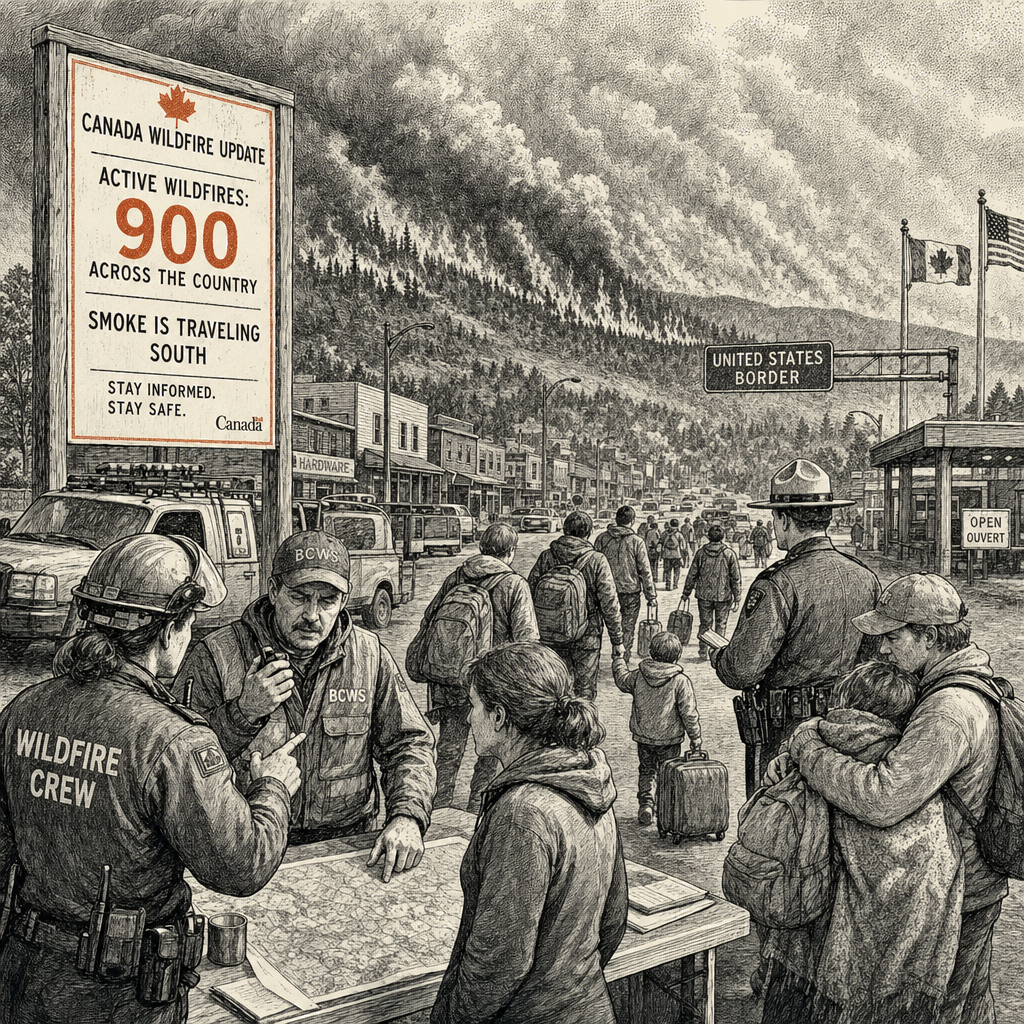
“You’re asking the impossible,” said Lori Daniels, a professor in the forestry department at the University of British Columbia. “When you have 900 fires burning simultaneously, the ones that get the greatest attention are those closest to communities, homes or critical infrastructure.”
Wildfires are active in all but one of Canada’s ten provinces and in all three territories. The manpower is stretched thin; officials have asked the federal government to prepare for simultaneous air evacuations, particularly from fly‑in First Nations communities. Firefighters from other provinces have been deployed to assist.
The political dimension escalated Friday when President Trump wrote on Truth Social that he would call Prime Minister Mark Carney “to learn what Canada is doing about the wildfires” and threatened to impose steeper tariffs. “We are holding Canada responsible for the fact that they are not properly maintaining their Forests, and Brush therein, and the United States is being unnecessarily invaded by filthy, polluted, and unhealthy air, the quality of which is dangerous, and totally unacceptable!” the post said.
The statement drew pushback from Canadian scientists and officials. Carney’s office did not immediately respond, but the prime minister has previously said the United States needs to do more to fight climate change. The Canadian climate is warming at twice the global average rate, and scientists say that trend is making fire seasons longer and more intense across the country.
Ontario Premier Doug Ford responded directly. “If there’s politicians out there chirping away, well maybe what you should do rather than complain, is send support, send help, because we have done the exact same thing for our American friends,” Ford said, listing several occasions when Ontario had assisted the U.S. with disasters, including wildfires. MSI previously reported that a freight train crew was trapped by flames in northwestern Ontario earlier this week.
Canadians are already fighting fires in the United States this year, where blazes have burned over 3.7 million acres. A firefighter from British Columbia died this week while battling a blaze in Colorado. And it is not uncommon for wildfire smoke from the U.S. to drift into Canada.
The ignition sources are split. Of the more than 3,640 wildfires recorded in Canada this year, nearly half were human‑caused and about half were started by natural means, primarily lightning, according to the Canadian Interagency Forest Fire Center. Lightning‑caused fires typically account for 85 percent of the total area burned in a given year.
Worsening conditions have multiple drivers. Hot, dry weather has dominated northern Ontario and Quebec, while the Northwest Territories is in drought after receiving less than 40 percent of normal precipitation in June. Some regions had unusually low snowpack last winter. Climate change is also making parts of Canada more hospitable to insects that weaken trees, and a history of fire suppression — coupled with bans on Indigenous cultural burning — has allowed more combustible material to accumulate on the forest floor.
More than 90 percent of Canada’s forestland is publicly owned, and its management is largely the responsibility of the provinces and territories, some of which have cut wildland firefighting budgets in recent years.