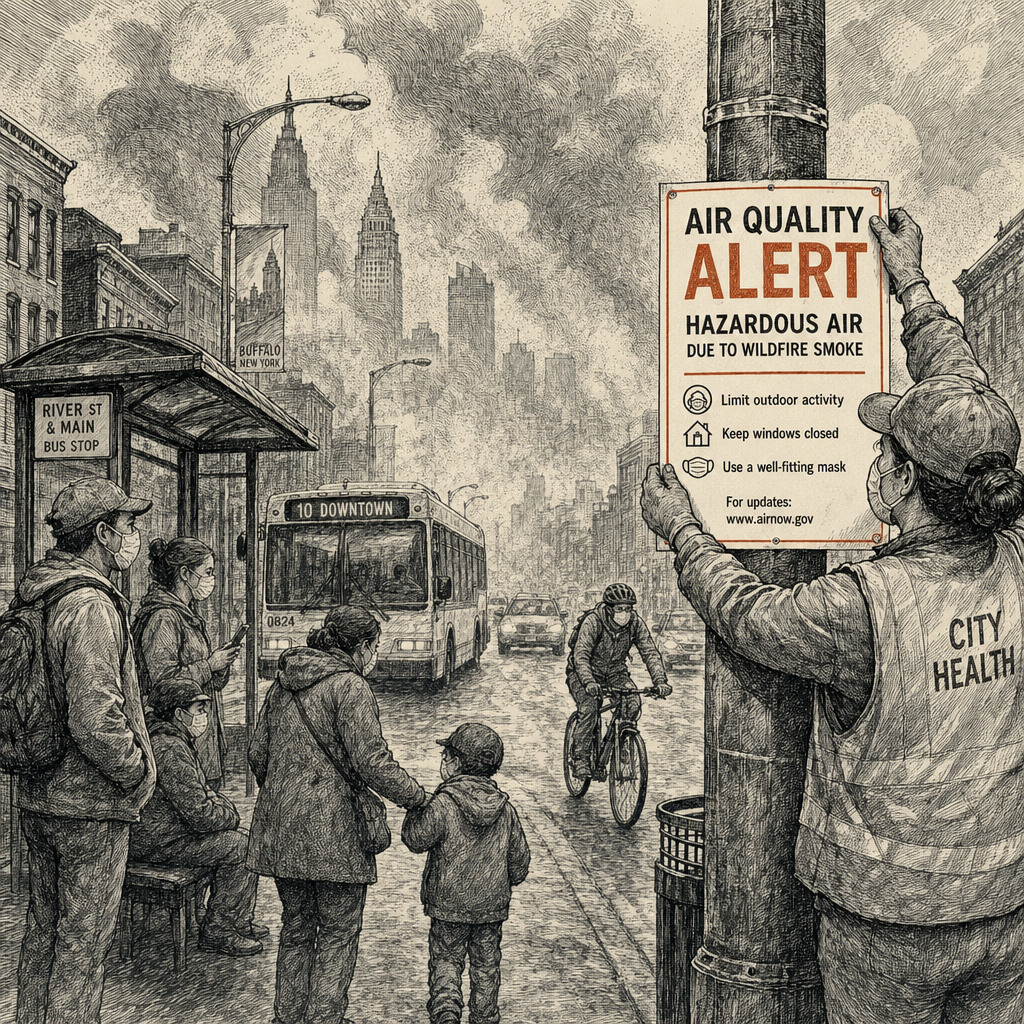
More than 100 uncontrolled blazes in Canada drive plume south
Wildfire smoke from Canada shrouded the Northeast and Midwest on Wednesday, degrading air quality in regions already enduring a summer heat wave, according to the Environmental Protection Agency and the National Weather Service.
The Canadian government reported more than 100 uncontrolled wildfires burning in the north, and winds swept smoke southward into the United States. Swaths of the Northeast and Midwest were under air quality alerts that could continue into Thursday, the National Weather Service said.
“Expect we’ll once again see widespread reduced visibility, perhaps even lower than what we’re seeing so far,” the National Weather Service said.
Forecasters said the densest plume of smoke was expected to move south over the Mid-Atlantic, with more smoke potentially arriving Thursday night. The weekend outlook remained uncertain, meteorologists said.
Smoky conditions were set to worsen Thursday and possibly Friday in Maryland, Washington, D.C., and Virginia, meteorologists said.
The smoke turned skies gray across affected areas on Wednesday, compounding the heat wave. The EPA reported unhealthy air quality in parts of the Northeast and Great Lakes and suggested that people, especially children and the elderly, shorten time spent outdoors.
The agency identified fine particulate matter — particles small enough to be inhaled or enter the eyes — as the primary health threat from the smoke. The particles can cause burning eyes or runny noses, though the EPA said healthy people are not usually at major risk from short-term exposure.
Authorities ordered evacuations in parts of northern Minnesota near a cluster of Canadian wildfires. New York City opened hundreds of cooling centers and was distributing masks to curb smoke inhalation.