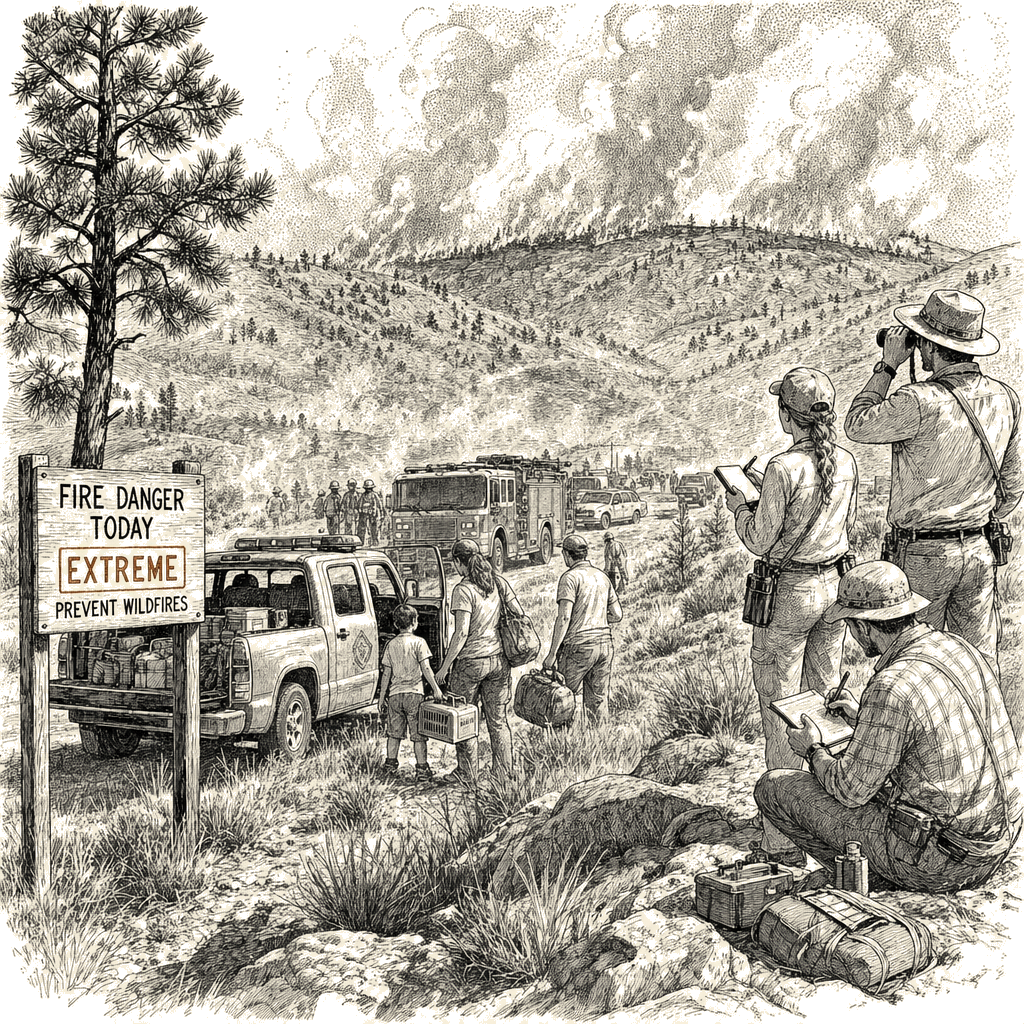
A new study from University of California, Merced researchers has provided the first systematic measurement of how heat waves amplify wildfire risk across the Western United States, finding that the relationship is far stronger than previously understood.
The research team — postdoctoral research scholar Dmitri Kalashnikov, postdoctoral researcher Cong Yin, Ph.D. student Madhulika Gurazada, and postdoctoral researcher Mukesh Kumar — analyzed two decades of wildfire activity from 2001 to 2024. They defined a heat wave as three or more consecutive days with temperatures in the top tenth of hottest days for a given location.
The results showed that while heat waves accounted for only 12% to 15% of warm-season days, 42% of all area burned by wildfires occurred during or right after a heat wave. In many parts of the West, the amount of land that burned each day was more than 50% larger during heat waves than during the cooler days immediately before the heat wave began. In some regions, the difference reached up to 300%.
“We expected a big impact, but the numbers still surprised us,” the researchers said.
The study identified several mechanisms by which heat waves worsen fire conditions. Hot temperatures increase the atmosphere’s demand for moisture, rapidly drying out vegetation and making it easier to ignite. Heat waves also limit nighttime humidity, allowing fires to remain active for longer periods and burn through more hours of the night.
Additionally, the hot, unstable atmosphere during heat waves creates conditions favorable for lightning. The researchers found increases in cloud-to-ground lightning, including “dry” lightning, during and after heat waves across many parts of the West. Dry lightning occurs when precipitation evaporates before reaching the ground, igniting vegetation without producing enough rainfall to douse the flames.
The risk often persists even after the heat wave ends, the researchers said, as dry vegetation and dead material on the ground tend to remain unusually dry for days after temperatures return closer to normal.
The connection between heat waves and wildfire activity is becoming increasingly important as global temperatures rise, fueled by greenhouse gas emissions. Since 2001, the number of heat wave days across Western U.S. forests has nearly doubled. During the same period, the amount of forest area burned increased by 2.5 times. The researchers calculated that without the increase in heat wave days since 2001, the cumulative area of burned forest would have been 37% smaller.
As MSI previously reported, the wildfire burning season in North America has extended by 36% due to climate change, and fire-prone weather days have nearly tripled globally as the climate warms.
Not all ecosystems responded the same way, the study found. While researchers observed a strong long-term relationship between increasing heat waves and increasing burned area in forests, this was not the case in grasslands and shrublands, where total burned area has not increased. In those ecosystems, the amount of land that burns in a given year is influenced more strongly by the amount of available vegetation than by heat alone.
Climate change is causing Western U.S. summers to trend hotter and drier, the researchers said. Relative humidity during heat waves has declined in recent decades, especially in forested regions of California, Oregon and Washington. These drier heat waves appear particularly effective at increasing wildfire activity.
The researchers noted that wildfire forecasts already account for factors such as wind, humidity and fuel dryness, but typically have not included heat waves. The study suggests that heat waves deserve greater attention as increasingly important drivers of wildfire risk.