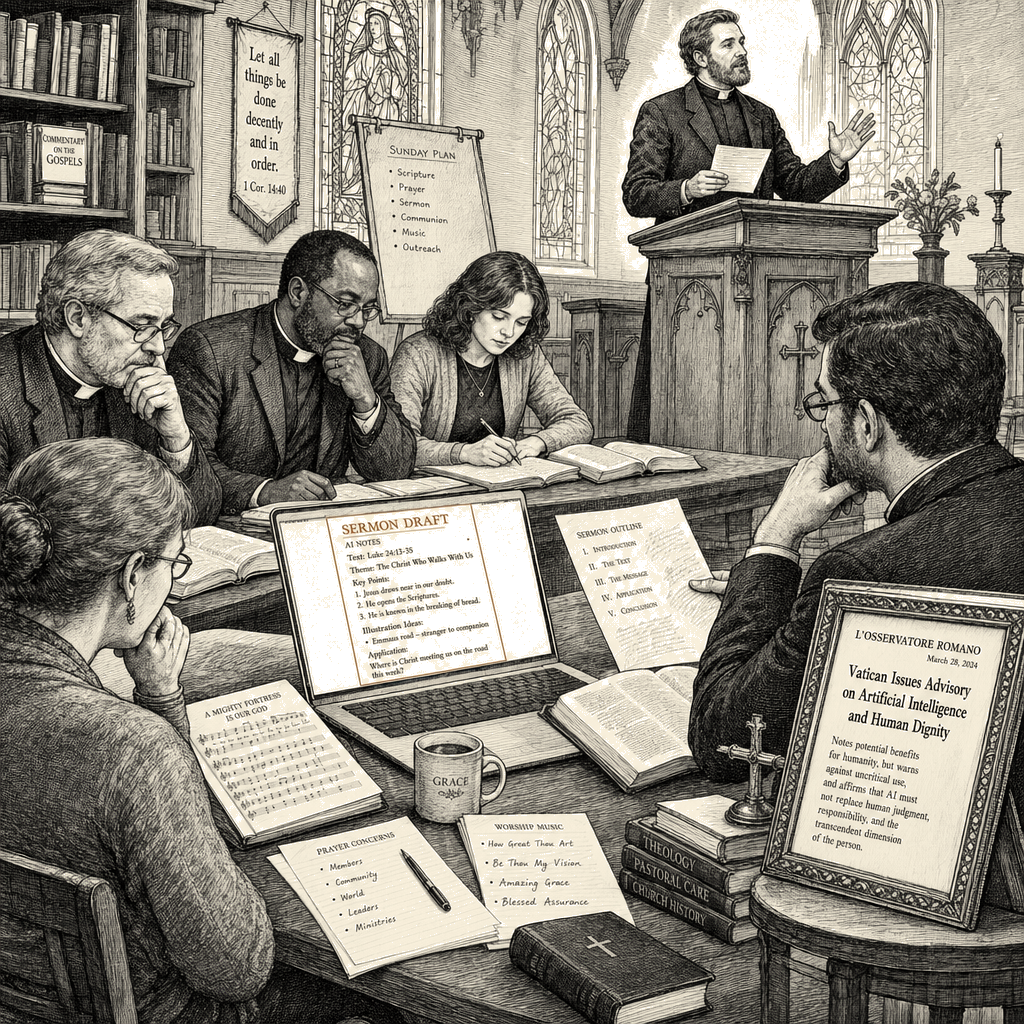
The economic engine
The structural driver is financial. Stetler’s finances are the diagnosis — the Barna numbers are the fever chart.
Darrell Stetler II, lead pastor of Bible Methodist Church in Oklahoma City, is married, a father of seven, earns $600 per week plus a $1,500 monthly housing stipend that falls short of his actual housing costs. His church keeps about two months of reserves. He takes construction jobs on the side. A sermon previously took him 10 to 15 hours to prepare; AI tools doing first-pass research and phrasing save several of those hours.
The reclaimed time does not sit idle. The article places Stetler at a hospital bedside on the same Saturday afternoon he was preparing the sermon “Forged.” During sermon prep, his phone rang with another hospital visit request. Those hours, he said, are what the AI is buying back. The math is brutal and it is simple: a pastor who cannot afford to spend 15 hours on a sermon cannot afford not to use the tool that cuts it to five.
Stetler is in ChatGPT’s top one percent of users. He runs a Facebook group of 500 pastors experimenting with the technology. He has built a tool that generates dozens of sermon illustrations in seconds. He is also among the most cautious voices the article profiles. “This AI does not enjoy what it finds,” he said. “It cannot love it.” Caution and adoption coexist in the same person — and what generates adoption in the cautious is structural pressure, not theological appetite. He sees the gap between the tool’s output and the theological claim a sermon makes. He adopts anyway because the economic incentive overwhelms the theological objection.
The pastoral role encompasses far more than preaching — hospital visits, counselling, administration, community engagement. The calling model of ministry, in which pastoral labour is conceived as self-organising rather than as a profession whose hours merit indexed compensation, makes the undercompensation of that breadth structurally invisible. Pastors who frame their low pay as spiritually appropriate sacrifice will not agitate for structural change — and the calling model ensures they don’t. That framing is the political lid on the pressure cooker.
Denominational governance structures in congregational-autonomy traditions resist the consolidation, shared-staff, or multi-site reforms that would close the scope mismatch between what the role demands and what the budget supports. The under-resourced solo-pastor model remains the default not because it works but because no one with authority will challenge it. That model is the structural precondition for the financial pressure that makes AI adoption not a choice but a survival adaptation.
Denominational abdication
Denominational governance has abdicated. Not a single Protestant body with authority over the adopting population has issued binding guidance on AI in sermon preparation. Pope Leo XIV warned earlier this year that to give a true homily is to share faith and that artificial intelligence cannot do that — but the Pope’s authority is Catholic, not Protestant. The annual conferences, synods, and presbyteries that set ministerial norms in Protestant traditions have said nothing. Their silence is not neutrality. It is permission.
Meghan Sullivan, a University of Notre Dame philosophy professor leading a research project on AI and religion, said using AI to draft spoken worship content reflects “a basic misunderstanding of what Christians believe is happening when a preacher delivers a homily.” She characterised AI as a “theological software middleman” and invoked Martin Luther: “Martin Luther is rolling over in his grave.” Churches, in her view, might be among the last institutions where people are asked to sit still, in silence, and encounter another human being without mediation.
The critique is substantive. It names a specific claim about what a homily is — a personal act of faith-sharing, not a product to be generated. It is also toothless where it matters most. Protestant polity makes top-down rule-setting difficult; the denominational governance bodies that could issue guidance analogous to the Pope’s have not acted. Sullivan’s invocation of Luther — aimed at a Protestant audience from a Catholic university — is a rhetorical move by someone with no enforcement authority over the pastors she is addressing. By the time a denominational framework exists, the practice will have normalised itself through the very data that was meant to track it.
Loops that deepen the dependency
Three reinforcing feedback mechanisms are driving adoption forward faster than any institutional response can operate. Each one compounds the others. None of them resolve the underlying problem they were introduced to manage.
The first operates through time poverty. AI saves sermon-prep hours. Those hours get absorbed by other pastoral demands — hospital visits, counselling sessions, congregational crises. Pastoral work expands to fill the available time; the pastor remains stretched. The AI does not solve the underlying time shortage. It makes the shortage survivable, which makes the tool indispensable. The weeks-to-months delay between initial adoption and felt dependency means the habit is set before the pastor recognises it as dependency.
The second operates through peer networks. Stetler runs a 500-pastor Facebook group experimenting with AI tools. Rev. Justin Lester, 37, a California pastor, built PastorGPT — a free, small-language model trained entirely on a given pastor’s sermons that refreshes itself weekly by downloading and transcribing new sermon uploads from YouTube. More than 30 churches now run versions of it. Each adoption becomes a vector for further adoption. Each pastor who uses AI becomes more skilled, integrates it deeper, shares it with peers. The network delay is months. The network reach is thousands.
The third operates through tool lock-in. PastorGPT trains on each pastor’s own sermons. After enough cycles, the pastor’s preaching style adapts to what the tool produces well. Return to human-only preparation begins to feel like a loss of capability. The tool and the practice become entangled; they are no longer separable.
The three loops operate on overlapping timelines — weeks, months, and one to two years — creating a compounding effect. The longer adoption continues without institutional governance, the deeper the lock-in and the harder any future policy intervention becomes. Every month of silence from denominational bodies makes their eventual guidance less relevant.
The paradox of institutional resistance
The intended brake on adoption — theological warnings, institutional caution — is functioning instead as an accelerator.
What happens in practice is that the warnings induce caution, which reduces the risk of egregious errors, which makes pastors feel they can use AI responsibly. The guardrail becomes the permission structure. Stetler illustrates the pattern precisely. He quotes Isaiah 29:13 condemning hypocrisy as a warning label for his own habits. He tells cautionary tales — like the time he dropped an AI-generated image into a sermon slide without checking it and a congregant asked after the service if he knew there was a topless woman in the background. He apologised on the spot. He is simultaneously one of ChatGPT’s most intensive users and its most articulate theological sceptic among those profiled. The scepticism does not reduce the use. It sanctifies it.
During a later Sunday service, an AI-generated handout fell out of sync with his slides. “AI has failed me,” he told worshipers. “It’s really messed me up.” He tells that story as a cautionary tale. “I don’t need to rush this,” he said.
ChatGPT once signed off a reply with “Praying for you as you preach.” Stetler thought: “No you’re not.” He kept using the tool. The exchange captures the entire dynamic: the tool produces the surface grammar of pastoral care without the underlying reality, the pastor recognises the gap, and the structural pressure closes it anyway.
The institutional resistance timeline — months to years for doctrinal response, longer for behavioural change — cannot match the weeks-to-months timeline of the adoption loops. By the time a denominational framework exists, the practice will have normalised itself through the very data that was meant to track it.
The three pastors as adoption spectrum
The three pastors at the centre of the reporting represent different points on a shared adoption spectrum, and their differences are instructive. Stetler is simultaneously ChatGPT’s top-1% user and its most articulate theological sceptic among those profiled. Lester has taken the experiment further — custom infrastructure, robot dog Theo trotting the aisles, confession analytics. Rev. Dwight Lee Wolter, 75, of the Congregational Church of Patchogue on Long Island, turned to ChatGPT at an acute crisis moment: the July 2024 assassination attempt on Donald Trump. “What should I tell my congregation tomorrow morning?” he asked the chatbot. It produced, he said, a nearly perfect prayer. Wolter does not frame his adoption as a problem — “Dwight is here. He didn’t abdicate” — but he has articulated a forward view that unsettles fellow clergy: “I cannot imagine that a time is not coming that AI will present us with a God that’s more attractive and more flexible and 24/7.”
The chronic financial pressure and the acute crisis moment converge on the same symptom: a pastor who is already habituated to chatbot-assisted prep because of time constraints is more likely to reach for the tool in a crisis than one who has never opened one. The two mechanisms reinforce each other.
Whose voice is absent
A stakeholder map of the situation reveals that the parties with the most to lose are the ones with the least power to shape adoption conditions. The pattern is consistent: those closest to the consequences are furthest from the decisions.
The congregants who receive AI-assisted sermons have no formal voice in whether their pastor uses these tools. They did not negotiate the introduction of a third party into the pastoral relationship. Sullivan’s characterisation of church as one of the last spaces for unmediated human encounter describes a claim on congregants’ experience that congregants themselves have no mechanism to assert or waive. They sit in the pews. They receive what they are given. No one asked.
A more specific vulnerability operates inside Lester’s PastorGPT system. The tool includes a pastoral early-warning function: anonymised data flags recurring themes in what congregants confide to the bot. Last year, Lester said, it surfaced a surge in teenagers talking about bullying, and he built a lesson around it. The pastoral response was well-intentioned and locally effective. The structural question it raises is darker: no congregant was reported to have been told their disclosures would be aggregated and processed. No opt-out mechanism was offered. The privacy arrangement was never negotiated. The people whose confidential disclosures are being processed for pattern detection are teenagers discussing bullying with a figure they trusted with their confidence. They have the least power in the system and the most to lose from its opacity.
The media narrative itself is bounded in a way that distorts the picture. The adoption story centres three named white male pastors, a white Notre Dame professor, and the Pope. The 24 percent adoption figure implies thousands of pastors across demographics are using these tools. No woman pastor, Latino pastor, Asian-American pastor, or immigrant-congregation pastor appears as a named voice. Lester’s work with the Black Church and his doctoral research on gamification in the Black Church represent a partial channel, not a representative one. The governance norms forming in this absence will be shaped by voices that do not represent the breadth of the adopting population. Seminaries that shape future clergy formation are absent from the record. Non-Christian religious communities are absent entirely. Also absent are the pastors who have considered AI and declined — the voices that might reframe the entire debate by explaining what they see that the adopters don’t.
The party with the most operational power — OpenAI and Anthropic, whose platforms Stetler depends on — has the least stake in the theological outcome. The infrastructure layer does not depend on pastoral adoption and has no product roadmap shaped by it. The platforms control model behaviour, content policies, and pricing. They sit in the highest-power, lowest-theological-interest quadrant of any stakeholder map of the situation.
The trajectory
What the systems dynamics analysis predicts is that the current trajectory will hold. The financial pressure loop will deepen dependency. The network-spread loop will accelerate adoption. The guardrail paradox will make cautious pastors feel safe using AI, sustaining the very behaviour the guardrails were meant to constrain. Theological resistance will remain weak as long as the warnings carry no enforcement authority over the Protestant majority adopting the tools. Congregational trust will be tested not gradually but in discrete, visible moments — the AI-generated error in a sermon slide, the confession analytics revealed, the realisation that years of homilies were co-written by a chatbot — and when those moments arrive, the relational foundation the pastor was trying to protect by saving time will already have been eroded by the tool he used to save it.
The system archetype that best describes the situation is “shifting the burden.” The underlying problem is inadequate pastoral compensation and unsustainable workload. AI is the symptomatic solution. The fundamental solution — restructuring pastoral economics — has no real-world actor currently willing to own it. Adoption has nearly doubled between 2024 and 2026 without a reported parallel increase in church financial planning or denominational support. Barna’s data does not measure whether pastors experience low pay as calling-consistent sacrifice or as structural failure — and that distinction matters, because if pastors frame undercompensation as spiritually appropriate, they will not agitate for the compensation reform that is the only structural intervention the analysis identifies as capable of altering the trajectory.
The only structural intervention that would change the trajectory is compensation reform that closes the gap between what small-church ministry demands and what it pays. No denominational body, seminary, or research organisation is currently positioned to own that intervention. The gap remains, and the loops are running.
Analytical techniques used in this piece
This analysis applies the methods below. Each links to a short, plain-English explainer you can read and reuse.
- Root-Cause Analysis
- Traces a symptom back along its causal chain to the conditions that actually generated it.
- Stakeholder Mapping
- Charts the parties to a situation — their interests, power, and alignments.
- Systems Dynamics (Causal)
- Models the feedback loops and delays that drive a behavior over time.